
Fuel Dilution: The Silent Killer Living In Your Oil
Why Fuel In Your Oil Is Costing More Engines Than Most People Realise
When people think about engine wear, they usually blame the obvious suspects.
Poor maintenance.
Overheating.
Dirty air filters.
Low oil levels.
Aggressive tuning.
But one of the most destructive threats to engine longevity is often completely invisible.
Fuel dilution.
It doesn't make noise.
It doesn't trigger warning lights.
It doesn't leave a puddle on the workshop floor.
Yet every day, fuel dilution quietly destroys engine oil, reduces protection, accelerates wear and shortens engine life.
The worst part?
Many operators don't even know it's happening.
What Is Fuel Dilution?
Fuel dilution occurs when unburnt fuel bypasses the piston rings and enters the crankcase, where it mixes with the engine oil.
In small amounts, this is a normal part of engine operation.
Modern lubricants are designed to tolerate some level of contamination.
Problems begin when fuel enters the oil faster than it can be removed through normal operating temperatures and crankcase ventilation.
When that happens, the oil begins to change.
And not in a good way.
Why Fuel In Oil Is Such A Big Problem
Engine oil is carefully formulated to maintain a specific viscosity and protective film strength.
That oil film is often the only thing separating expensive metal components operating under enormous load.
Bearings.
Camshafts.
Lifters.
Piston skirts.
Timing systems.
Turbochargers.
When fuel contaminates the oil, it effectively thins the lubricant.
As viscosity falls, the protective film becomes weaker.
The result can include:
- Reduced oil pressure
- Reduced bearing protection
- Increased metal-to-metal contact
- Accelerated wear
- Increased oil consumption
- Reduced component life
In severe cases, engine damage can occur long before any visible symptoms appear.
How Fuel Dilution Happens
Fuel dilution can affect virtually any internal combustion engine, but some operating conditions make it significantly worse.
Short Trip Driving
One of the biggest contributors is repeated short-trip operation.
The engine starts, injects additional fuel during warm-up, but never reaches full operating temperature long enough to evaporate contamination.
Over time, fuel accumulates in the oil.
This is particularly common in modern direct-injection petrol engines.
Excessive Idling
Engines that spend extended periods idling can experience increased fuel contamination due to incomplete combustion and lower operating temperatures.
Rich Air-Fuel Ratios
Performance engines running rich mixtures can introduce significant fuel contamination into the crankcase.
While rich mixtures may be necessary under certain conditions, they often accelerate oil degradation.
Worn Piston Rings
Poor ring seal allows increased blow-by gases and unburnt fuel to enter the crankcase.
As engines wear, fuel dilution often becomes more severe.
Injector Problems
Leaking or poorly atomising injectors can dramatically increase fuel contamination levels.
Why Modern Engines Are More Susceptible Than Ever
Many people assume modern engines are immune to problems like fuel dilution.
The reality is often the opposite.
Direct injection technology has delivered enormous gains in efficiency and performance.
However, it has also increased fuel dilution challenges in many applications.
This is particularly noticeable in:
- Turbocharged petrol engines
- Direct injection engines
- Hybrid vehicles
- Stop-start applications
- Vehicles used for frequent short trips
Many manufacturers now acknowledge fuel dilution as an ongoing challenge in certain engine designs.
Diesel Engines And Fuel Dilution
Fuel dilution is not limited to petrol engines.
Modern diesel engines can experience significant fuel contamination, particularly those fitted with emissions systems requiring active regeneration cycles.
During regeneration events, additional fuel may be introduced into the exhaust stream to increase temperatures.
Under certain conditions, some of that fuel can find its way into the crankcase.
This is one reason many diesel operators notice rising oil levels between services.
In some cases, the crankcase may actually contain more oil volume than when the service was performed.
The problem?
A portion of that "oil" may no longer be oil.
It may be fuel.
Fuel Dilution In Motorsport
This is where things get serious.
High-performance racing engines often operate under conditions far more severe than anything seen on the street.
Higher cylinder pressures.
Higher RPM.
More aggressive fuel strategies.
Greater thermal stress.
The result is significantly increased potential for fuel contamination.
Methanol: A Unique Challenge
Methanol is an incredible racing fuel.
It burns cooler.
Supports higher compression ratios.
Provides exceptional charge cooling.
Produces impressive power.
But it can be brutal on engine oil.
Methanol can wash cylinder walls, bypass piston rings and contaminate lubricants at rates significantly higher than conventional petrol.
This contamination attacks viscosity and reduces film strength.
For racers, oil selection becomes critical.
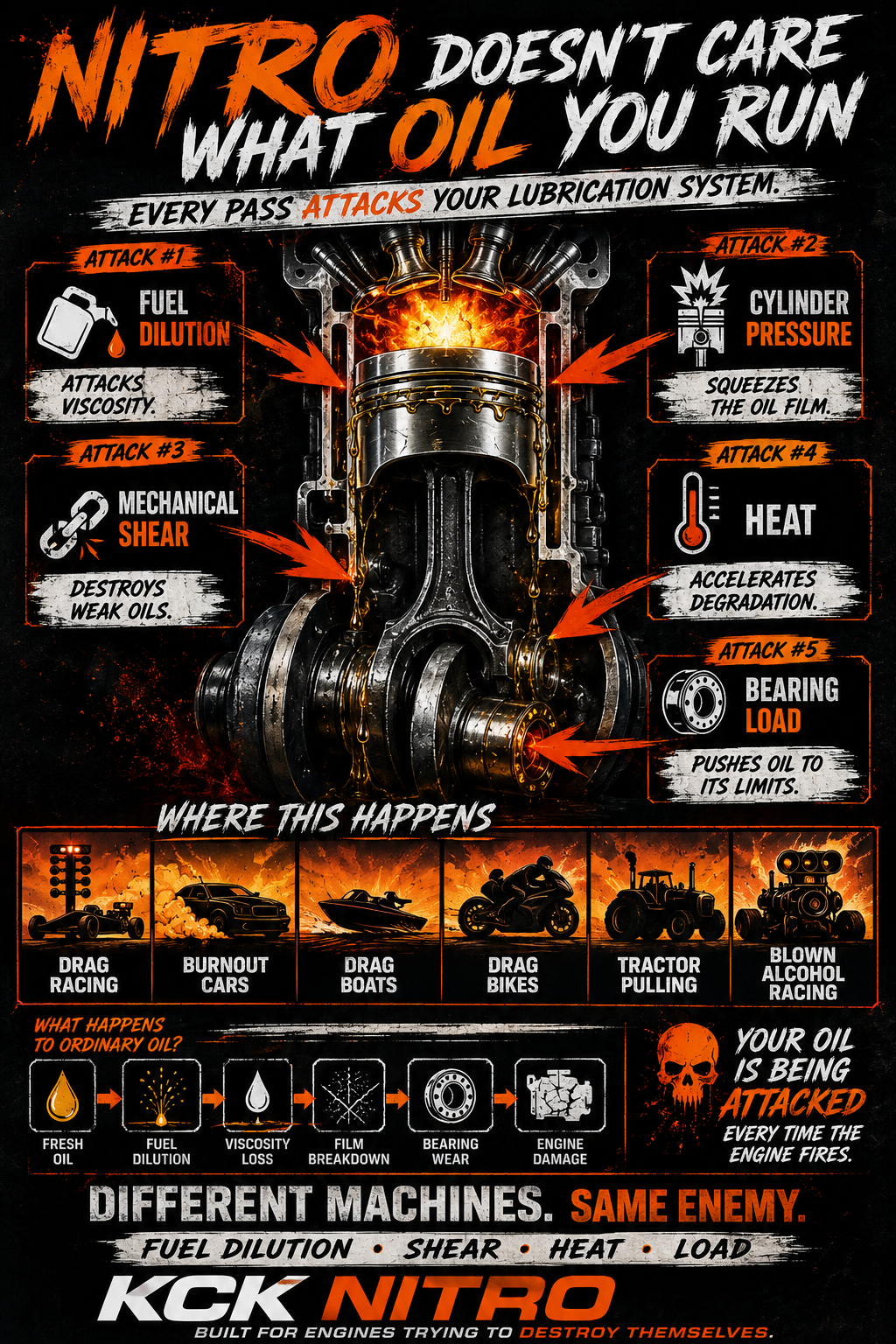
Nitro-Methane: The Extreme End Of Fuel Dilution
If methanol is hard on oil, Nitro-Methane takes things to another level.
Nitro engines operate in one of the harshest lubrication environments on Earth.
Extreme fuel volumes.
Extreme cylinder pressures.
Extreme contamination potential.
The lubricant isn't simply lubricating.
It's fighting for survival.
Maintaining viscosity and film strength under these conditions requires specialised lubrication strategies and purpose-built formulations.
Ordinary oils simply weren't designed for this environment.
The Signs Of Fuel Dilution
Fuel dilution isn't always obvious, but there are warning signs.
These may include:
- Rising oil level
- Reduced oil pressure
- Strong fuel smell on the dipstick
- Thinner oil consistency
- Increased engine wear
- Poor oil analysis results
- Reduced oil service life
Unfortunately, by the time many operators notice symptoms, damage may already be occurring.
The Best Way To Detect Fuel Dilution
Professional oil analysis remains the most effective method.
Oil analysis can reveal:
- Fuel contamination percentage
- Viscosity changes
- Wear metals
- Additive condition
- Oxidation levels
- Overall lubricant health
For high-value engines, oil analysis can identify problems long before they become expensive repairs.
How To Reduce Fuel Dilution
While some fuel dilution is unavoidable, several strategies can help minimise its impact.
Maintain Proper Ring Seal
Healthy rings dramatically reduce blow-by contamination.
Fix Fuel System Problems Quickly
Leaking injectors and rich running conditions should never be ignored.
Use The Correct Oil
Lubricants with strong base oils and robust additive systems are better equipped to handle contamination.
Monitor Oil Condition
Regular inspections and oil analysis provide early warning signs.
Match Service Intervals To Conditions
Severe-duty engines often require more frequent oil changes than standard service schedules suggest.
Why Oil Quality Matters
Not all engine oils respond to fuel dilution equally.
The quality of the base oil system plays a major role in maintaining viscosity, film strength and protection under contaminated conditions.
High-quality synthetic formulations built around advanced base stocks and carefully balanced additive systems generally provide greater resilience when contamination occurs.
That resilience can mean the difference between maintaining protection and rapidly losing it.
The Bottom Line
Fuel dilution is one of the most common—and most misunderstood—threats facing modern engines.
From diesel workhorses and turbocharged street cars to methanol race engines and Nitro-Methane monsters, fuel contamination has the ability to quietly reduce protection, accelerate wear and shorten engine life.
The challenge isn't simply keeping oil in the engine.
It's keeping the oil capable of doing its job.
Because once fuel begins attacking viscosity and film strength, the clock starts ticking.
And unlike many engine problems, fuel dilution often works silently.
Until the damage is already done.
Frequently Asked Questions
What is fuel dilution in engine oil?
Fuel dilution occurs when unburnt fuel enters the crankcase and mixes with the engine oil, reducing viscosity and potentially compromising engine protection.
Does fuel dilution damage engines?
Yes. Excessive fuel dilution can reduce oil viscosity, weaken the oil film and accelerate wear on bearings, camshafts, pistons and other critical components.
What causes fuel dilution?
Common causes include short trips, excessive idling, rich air-fuel ratios, worn piston rings, leaking injectors and certain diesel regeneration strategies.
How do I know if my engine has fuel dilution?
Signs can include rising oil levels, reduced oil pressure, fuel smell in the oil, thinner oil consistency and abnormal oil analysis results.
Is fuel dilution worse in methanol or Nitro engines?
Generally, yes. Methanol and Nitro-Methane applications can introduce significantly higher levels of fuel contamination compared with conventional petrol engines, placing extreme stress on engine oil.