
What Actually Happens Inside Your Engine at 7,000 RPM
Most people see RPM as just a number on a tachometer.
7,000 RPM sounds impressive.
Aggressive.
Fast.
But very few people truly understand what’s happening inside an engine at those speeds.
Because at 7,000 RPM, your engine isn’t simply “running harder.”
👉 It’s surviving controlled mechanical violence.
And the only thing separating that violence from catastrophic failure…
is the oil.
7,000 RPM: The Reality
At 7,000 RPM:
- The crankshaft spins 116 times every second
- Each piston changes direction 233 times per second
- Valvetrain components accelerate and decelerate violently thousands of times per minute
- Oil is exposed to extreme heat, pressure, and shear forces
Everything inside the engine is happening:
Faster
Hotter
Harder
Than most people realise.
Piston Speed: Brutal Physics in Motion
Pistons don’t move smoothly.
They:
- Accelerate away from TDC (Top Dead Centre)
- Reach enormous speeds mid-stroke
- Decelerate instantly
- Reverse direction violently
And they do this:
Thousands of times per minute
In a typical high-performance engine at 7,000 RPM:
Average piston speed can exceed 20 metres per second
Peak piston acceleration can exceed 2,000–3,000 G
That means:
The piston, pin, rod, and bearings are being slammed with enormous forces every revolution.
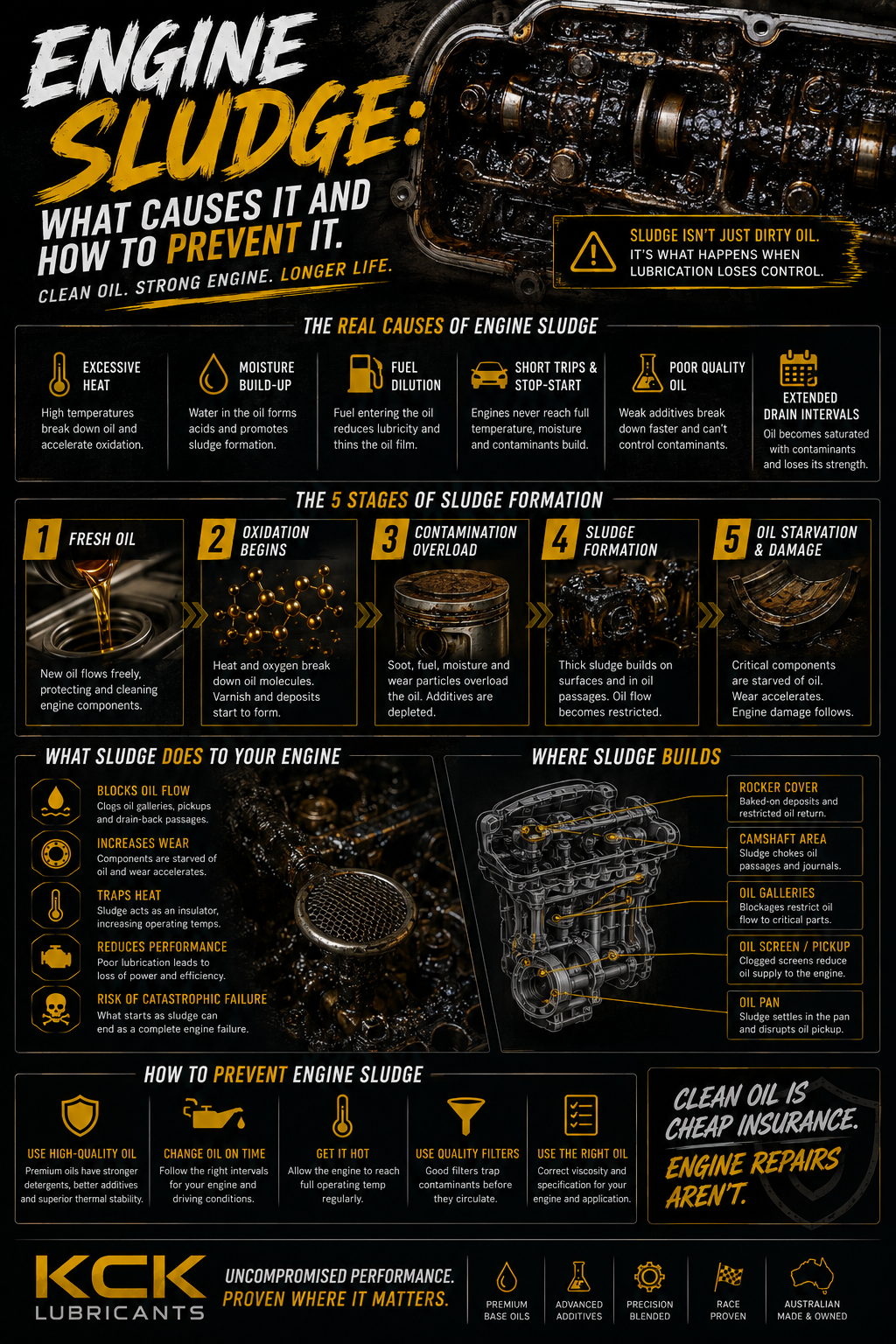
Heat Becomes the Enemy
Combustion temperatures inside a petrol engine can exceed:
👉 2,000°C+
Most of that heat never reaches the coolant.
Instead:
- Pistons absorb it
- Bearings absorb it
- Oil absorbs it
And at high RPM:
Oil temperature rises rapidly
This is where lower-quality oils begin to fail.
Oil Film Strength: The Invisible Lifeline
Here’s the part most people never think about:
Your crankshaft bearings do not normally touch the crankshaft.
They ride on a microscopic pressurised oil film.
At 7,000 RPM:
That oil film is all that prevents direct metal-to-metal contact.
And the clearance?
Often:
Smaller than a human hair.
When Oil Fails, Everything Fails
At high RPM, oil is exposed to:
- Extreme shear forces
- Intense heat
- Aeration
- Rapid pressure cycling
Inferior oils begin to:
- Thin out
- Oxidise
- Lose viscosity stability
- Lose film strength
And when that happens:
👉 Bearings touch the crank
👉 Temperatures spike
👉 Wear accelerates instantly
This is how engines:
- Spin bearings
- Damage cams
- Destroy pistons
- Wipe lifters
- Crack ring lands
Sometimes in seconds.
The Valvetrain Is Fighting for Its Life
At 7,000 RPM, the valves are no longer simply “opening and closing.”
They are:
Being violently accelerated by the camshaft
Then slammed shut by valve spring pressure
This creates:
- Massive contact stress
- Friction heat
- Shear load on the oil film
Modern high-lift camshafts make this even worse.
And if oil protection breaks down here?
Camshaft and valvetrain wear accelerates fast.
Windage: The Hidden Power Robber
At high RPM, the crankshaft spins so fast it starts whipping oil into a storm.
This creates:
- Windage drag
- Oil aeration
- Power loss
- Reduced oil control
Oil becomes:
👉 Foam-like
👉 Less stable
👉 Harder to pump consistently
High-performance oils are formulated to resist foaming and maintain stability under these extreme conditions.
Shear Stability: Why Cheap Oils Get Murdered
Multi-grade oils rely on viscosity modifiers to maintain thickness across temperature ranges.
At high RPM:
These molecules are mechanically stressed and torn apart.
This is called:
Viscosity shear
Cheap oils:
- Lose viscosity rapidly
- Thin out under load
- Lose protective capability
High-performance oils are engineered specifically to resist this breakdown.
Turbocharged Engines? Even Worse.
Turbochargers can spin:
👉 Over 200,000 RPM
And they rely almost entirely on oil for:
- Lubrication
- Cooling
- Shaft stability
Oil exiting the turbo can experience:
👉 Extreme localised temperatures
This is where poor oils:
- Coke
- Oxidise
- Form deposits
And once deposits form:
👉 Oil flow suffers
👉 Turbo life drops dramatically
Motorsport Teaches the Truth Quickly
In motorsport:
There’s nowhere for weak oil to hide.
High RPM exposes:
- Poor film strength
- Weak additive systems
- Inferior base oils
- Thermal instability
That’s why professional race teams obsess over lubrication.
Because at the limit:
Oil quality becomes survival.
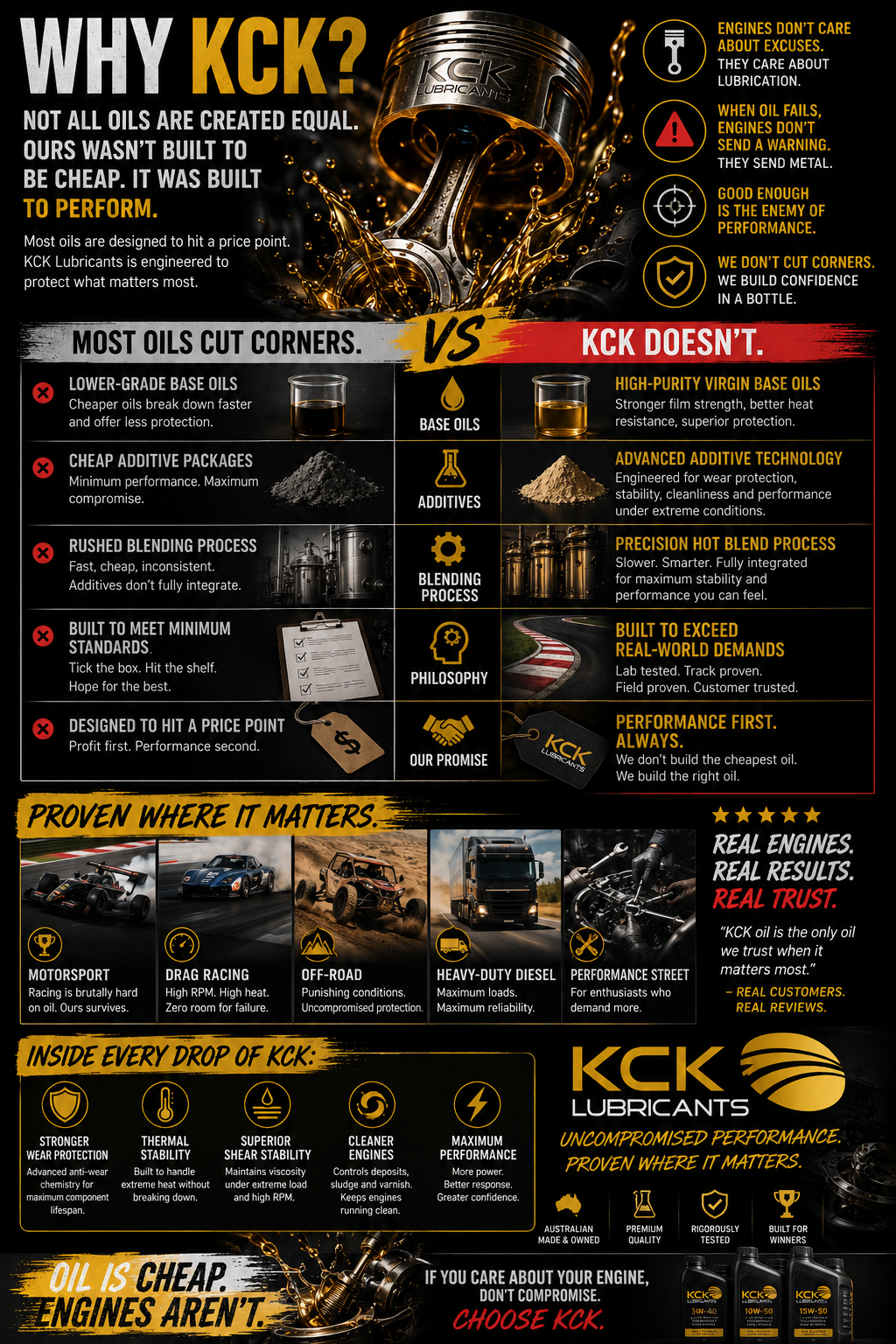
The KCK Difference
At KCK Lubricants, we formulate oils for environments where:
- Heat is extreme
- Load is constant
- RPM is brutal
- Failure is expensive
That means:
- High-purity base oils
- Advanced anti-wear chemistry
- Strong viscosity stability
- High thermal resistance
- Precision hot blending technology
Because when an engine is living at 7,000 RPM and beyond…
“Good enough” is already a failure.
Technical Summary
At high RPM, engine oil must:
- Maintain viscosity under extreme shear
- Resist thermal breakdown
- Prevent metal-to-metal contact
- Control aeration and foaming
- Protect bearings and valvetrain components
High-performance lubricants are engineered specifically for these conditions.
Myth vs Fact
Myth:
If the engine survives high RPM, the oil must be doing its job.
Fact:
Many oils provide basic lubrication but lose film strength, viscosity stability, and thermal resistance under sustained high-RPM operation. Damage often occurs gradually long before catastrophic failure becomes visible.
🏁 Final Thought
At 7,000 RPM:
- Pistons reverse direction hundreds of times per second
- Bearings ride on microscopic oil films
- Temperatures soar
- Loads become violent
And through all of it…
Your engine is trusting the oil.
Every second.
Every revolution.
Every pull.
The Bottom Line
Horsepower gets the glory.
But oil is what keeps the whole thing alive.
About the Author
Matt is part of the team behind KCK Lubricants, an Australian manufacturer specialising in high-performance engine oils for motorsport, heavy-duty diesel, and extreme mechanical environments.
With more than 25 years of formulation and real-world testing experience, KCK oils are engineered to perform where lesser lubricants fail.