
Engine Sludge: What Causes It and How to Prevent It
Engine sludge.
Just hearing the term makes mechanics uncomfortable.
Because sludge isn’t just “dirty oil.”
👉 Sludge is what happens when lubrication completely loses control.
It’s the thick, black, tar-like contamination that blocks oil galleries, sticks piston rings, destroys oil flow, and slowly suffocates an engine from the inside out.
And despite what many people think…
👉 Sludge is rarely caused by one single issue.
It’s usually the result of:
- poor oil quality
- neglected maintenance
- heat
- contamination
- incorrect driving conditions
- or oils simply being pushed beyond their limits
The scary part?
Most engines begin forming sludge long before the owner realises there’s a problem.
What Engine Sludge Actually Is
Engine sludge is a mixture of:
- oxidised oil
- fuel contamination
- soot
- moisture
- combustion by-products
- microscopic wear particles
Over time, these contaminants combine and thicken into heavy deposits that begin sticking to internal engine surfaces.
Instead of flowing like oil should…
👉 sludge behaves more like sticky asphalt.
And once it starts building, the damage accelerates quickly.
Heat Is One of the Biggest Causes
Modern engines run HOT.
Especially:
- turbocharged engines
- direct injection engines
- performance engines
- heavy-duty applications
Heat causes oil molecules to oxidise and degrade over time.
This process creates:
- varnish
- carbon deposits
- sludge precursors
The hotter the engine operates…
👉 the faster low-quality oils begin breaking down.
Short Trips Are Brutal on Oil
One of the biggest sludge myths is that only “abused” engines sludge up.
Reality?
👉 Short-trip city driving is one of the worst environments possible for engine oil.
Why?
Because the engine often:
- never reaches full operating temperature
- never evaporates moisture properly
- accumulates fuel dilution
- builds condensation inside the crankcase
Over time:
👉 water + fuel + combustion contamination = sludge formation.
This is extremely common in:
- daily commuters
- stop-start traffic vehicles
- lightly used cars
- vehicles that sit for long periods
Moisture: The Hidden Enemy
Every engine produces moisture internally.
Normally:
👉 properly heated oil evaporates and removes it.
But when moisture remains trapped inside the oil:
- oxidation accelerates
- acids form
- additives deplete faster
- sludge formation increases dramatically
This is why engines that rarely get a proper long drive often sludge up faster than hard-driven highway vehicles.
Cheap Oil Gets Overwhelmed Faster
This is where oil quality becomes critical.
Lower-quality oils often:
- oxidise faster
- lose viscosity stability sooner
- use weaker detergent systems
- contain less robust additive packages
Once additives become depleted:
👉 contaminants begin sticking together instead of remaining suspended.
That’s the beginning of sludge.
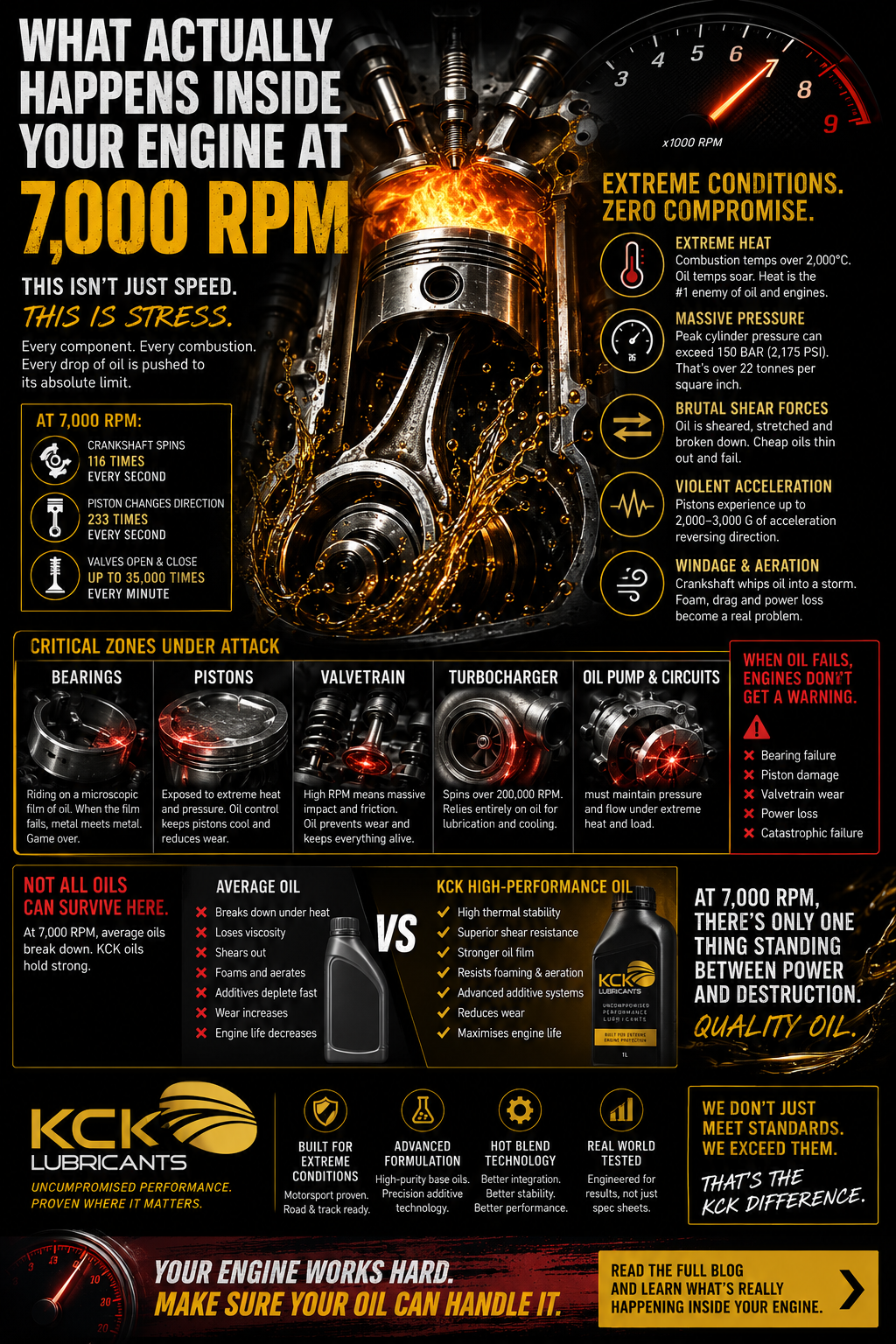
High-performance oils are specifically engineered to:
- resist oxidation
- control contamination
- suspend particles properly
- maintain stability under heat and stress
Because preventing sludge is far easier than removing it.
Sludge Restricts Oil Flow
Here’s where things become dangerous.
Sludge doesn’t just “look bad.”
It physically:
- blocks oil galleries
- restricts oil pickup screens
- reduces oil flow
- traps heat
- starves critical components of lubrication
And engines rely on continuous oil flow for survival.
Once oil supply becomes restricted:
👉 bearing wear accelerates
👉 valvetrain damage increases
👉 turbochargers suffer
👉 temperatures rise rapidly
At that point:
👉 catastrophic engine failure isn’t far away.
Turbocharged Engines Are Especially Vulnerable
Turbochargers are absolute torture chambers for engine oil.
Extreme shaft speed.
Extreme localised heat.
Tiny oil passages.
Poor-quality oil exposed to turbo heat can:
- oxidise rapidly
- form carbon deposits
- coke inside oil lines
- restrict lubrication
This is why neglected turbo engines often become sludge nightmares.
And once turbo oil passages begin clogging?
👉 failure happens fast.
The Real Causes of Engine Sludge
Let’s kill a few myths.
❌ Myth:
Sludge only happens in neglected engines.
✅ Reality:
Even regularly serviced engines can sludge if:
- poor oil is used
- oil specs are incorrect
- service intervals are excessive
- driving conditions are severe
❌ Myth:
Synthetic oils never sludge.
✅ Reality:
Any oil can sludge if:
- overheated
- contaminated
- neglected
- or poorly formulated
The difference is:
👉 high-quality synthetics resist sludge formation FAR better.
❌ Myth:
Engine flushes magically fix sludge safely.
✅ Reality:
Aggressive flushes can sometimes:
- dislodge large deposits
- block oil pickups
- create sudden lubrication problems
Severe sludge engines often require mechanical cleaning and inspection.
How to Prevent Engine Sludge
The good news?
Most sludge problems are preventable.
Use High-Quality Oil
This is the foundation.
Premium oils contain:
- stronger detergents
- better dispersants
- superior oxidation resistance
- improved thermal stability
Cheap oil might survive basic operation…
But under heat and contamination:
👉 the cracks appear quickly.
Change Oil Before It’s Destroyed
Oil change intervals are not magical guarantees.
Driving conditions matter massively.
Severe conditions may require:
- shorter intervals
- more frequent inspection
- better filtration
- higher quality lubricants
Especially in:
- towing
- racing
- short-trip driving
- dusty conditions
- turbocharged applications
Let the Engine Reach Full Temperature
Occasional longer drives help:
- evaporate moisture
- reduce fuel dilution
- stabilise oil temperature
- reduce sludge buildup
Engines hate living permanently cold.
Use the Correct Oil Specification
Viscosity matters.
But so does:
- additive chemistry
- thermal stability
- OEM approvals
- base oil quality
Using the wrong oil can accelerate:
- oxidation
- contamination
- deposit formation
What Sludge Looks Like Inside an Engine
A healthy engine:
✅ clean golden metal surfaces
✅ free-flowing oil return passages
✅ clean rocker covers
✅ stable oil flow
A sludge-filled engine:
❌ thick black deposits
❌ blocked drain-back passages
❌ sticky varnish buildup
❌ restricted oil pickup screens
❌ cooked oil residue everywhere
One survives.
The other slowly destroys itself.
Motorsport Teaches This Quickly
High-performance engines expose oil weakness FAST.
Heat.
RPM.
Load.
Shear stress.
Weak oils:
👉 oxidise quicker
👉 contaminate faster
👉 lose control of deposits
That’s why serious race teams obsess over:
- oil condition
- oil analysis
- temperature control
- premium lubrication
Because sludge isn’t just dirty oil.
👉 It’s failed lubrication chemistry.
The KCK Difference
At KCK Lubricants, we formulate oils to survive:
- high heat
- heavy load
- extreme RPM
- severe contamination environments
That means:
✅ high-purity base oils
✅ advanced additive systems
✅ strong detergent technology
✅ high thermal stability
✅ precision hot blend manufacturing
Because the goal isn’t just lubrication.
The goal is long-term engine survival.
Technical Summary
Engine sludge is caused by:
- oxidation
- heat
- contamination
- moisture
- fuel dilution
- additive depletion
Sludge formation accelerates when:
- low-quality oils are used
- service intervals are excessive
- engines operate under severe conditions
High-quality lubricants help resist sludge formation through:
- superior thermal stability
- advanced detergents
- stronger dispersants
- oxidation resistance
Myth vs Fact
Myth:
If the oil level is correct, the engine is protected.
Fact:
Oil condition matters just as much as oil level. Contaminated or degraded oil can lose its ability to protect the engine long before the sump runs low.
Final Thought
Sludge doesn’t happen overnight.
It builds slowly. Quietly.
Heat cycle after heat cycle.
And by the time symptoms appear…
👉 damage is usually already happening.
The scary part?
Most sludge problems started long before the engine ever made a noise.
The Bottom Line
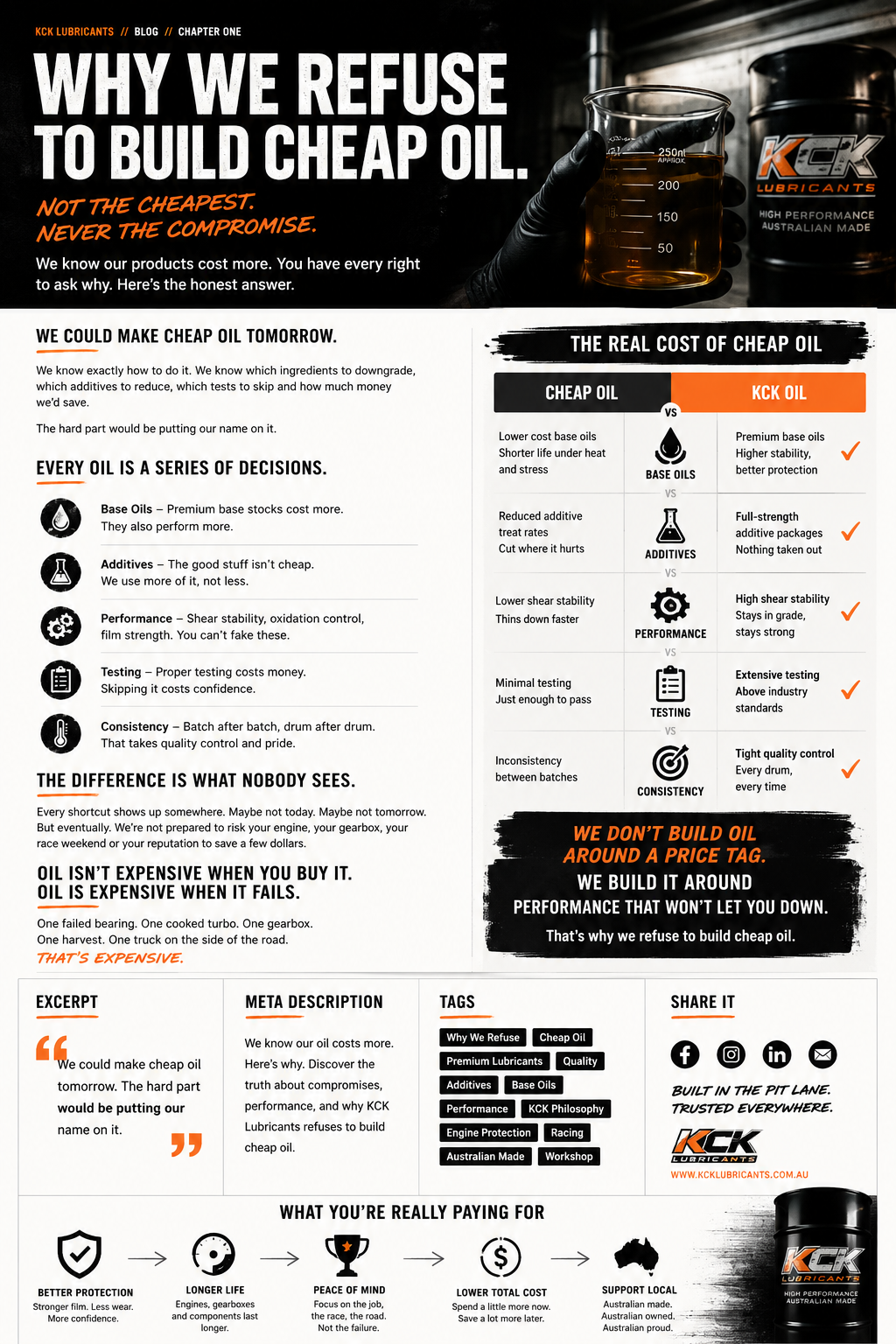
Cheap oil can become expensive VERY quickly.
Because when lubrication loses control…
The engine pays the price.
About the Author
Matt is part of the team behind KCK Lubricants, an Australian manufacturer specialising in high-performance engine oils for motorsport, heavy-duty diesel, and demanding mechanical applications.
With more than 25 years of formulation and real-world testing experience, KCK oils are engineered to perform where reliability matters most.