
Cold Starts: The Most Damaging 5 Seconds Your Engine Faces
Most engine wear doesn’t happen at full throttle.
It doesn’t happen at redline.
It doesn’t happen halfway down the straight at 7,000 RPM.
And it doesn’t happen while towing a load uphill in the middle of summer.
The harshest moment for your engine often happens before you even leave the driveway.
👉 The cold start.
Those first few seconds after startup are some of the most mechanically violent moments your engine will ever experience.
Because during a cold start:
- oil pressure is still building
- lubrication films are incomplete
- clearances are unstable
- oil flow is limited
- and metal surfaces are far more vulnerable to wear
Modern engines survive this because engine oil acts as a protective barrier between moving parts.
But when lubrication quality drops…
👉 cold starts become brutal.
Why Cold Starts Are So Hard on Engines
When an engine sits overnight:
- oil drains back toward the sump
- components cool and contract
- moisture accumulates internally
- oil thickens as temperature drops
The next startup begins before full lubrication is restored.
For a brief period:
👉 critical components operate with reduced oil film protection.
And in mechanical terms…
That’s bad news.
Oil Pressure Doesn’t Instantly Mean Protection
One of the biggest misconceptions in the automotive world is:
“As soon as the oil pressure light goes out, everything is protected.”
Not exactly.
Oil pressure builds relatively quickly.
But proper lubrication takes longer because oil still needs to:
- reach critical areas
- establish stable film thickness
- fully circulate through galleries and bearings
- maintain separation between moving surfaces
During this period:
👉 wear rates spike dramatically.
Boundary Lubrication: Where Wear Happens
Under ideal conditions, engines operate in what’s called:
Hydrodynamic Lubrication
This means a full oil film completely separates metal surfaces.
But during cold startup?
Many components temporarily operate in:
Boundary Lubrication
That means:
👉 microscopic metal-to-metal contact begins occurring.
This is where:
- camshaft wear
- bearing wear
- piston scuffing
- valvetrain wear
can begin accelerating.
Oil Thickness Changes Dramatically When Cold
Cold oil behaves very differently from hot oil.
As temperature drops:
- viscosity increases
- oil flows slower
- pump resistance increases
- circulation takes longer
Thicker oil may protect well once hot…
But if it’s excessively thick during startup:
👉 critical lubrication delay occurs.
That’s why viscosity selection matters enormously.
Especially in colder climates.
Modern Engines Make This Worse
Today’s engines are:
- tighter tolerance
- higher compression
- turbocharged
- hotter running
- lower viscosity
- more emissions sensitive
This creates enormous stress on lubrication systems during startup.
Turbochargers are especially vulnerable because:
- they rely entirely on oil flow
- spin at extreme RPM
- operate under intense heat
- use very small oil passages
A dry turbo startup repeated thousands of times?
👉 that damage adds up.
Most Engine Wear Happens During Startup
This surprises many people.
But studies and real-world engine analysis consistently show:
👉 a significant percentage of total engine wear occurs during startup and warm-up.
Why?
Because once fully warm:
- oil flows properly
- clearances stabilise
- lubrication films strengthen
- contamination evaporates
Cold startup is the opposite.
It’s the moment the lubrication system is working hardest to catch up.
Short Trips Are a Double Hit
Short-trip driving is one of the worst things for engine oil.
Because the engine:
- repeatedly cold starts
- rarely reaches full temperature
- accumulates moisture
- increases fuel dilution
- accelerates contamination
That means:
👉 higher wear AND faster oil degradation.
This is why vehicles doing endless short commutes often:
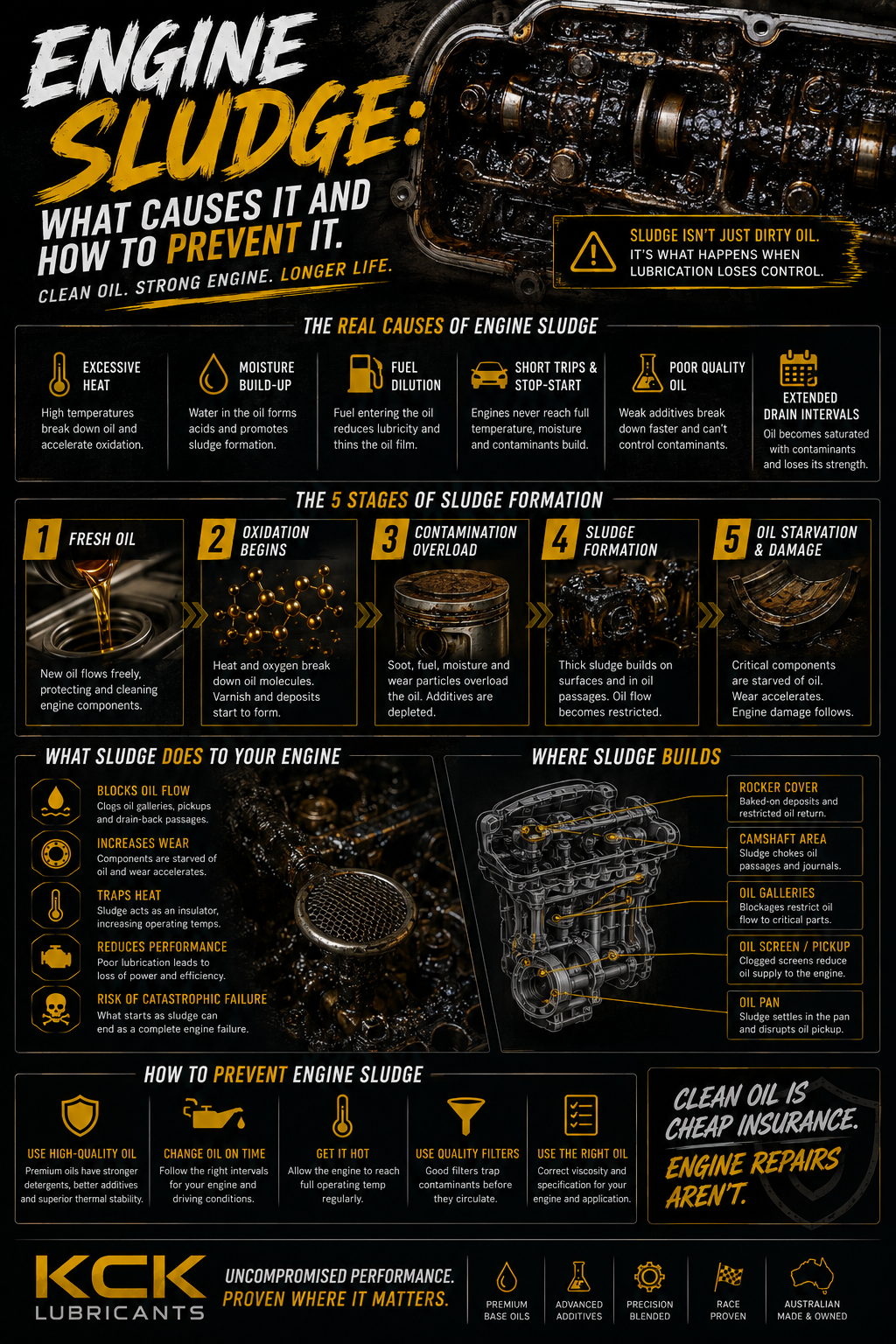
- sludge up faster
- wear internally sooner
- contaminate oil heavily
even if mileage stays relatively low.
Cheap Oil Gets Exposed FAST During Cold Starts
Cold starts separate good oil from bad oil very quickly.
Low-quality oils often struggle with:
- cold-flow characteristics
- viscosity stability
- additive durability
- film strength
- oxidation resistance
This means protection during startup becomes weaker exactly when the engine needs it most.
High-performance lubricants are engineered to:
✅ flow quickly when cold
✅ establish film strength rapidly
✅ resist viscosity instability
✅ maintain startup protection under stress
Because the first few seconds matter massively.
Anti-Wear Additives Become Critical
Modern oils contain anti-wear chemistry specifically designed for startup protection.
Additives such as:
- Zinc compounds (ZDDP)
- friction modifiers
- anti-scuff agents
help create sacrificial protective films on metal surfaces.
During cold starts:
👉 these additives become extremely important.
Without them:
- friction increases
- wear accelerates
- surface damage compounds over time
What’s Happening Inside the Engine During Startup?
At startup:
- crankshafts begin rotating immediately
- bearings load instantly
- valve springs compress
- cam lobes slide under pressure
- piston rings scrape cylinder walls
- turbochargers begin accelerating
And all of this happens:
👉 before ideal oil circulation exists.
That’s why startup lubrication quality matters so much.
Letting the Engine Idle Forever Isn’t the Answer Either
Here’s another myth worth killing.
❌ Myth:
Long idle warmups are best for engines.
✅ Reality:
Excessive idling can:
- increase fuel dilution
- increase carbon buildup
- slow proper warm-up
- contaminate oil faster
The ideal approach is:
👉 allow brief stabilisation, then drive gently until fully warm.
That helps:
- build temperature faster
- stabilise oil flow
- reduce contamination buildup
Repeated Cold Abuse Adds Up
One brutal cold start?
Probably not catastrophic.
But thousands over years?
That’s where:
- ring wear
- cam wear
- bearing fatigue
- timing component wear
- turbo wear
begin accumulating significantly.
Cold-start damage is usually:
👉 slow, invisible, cumulative wear.
Until one day:
- oil consumption increases
- compression drops
- noise develops
- performance declines
And the owner wonders why.
The KCK Difference
At KCK Lubricants, startup protection is a major focus in formulation design.
Our oils are engineered to:
✅ flow rapidly during cold startup
✅ maintain film strength under load
✅ resist viscosity instability
✅ provide strong anti-wear protection
✅ survive extreme thermal cycling
Because protecting an engine after it warms up is only half the battle.
The real test?
👉 protecting it BEFORE conditions become ideal.
Motorsport Learns This Quickly
Race engines experience violent thermal cycles.
Hot.
Cold.
Restart.
Heat soak.
Load.
Cooldown.
And startup wear becomes a major engineering consideration.
That’s why serious race teams obsess over:
- oil quality
- warm-up procedures
- viscosity selection
- thermal stability
- additive chemistry
Because weak lubrication shows itself quickly under repeated stress.
Technical Summary
Cold starts increase engine wear because:
- oil flow is reduced
- viscosity is higher
- lubrication films are incomplete
- thermal clearances are unstable
Critical wear occurs during:
- boundary lubrication conditions
- delayed oil circulation
- incomplete film protection
High-quality oils help reduce startup wear through:
- superior cold-flow properties
- strong anti-wear additives
- viscosity stability
- rapid film formation
Myth vs Fact
Myth:
Hard driving causes the most engine wear.
Fact:
A significant amount of engine wear occurs during startup and warm-up — before full lubrication protection is established.
Final Thought
Most people fear high RPM.
Smart engine builders fear dry startups.
Because engines don’t magically wake up fully protected.
For the first few seconds after startup…
👉 your oil is fighting to save the entire engine.
The Bottom Line
Cold starts are where lubrication proves its worth.
And cheap oil gets exposed FAST.
Because when metal surfaces meet before proper film protection exists…
Wear begins immediately.
Choose your oil accordingly.
About the Author
Matt is part of the team behind KCK Lubricants, an Australian manufacturer specialising in high-performance engine oils for motorsport, heavy-duty diesel, and demanding mechanical applications.
With more than 25 years of formulation and real-world testing experience, KCK oils are engineered to perform where reliability matters most.