
What Actually Happens Inside a Differential Under Load?
The brutal little world between the gear teeth — and why keeping it lubricated is harder than it looks
Most people know what a differential does.
It allows the wheels on the same axle to rotate at different speeds when the vehicle turns.
Simple enough.
But that's the bit happening on the outside.
Inside the housing, things are considerably less civilised.
You've got gears carrying serious torque. You've got rolling and sliding contact between tooth surfaces. You've got bearings carrying load. You've got heat being generated. You've got changing torque, shock loads and constantly changing contact conditions.
And sitting in the middle of all of it is a relatively small quantity of lubricant being asked to protect those surfaces every second the vehicle is moving.
That's a bloody tough job.
And it's one of the reasons we've always believed differential oil deserves far more respect than it gets.
Because when everything is working properly, nobody thinks about it.
The differential just does its job.
It's only when something starts whining, howling, overheating or coming apart that people suddenly become very interested in what's inside it.
By then, the interesting part may already be over.
The damage has started.
So let's have a look at what's actually happening in there.
First, the gearset
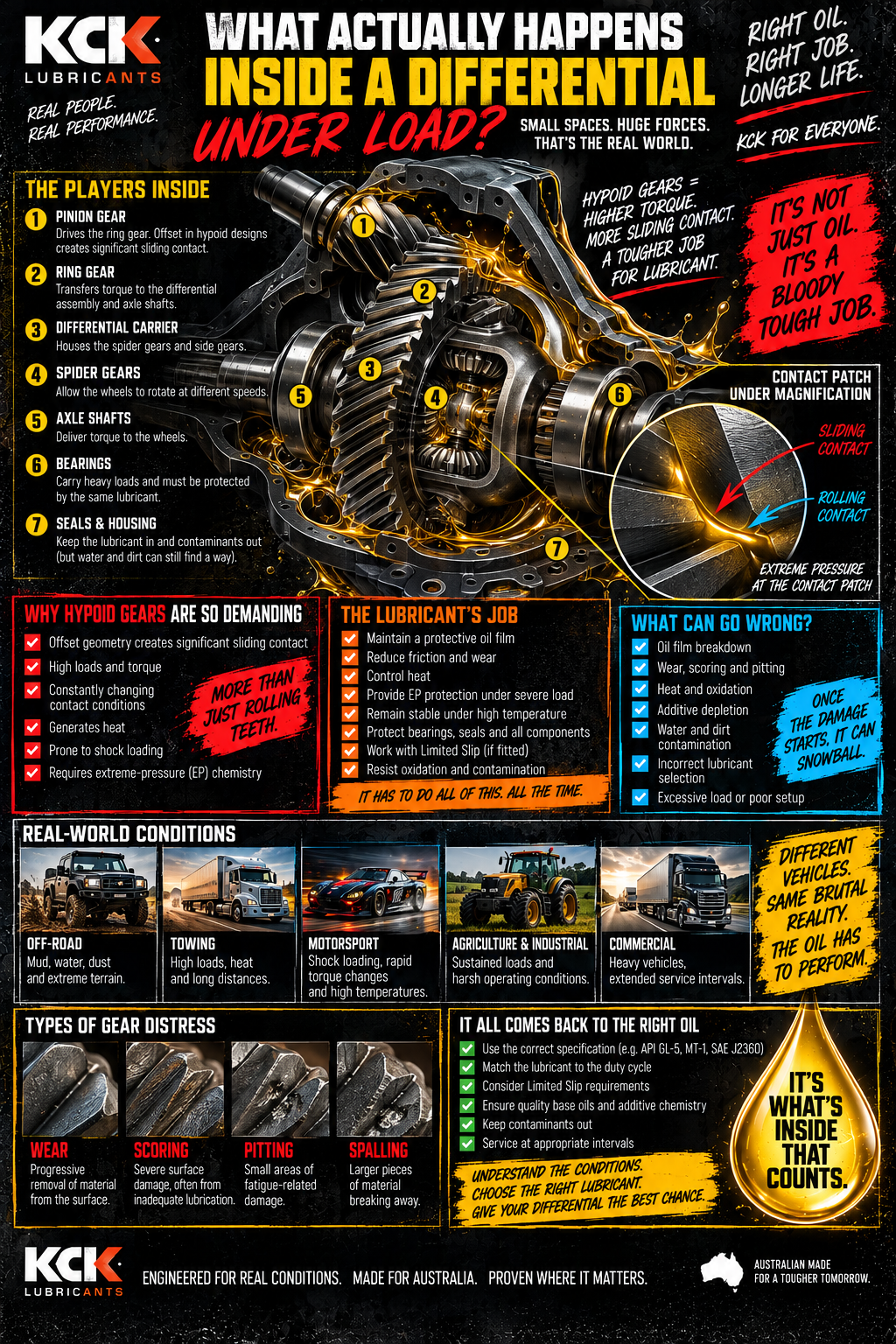
In a driven axle, the driveshaft transfers torque into the differential through the pinion gear.
The pinion drives the ring gear, which ultimately transfers that torque through the differential assembly and out to the axle shafts and wheels.
But in many automotive applications, the ring and pinion are hypoid gears.
And that's where things get interesting.
A hypoid gearset uses an offset arrangement between the pinion and ring gear.
That geometry provides important packaging and strength advantages, but it also produces a significant amount of sliding contact between the gear teeth.
And sliding contact is hard work for lubricant.
Rolling is one thing. Sliding is another.
Imagine two rollers pressed together.
They rotate, and much of the contact is rolling.
Now take two heavily loaded surfaces and make them slide across each other while they're transmitting substantial torque.
Different problem.
Hypoid gears experience a combination of rolling and sliding as the teeth engage, carry load and disengage.
That sliding movement creates friction and heat and places substantial demands on the lubricant.
SAE J2360 specifically addresses automotive hypoid gear applications involving high-speed/shock-load and low-speed/high-torque conditions and recognises the significant sliding contact involved in these gearsets.
So when someone says:
“It's only a couple of gears.”
Not quite.
Those gears are having a fairly serious argument.
The contact patch is where the real battle happens
A gear tooth looks fairly substantial when you're holding one in your hand.
But the actual area carrying load at any particular moment can be surprisingly small.
That means the forces involved are concentrated into relatively small contact areas.
Now add torque.
Lots of it.
Then add sliding.
Then temperature.
Then change the torque suddenly.
Accelerate hard.
Tow something heavy.
Climb a hill.
Lose traction and regain it.
Launch a competition car.
Drive across corrugations.
Every one of those situations changes what the gear teeth are experiencing.
The contact patch doesn't care that the vehicle looks comfortable from the driver's seat.
Inside the differential, the loads can be anything but comfortable.
This is where the oil earns its keep
A good gear lubricant has several jobs happening at once.
It needs to provide an appropriate lubricating film between moving surfaces.
It needs to help control friction and heat.
It needs to protect heavily loaded gear surfaces.
It needs to cope with oxidation.
It needs to help protect components from wear and corrosion.
And under severe conditions, its additive system needs to provide additional protection when the lubricant film alone isn't enough.
That last part is where EP — Extreme Pressure — chemistry becomes particularly important.
What does EP actually do?
Extreme-pressure additives aren't there simply to make the oil “slipperier.”
They're there because sometimes the mechanical conditions become too severe for ordinary fluid-film lubrication to provide all the protection required.
Under high pressure and temperature, certain EP additive components can react with the metal surface and form protective films.
Those films can help reduce severe surface damage when gear teeth are heavily loaded and sliding against each other.
This is a major part of the reason hypoid gear oils require carefully designed EP chemistry.
But there's an important distinction here.
EP chemistry isn't magic.
And more of it isn't automatically better.
The chemistry needs to be appropriate for the application, the operating conditions and the materials involved.
That's formulation.
Not simply adding more additive until the number on the technical sheet looks impressive.
More EP doesn't automatically mean more protection
This is one of those things that sounds logical until you understand lubricant chemistry.
You might think:
More extreme-pressure additive = more extreme-pressure protection.
But lubricant formulation is about balance.
You need the right chemistry.
At the right concentration.
Working with the rest of the additive package.
In the right base oil.
At the temperatures the lubricant will actually experience.
And you need that chemistry to behave appropriately around the materials inside the component.
That last part is particularly important.
A differential isn't made entirely from one type of metal.
Neither is a gearbox.
The lubricant has to protect the machine without creating another problem somewhere else.
That's why proper gear-oil formulation is considerably more complicated than simply making an oil thick and loading it with EP chemistry.
Heat changes everything
Every differential generates heat.
That's normal.
Gears move.
Bearings move.
Oil is churned.
Surfaces slide against each other.
There is friction.
Under light use, the thermal load may be relatively modest.
Now change the conditions.
Heavy towing.
Steep terrain.
High vehicle mass.
High ambient temperature.
Long periods under load.
Motorsport.
Commercial operation.
Suddenly the differential is working a lot harder.
And temperature matters because oxidation and lubricant degradation are influenced by temperature and time.
The hotter the operating environment, the harder the lubricant has to work to remain stable and continue providing protection.
This is one reason duty cycle matters so much when selecting gear oil.
Then you add shock loading
This is where things can get particularly nasty.
Imagine a vehicle pulling hard.
The gearset is loaded.
Then traction changes.
A tyre spins.
It suddenly grips.
Torque is transferred through the driveline.
The load isn't necessarily delivered as a nice, smooth line.
It can arrive as a hit.
That's shock loading.
The same thing can happen when you're bouncing through difficult terrain, launching a competition car, towing heavily up a steep grade or operating machinery under rapidly changing loads.
Gear teeth don't get to vote on how gently the driver uses the throttle.
They just take the load.
And the lubricant has to be there when they do.
Why hypoid gears are such a demanding lubrication problem
Put the pieces together.
You've got:
High load.
High contact pressure.
Sliding contact.
Heat.
Changing torque.
Shock loading.
And a lubricant expected to keep protecting the surfaces through all of it.
That's the problem the gear-oil specification is trying to address.
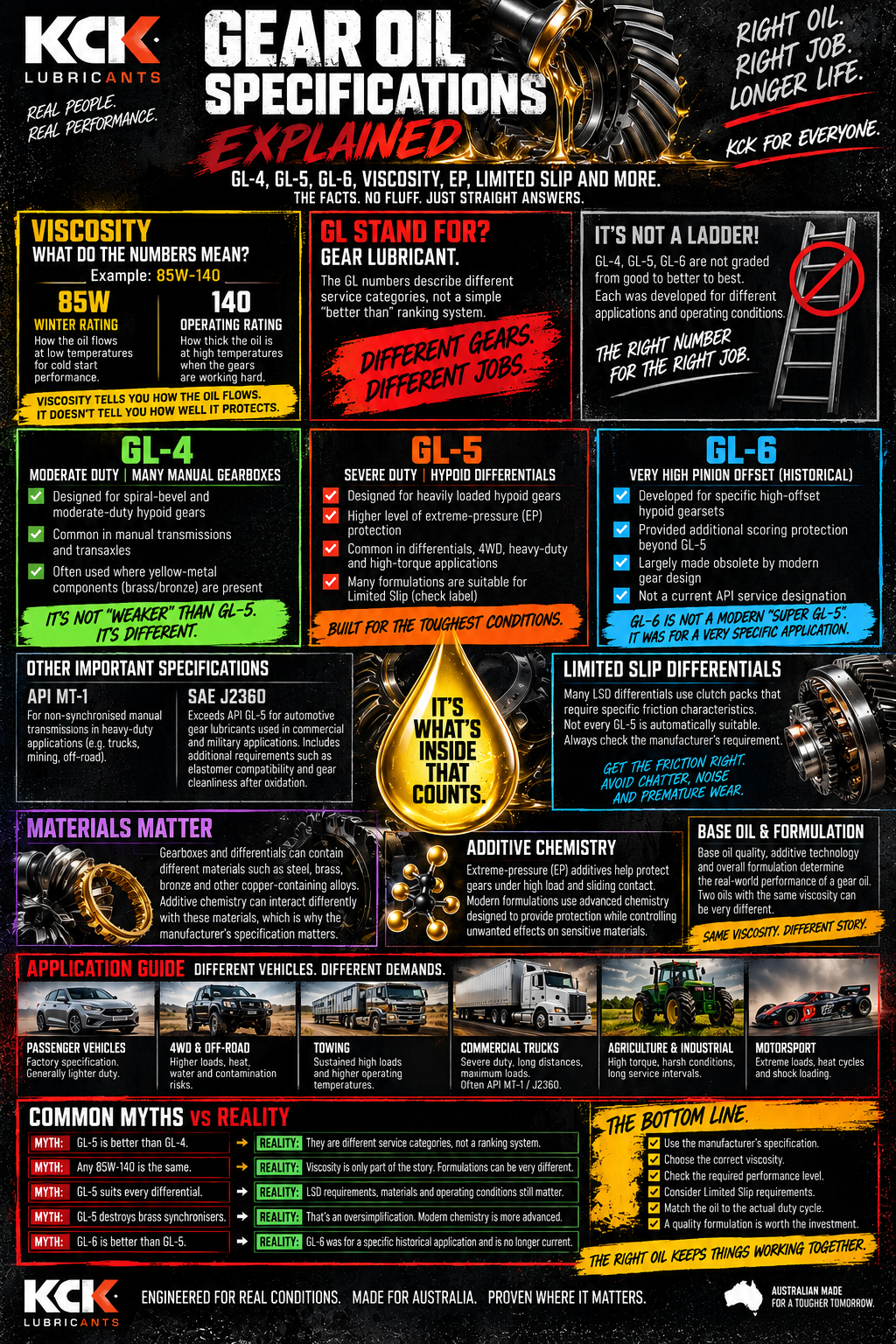
API GL-5, for example, is intended for severe hypoid gear service involving combinations of high-speed/shock-load and low-speed/high-torque conditions.
It's not a random designation.
It's a response to a mechanical problem.
What happens when the lubricant can't keep up?
This is where the trouble starts.
Under ideal conditions, the lubricant helps separate the surfaces.
But as load, temperature and sliding conditions increase, the protective film can become increasingly challenged.
If the surfaces begin interacting more directly, wear and surface distress can occur.
And once damage begins, it doesn't necessarily stop politely.
A damaged surface can create more friction and altered contact conditions.
More friction can generate more heat.
More heat places more stress on the lubricant.
And the cycle can continue.
That's why lubrication isn't simply about preventing a catastrophic failure.
It's about controlling the conditions that eventually lead to one.
Pitting, scoring and wear aren't all the same thing
You'll often hear these words used interchangeably.
They're not.
Wear is the progressive removal or deterioration of material from a surface.
Scoring involves more severe surface damage, often associated with sliding under inadequate lubrication or extreme conditions.
Pitting involves localised fatigue damage where small pieces of material break away from the surface.
There are other forms of gear distress as well, including scuffing, spalling and micropitting.
The causes can vary.
Load.
Surface finish.
Alignment.
Geometry.
Lubricant condition.
Contamination.
Temperature.
Operating cycle.
So when somebody says:
“The diff failed because the oil was bad.”
that may be true.
But it may also be missing half the story.
The lubricant is one part of a mechanical system.
Good lubricant selection gives that system the best chance of surviving the job it's being asked to do.
And the gears aren't the only things in there
This is easy to overlook.
A differential contains more than a ring and pinion.
There are bearings.
There are shafts.
There are seals.
There is the differential mechanism itself.
And in a Limited Slip unit, there may also be clutch components requiring particular friction behaviour from the lubricant.
That's why gear-oil selection has to consider the whole assembly.
It's not enough to ask:
“Will this protect the gears?”
You also need to ask:
“Is it suitable for everything else sharing that lubricant?”
That's where manufacturer specifications become so important.
Limited Slip adds another layer
A Limited Slip differential can place additional demands on lubricant friction characteristics.
Clutch-type Limited Slip units rely on controlled friction within the clutch packs to provide their intended function.
The lubricant therefore has to provide gear protection while behaving appropriately around those friction surfaces.
Get that balance wrong and you can end up with chatter, noise or undesirable operating characteristics.
And again, this isn't something to guess.
Check the manufacturer's requirement.
A bottle being labelled GL-5 doesn't automatically tell you everything you need to know about Limited Slip compatibility.
Then there's the Australian problem: water
If you're running a 4WD, this one deserves attention.
A differential can spend most of its life on dry roads without much drama.
Then you take it off-road.
Mud.
Creeks.
Water crossings.
Dust.
Heat.
Cold water.
Sudden changes in operating conditions.
The differential housing and breather system have to deal with those conditions, and if water gets into the lubricant, you've introduced contamination into an environment where you absolutely don't want it.
This is one reason serious off-road users need to think about differential maintenance as part of the operating environment, not simply as another item on a generic service checklist.
If the vehicle works hard, the lubricant works hard.
The same differential can live two completely different lives
This is something we've seen over and over.
A vehicle can have exactly the same differential as another vehicle sitting beside it.
One might spend its life commuting.
The other might tow a heavy trailer, run oversized tyres, climb steep tracks, cross water, carry serious loads and spend hours working in high ambient temperatures.
Same basic hardware.
Completely different duty cycle.
And that matters.
Because lubricant selection shouldn't be based solely on what the component looks like.
It should be based on what the component is actually being asked to do.
This is why motorsport is such a good teacher
Motorsport has a nasty habit of exposing weaknesses.
You can't hide behind a ten-minute road test when the same component is being hammered lap after lap.
High loads.
Rapid torque changes.
Heat.
Repeated cycles.
Limited cooling time.
Shock loading.
And very little tolerance for failure.
It's one of the reasons motorsport has always been such a useful environment for lubricant development.
It doesn't necessarily make every race lubricant appropriate for every road vehicle.
But it does expose what happens when the lubricant is asked to perform under pressure.
The real test starts when the vehicle leaves the workshop.
So where did RE30 come from?
This is exactly the environment we had in mind when we developed RE30.
Not simply:
“Let's make an 85W-140.”
The question was:
What does a severe-duty differential actually ask of its lubricant?
Heat.
Load.
Sliding contact.
Shock loading.
Towing.
4WD work.
Commercial transport.
Motorsport.
Agricultural and industrial equipment.
Then we worked backwards into the formulation.
Around 12 months went into developing RE30.
It's an SAE 85W-140 severe-duty gear oil formulated using carefully selected virgin base stocks and advanced additive technology, then hot blended and manufactured in Australia.
RE30 is formulated for Limited Slip applications and built around demanding requirements including API GL-5, API MT-1 and SAE J2360, along with a range of manufacturer and axle requirements.
But the important part isn't the bottle.
It's the thinking behind it.
Start with the job.
Understand the conditions.
Understand the component.
Understand the specification.
Then formulate the lubricant accordingly.
There's a lot happening inside that little housing
The next time you look at a differential, don't just see a housing full of gears.
Think about what's actually happening.
Gear teeth are carrying torque through small contact areas.
They're rolling and sliding against each other.
The lubricant is being worked.
Heat is being generated.
EP chemistry is protecting loaded surfaces.
Bearings are carrying load.
Torque is changing.
And depending on the vehicle, the whole assembly might also be dealing with towing, off-road work, water, dust, high temperatures or repeated shock loads.
All while you're sitting in the driver's seat thinking everything is perfectly normal.
That's actually the beauty of a good drivetrain.
You don't notice it working.
But underneath you, it's working bloody hard.
And that's the point of good lubrication
Good gear oil doesn't make the differential indestructible.
It doesn't overcome poor setup, damaged components, excessive loads or neglected maintenance.
What it can do is provide the lubrication, chemical protection and performance characteristics the component needs to do its job properly.
That's the goal.
Not magic.
Not marketing.
Protection.
And when you understand what's happening between those gear teeth, you start to understand why the oil in that housing deserves a little more attention.
Because the most important part of a gear oil isn't how impressive the bottle looks.
It's what happens after the bottle is gone and the oil is actually doing the work.
That's where formulation matters.
That's where chemistry matters.
That's where the real test begins.
KCK Lubricants.
Performance isn't created by marketing.
It's created by chemistry.
KCK for Everyone.