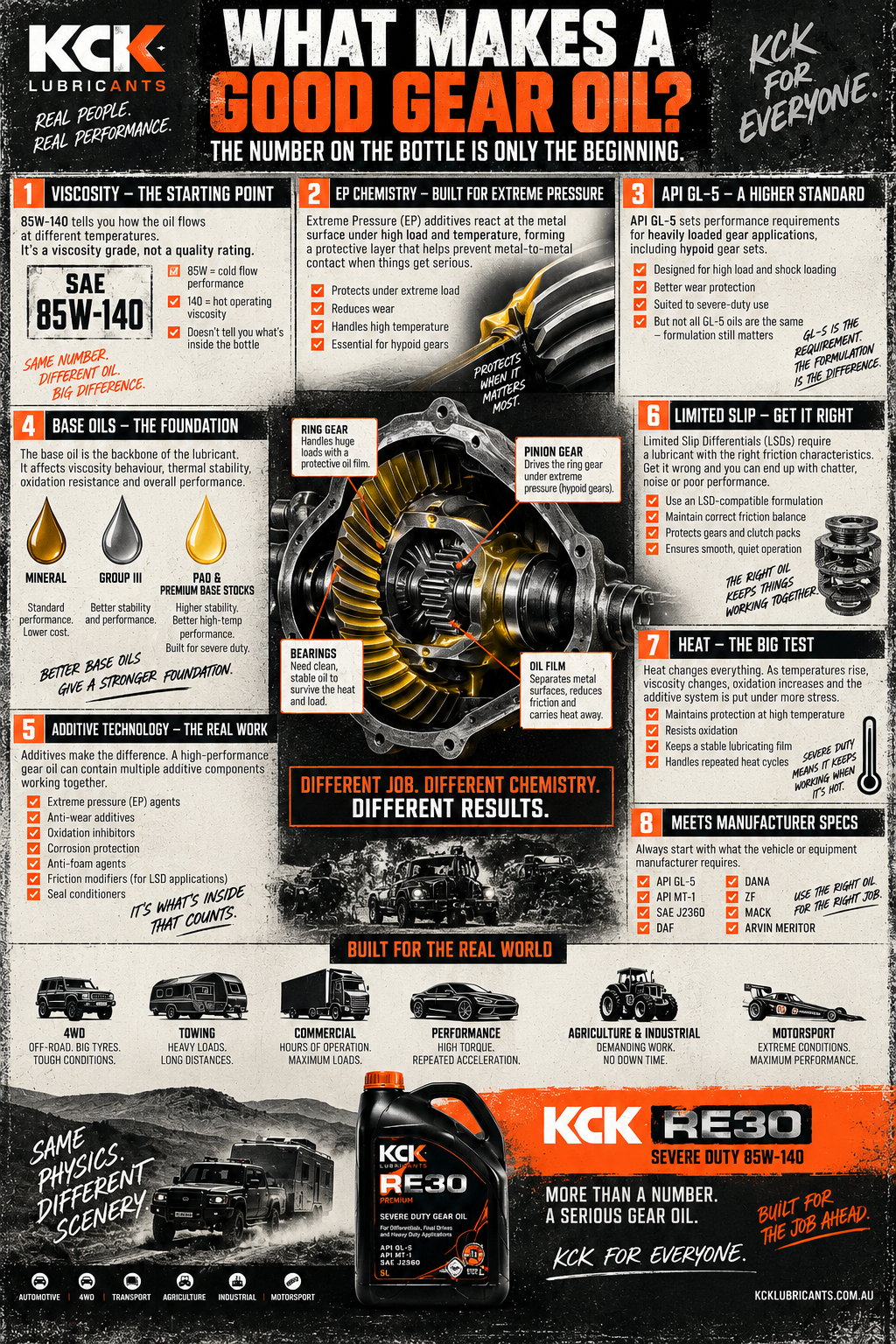

Your Gear Oil Doesn't Last Forever
Here's what happens when the oil protecting your differential gets worked, heated and forgotten.
There's a funny thing about gear oil.
When you put fresh oil into a differential, nobody thinks much about it.
The vehicle drives.
The gears turn.
The oil does its job.
Months go by.
Thousands of kilometres disappear under the tyres.
The vehicle gets loaded, unloaded, towed, driven off-road, driven hard, parked, started again and put back to work.
And underneath it all, that same oil keeps getting asked to do the same bloody difficult job.
Until one day someone asks:
“When was the last time you changed the diff oil?”
And the answer is usually somewhere between “I don't know” and “Is that actually due for changing?”
Yes.
It is.
Because gear oil doesn't have an unlimited working life.
And here's the important part:
The oil doesn't suddenly become bad on the day the differential fails.
It gets there one heat cycle, one load and one kilometre at a time.
Oil has a working life
We sometimes think of lubricant as though it's immortal.
Pour it in and forget about it.
That's not how it works.
A lubricant is there to protect moving components while they're doing a job.
And while it's doing that job, the lubricant itself is being exposed to the same environment.
Heat.
Pressure.
Friction.
Shear.
Contamination.
Oxidation.
Repeated temperature changes.
Every one of those things places demands on the formulation.
A good gear oil is designed to handle those demands.
That doesn't mean it can handle them forever.
Nothing can.
The harder the application, the more important that distinction becomes.
The oil is working even when you aren't thinking about it
Think about a typical differential.
You pull out of the driveway.
The gears start turning.
You accelerate.
The load increases.
You back off.
You accelerate again.
You cruise.
You climb a hill.
You tow something.
You stop.
Then you do it all again tomorrow.
The lubricant is continually moving through that process with the gears and bearings.
In many conventional differentials, the oil is distributed largely through the movement of the gears themselves, carrying lubricant around the housing and across the contact surfaces.
It's not sitting there doing nothing.
It's working every time the vehicle moves.
Now multiply that by tens of thousands of kilometres.
That's a lot of work for a relatively small amount of lubricant.
Heat is one of the big ones
If there's one thing worth remembering from this entire series, it's this:
Heat changes the game.
Gears generate heat as they operate.
The more work they're doing, the greater the thermal load can become.
A vehicle cruising unloaded down a flat highway isn't necessarily putting the same demands on its differential as a heavily loaded vehicle climbing a long grade.
A 4WD crawling up a steep track in low range isn't operating in the same conditions as the same vehicle cruising around town.
A race car doing repeated hard acceleration isn't experiencing the same duty cycle as a daily driver.
Same basic component.
Very different workload.
And the lubricant experiences that workload with it.
Every heat cycle leaves a mark
This is where the idea of heat cycles becomes important.
A lubricant heats up during operation.
Then the vehicle stops.
Everything cools down.
Next trip, it heats up again.
Then it cools again.
And again.
And again.
Over time, repeated exposure to operating temperatures can contribute to oxidation and changes in lubricant condition.
The more severe the operating environment, the more important thermal stability becomes.
This is one reason why a vehicle's actual use matters when thinking about lubricant service.
A car that spends its life doing short suburban trips isn't necessarily living the same life as a vehicle towing a heavy caravan across Australia.
A truck hauling serious loads for hours at a time is another story again.
And a competition vehicle can take the concept of heat cycling somewhere else entirely.
The odometer alone doesn't tell the whole story.
Then there's oxidation
Oxidation is one of those words that sounds more complicated than it really is.
In simple terms, exposure to heat and oxygen over time can cause a lubricant to chemically change.
As oxidation progresses, the oil can lose some of the characteristics you originally put it there for.
Oxidation can contribute to deposits, sludge or varnish and can affect the lubricant's ability to perform as intended.
That's one of the reasons antioxidant chemistry is part of a properly formulated lubricant.
The additive system helps the oil resist the effects of its operating environment.
But again, there's no magic shield.
Additives can help the lubricant survive the job. They don't make the lubricant immortal.
The additive package is doing some serious work
This brings us back to Part 2.
Remember all that chemistry we talked about?
Extreme-pressure additives.
Anti-wear components.
Antioxidants.
Corrosion protection.
Friction modifiers.
Other supporting chemistry.
They're not sitting inside the bottle waiting for something interesting to happen.
They're part of the reason the lubricant can perform the job it's designed for.
Some additives are there to protect the oil itself.
Others are there to protect the components.
Some interact with metal surfaces under demanding conditions.
Some control friction.
Some help manage oxidation.
It's a complete system.
And that system is being asked to perform every time the differential goes to work.
Eventually, the oil gets tired
This is probably the easiest way to think about it.
Fresh lubricant starts with a certain set of properties.
Then you put it to work.
Temperature changes.
Load changes.
The gears move.
The oil circulates.
Additive chemistry performs its functions.
Contaminants can enter the system.
The lubricant ages.
Eventually, it isn't the same lubricant you poured in on day one.
That doesn't mean it has suddenly become useless.
It means its condition has changed.
And the longer you leave it in service, particularly under severe conditions, the more important it becomes to consider whether it's still providing the level of protection the application demands.
And then there's contamination
Here's something people sometimes forget.
The differential isn't operating in a sterile laboratory.
It's underneath a vehicle.
It's exposed to the environment.
And while the housing is designed to keep the lubricant contained and contaminants out, seals, breathers, service conditions and operating environments all matter.
Wear particles can accumulate.
Dirt can find its way into places it shouldn't.
And for 4WDs, water deserves particular attention.
Anyone who's spent time off-road knows differentials can encounter conditions that a road-going vehicle never sees.
Mud.
Dust.
Water crossings.
Temperature changes.
A hot differential entering cold water is not exactly a relaxing afternoon for the hardware.
Depending on the vehicle design and conditions, water contamination can become a serious concern.
And water has no business being in your gear oil.
“But it still looks like oil”
This is one of my favourites.
Someone drains the differential.
Looks at the oil.
“Seems alright.”
That's understandable.
But you're asking your eyes to tell you something they aren't equipped to tell you.
Oil can still look like oil while its condition has changed.
You can't look at a drain pan and see oxidation.
You can't see every change in additive chemistry.
You can't see the condition of the protective film inside the gear mesh.
You can't see microscopic wear.
You can't see every contaminant.
You can't see whether the lubricant has experienced a lifetime of abuse or a relatively easy existence.
Colour and appearance can provide clues.
They're not a laboratory report.
Looking like oil doesn't mean it's still doing exactly the same job as fresh oil.
The biggest mistake is treating every kilometre equally
This is where severe duty really matters.
Let's say two vehicles have travelled the same distance.
One has spent most of its life cruising around town.
The other has spent its life towing a heavy caravan through summer, climbing hills, carrying loads and doing plenty of low-speed work.
Same kilometres.
Not remotely the same workload.
Now compare a normal road car with a competition car.
Again, the odometer doesn't tell you the full story.
This is why manufacturers often provide different service recommendations depending on vehicle use.
And it's why anyone operating a vehicle under severe conditions should pay attention to the manufacturer's severe-duty maintenance requirements.
Kilometres matter. Duty cycle matters too.
Towing is a perfect example
Take a caravan across Australia.
Long distances.
High ambient temperatures.
Heavy load.
Long climbs.
Extended periods of operation.
The differential doesn't get to pull over at the servo and have a cold drink.
It keeps working.
That's a completely different lubricant environment from a vehicle that spends most of its time empty and lightly loaded.
The same principle applies to work vehicles.
If you're hauling heavy equipment every day, your differential knows it.
If you're pulling trailers every weekend, your differential knows it.
If you're moving serious weight through hot country, your differential definitely knows it.
And the oil knows it too.
4WDs don't get an easy ride either
A four-wheel drive can be an absolute punishment machine for driveline components.
Low range changes the operating conditions.
Large tyres can alter the loads experienced by the driveline.
High traction can mean the drivetrain has fewer opportunities to relieve torque.
Steep climbs increase the workload.
Mud and rocks demand constant changes in load.
Then you can add water crossings and the contamination risk that comes with them.
None of this means every 4WD needs the same lubricant or the same service interval.
It means how the vehicle is used should influence how seriously you take differential maintenance.
If the vehicle is genuinely being worked, treat it like a machine that's being worked.
Motorsport doesn't get a free pass
Racing is another world.
The vehicle might only be operating for a few minutes at a time, but those minutes can be brutal.
Hard launches.
High torque.
Rapid acceleration.
Shock loading.
Repeated passes.
Heat cycles.
The differential doesn't care that the race only lasted eight seconds.
It just experienced eight seconds of work at a level far beyond what a normal road car sees.
Then it cools down.
Then it gets asked to do it again.
And again.
That's why motorsport has always been such a useful proving ground for lubricants.
It exposes weaknesses quickly.
When you're dealing with serious power and serious load, you don't have much room for a lubricant that isn't up to the job.
What happens when you ignore it?
Usually, nothing dramatic happens immediately.
That's actually the dangerous part.
You change nothing.
The vehicle still drives.
You still tow.
The 4WD still climbs.
The truck still works.
The race car still goes down the track.
So you assume everything is fine.
Then one day you hear something.
A whine.
A growl.
A vibration.
Maybe there's excessive wear.
Maybe a bearing is unhappy.
Maybe the gear teeth have been subjected to conditions they weren't supposed to endure.
And suddenly you're having a completely different conversation.
The problem is that the noise didn't necessarily cause the damage.
The damage caused the noise.
The lubricant may have been part of that story long before anyone could hear it.
The expensive part isn't the oil
This is where the economics get pretty simple.
Differential oil costs money.
So does changing it.
But compare that with:
Gears.
Bearings.
Seals.
Labour.
Vehicle downtime.
Recovery.
Lost work.
Lost race time.
Lost weekends.
Lost trips.
Suddenly the price of a few litres of properly specified gear oil doesn't look quite so significant.
Nobody likes spending money on maintenance.
But maintenance is generally cheaper than repair.
And nowhere is that more obvious than with components that are expensive to pull apart.
So when should you change it?
Here's where I'm going to give you the boring answer.
Follow the vehicle or component manufacturer's requirements first.
They're the people who designed the hardware.
They know what lubricant specification and viscosity the system requires.
But don't ignore the conditions you're actually operating under.
If you're towing heavily, operating off-road, competing, hauling commercial loads or working machinery hard, check whether the manufacturer provides a severe-duty service schedule.
And if you've been through water crossings or suspect contamination, don't simply wait for the normal interval because the calendar says you're fine.
Use some common sense.
The vehicle doesn't know what the service book says.
It only knows what you've asked it to do.
Don't wait for the noise
This is probably the biggest takeaway from Part 3.
Don't use differential noise as your service reminder.
By the time a differential is making noises loud enough for the average driver to notice, you're no longer asking whether the oil needs changing.
You're asking what else has been affected.
Good maintenance is deliberately boring.
You change the oil before there's a problem.
You inspect things before they fail.
You replace fluids because they're due, not because something has already gone wrong.
That's not paranoia.
That's mechanical common sense.
So what makes a long-life gear oil?
This is where Parts 1, 2 and 3 meet.
You need the correct viscosity for the application.
You need the appropriate performance level.
You need the right extreme-pressure and anti-wear chemistry.
You need thermal and oxidation stability.
You need the correct friction characteristics where Limited Slip applications require them.
You need contamination resistance appropriate to the operating environment.
And you need a formulation built to maintain its performance over the intended service life.
That's why lubricant formulation is more complicated than pouring something thick into a bottle and calling it heavy duty.
The oil has to start well.
Then it has to stay useful while it's being worked.
That's the real challenge.
This is where development matters
When KCK developed RE30, we weren't just interested in how the fresh oil looked on day one.
The whole point of a severe-duty formulation is what happens when the oil is actually put to work.
That's why RE30 went through a 12-month development process.
Carefully selected virgin base stocks.
Latest additive technology.
KCK hot-blend manufacturing.
A formulation designed around demanding applications.
The goal wasn't simply to produce another 85W-140.
The goal was to develop a lubricant for people who put serious demands on their differentials.
People towing.
People working.
People racing.
People going off-road.
People hauling.
People who simply don't have the luxury of pretending their vehicle lives an easy life.
There's a bigger lesson here
Lubricants are easy to forget because they're invisible.
You don't see the oil film between the gear teeth.
You don't see the additive chemistry doing its work.
You don't see the oxidation process starting.
You don't see the microscopic wear.
You don't see the heat inside the housing.
You just drive.
And that's exactly why maintenance matters.
Because by the time a lubricant's condition becomes obvious to you, it may have been changing for a very long time.
The oil doesn't get a voice.
So you have to pay attention for it.
The smartest thing you can do is boring
Check the manufacturer's specification.
Use the correct viscosity.
Use the correct performance level.
Know whether the differential requires Limited Slip compatibility.
Pay attention to how the vehicle is actually being used.
Change the lubricant at the appropriate interval.
Shorten that thinking when severe conditions demand it.
And if you've bought a vehicle and have absolutely no idea when the differential oil was last changed?
There's your answer.
Change it.
Not because the old oil is guaranteed to destroy your differential tomorrow.
Because you don't know what it's been through.
Fresh, correctly specified lubricant gives you one thing that guessing never will:
a known starting point.
The quiet job still matters
There's something I've always liked about good lubrication.
When it's working properly, nobody notices.
The gears turn.
The bearings turn.
The vehicle moves.
The job gets done.
That's the whole point.
You don't buy lubricant so you can think about lubricant every time you drive.
You buy it so the machinery can get on with the job.
But that doesn't mean you should forget it's there.
Because every kilometre, every load and every heat cycle asks something from it.
And eventually, it needs replacing.
Not because the oil suddenly failed.
Because it has spent its life doing exactly what you asked it to do.
That's actually something worth respecting.
The KCK way
After 25 years around lubricants, racing and the aftermarket, there's one thing you learn pretty quickly.
The real world doesn't care how good something sounds when it's new.
It cares how it performs when it's been worked.
That's the standard we keep coming back to.
Not just fresh oil.
Not just a number on a bottle.
Not just a specification.
The whole formulation.
Because severe duty isn't one big event.
It's thousands of little ones.
Every acceleration.
Every hill.
Every load.
Every heat cycle.
Every kilometre.
And somewhere underneath you, that oil is taking the punishment so the gears don't have to.
So give the bloody thing a chance.
Use the right lubricant.
Service it properly.
And don't wait until the differential starts talking to you.
Because by then, it might have quite a story to tell.
KCK Lubricants.
Real people. Real performance.
KCK for Everyone.