
75W-90 vs 80W-90 vs 85W-140: What's the Difference?
Understanding gear-oil viscosity, what those numbers actually mean, and why thicker isn't always better.
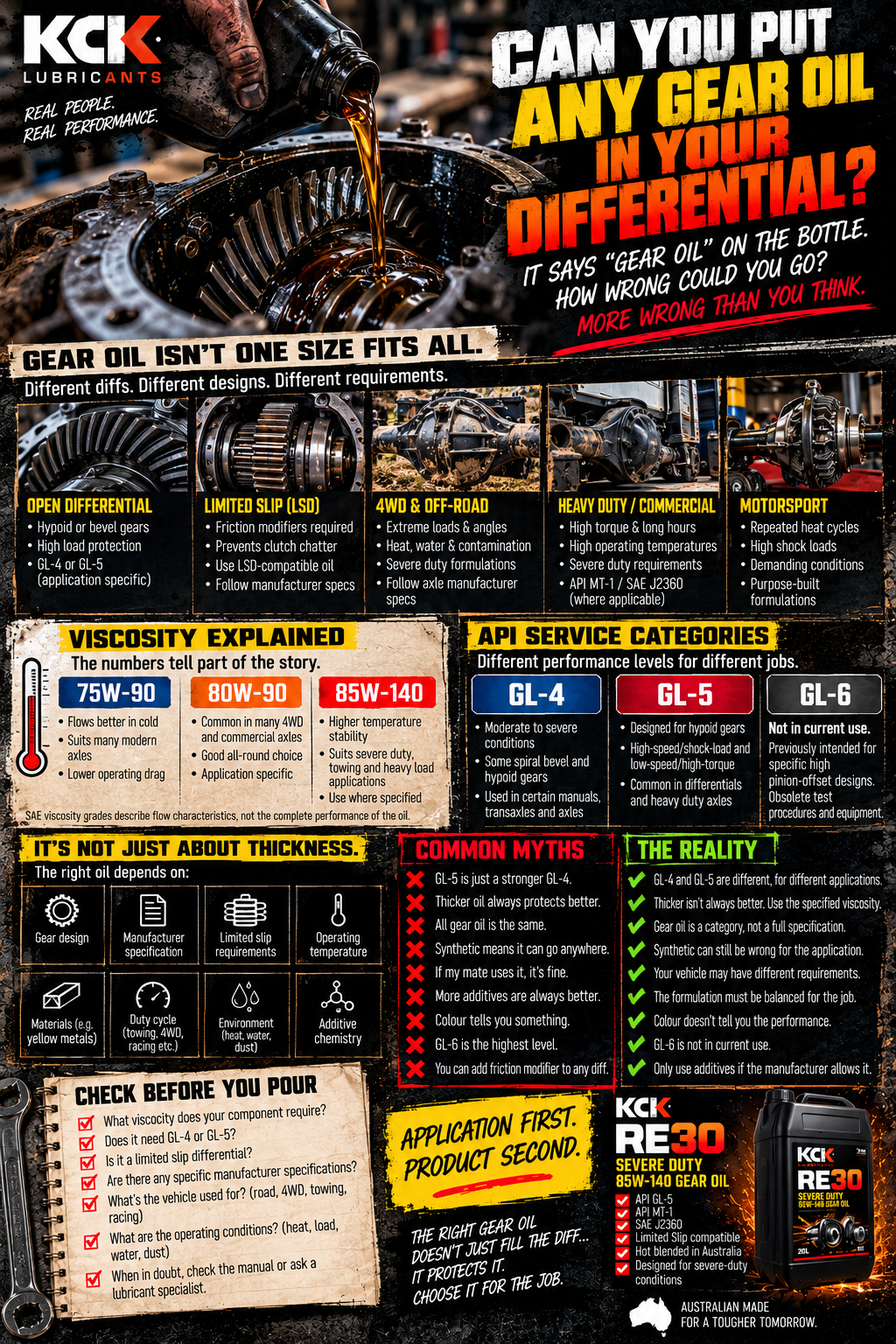
Walk into a workshop and ask someone what gear oil they recommend and you'll probably get an answer pretty quickly.
"Use 85W-140. It's thicker. It'll protect better."
Or perhaps:
"75W-90 is all you need. That's what the manufacturer recommends."
Both might be right.
Both might be wrong.
And that's the problem with the way gear-oil viscosity gets discussed. Somewhere along the way, people started treating the numbers on the bottle as a simple measurement of how good an oil is.
75W-90.
80W-90.
85W-140.
Bigger number. Thicker oil. More protection.
Sounds logical, doesn't it?
Unfortunately, lubricant selection doesn't work quite that way.
Those numbers describe something important about how the oil behaves at different temperatures. But they don't tell you everything about the formulation, the additive chemistry or whether the lubricant is suitable for the component you're putting it into.
After more than 25 years around lubricants, gearboxes, differentials and motorsport, we've had this conversation more times than we can count.
So let's clear it up.
Because once you understand what those numbers actually mean, choosing the right gear oil becomes a whole lot easier.
First, what do the numbers actually mean?
Let's take a familiar example:
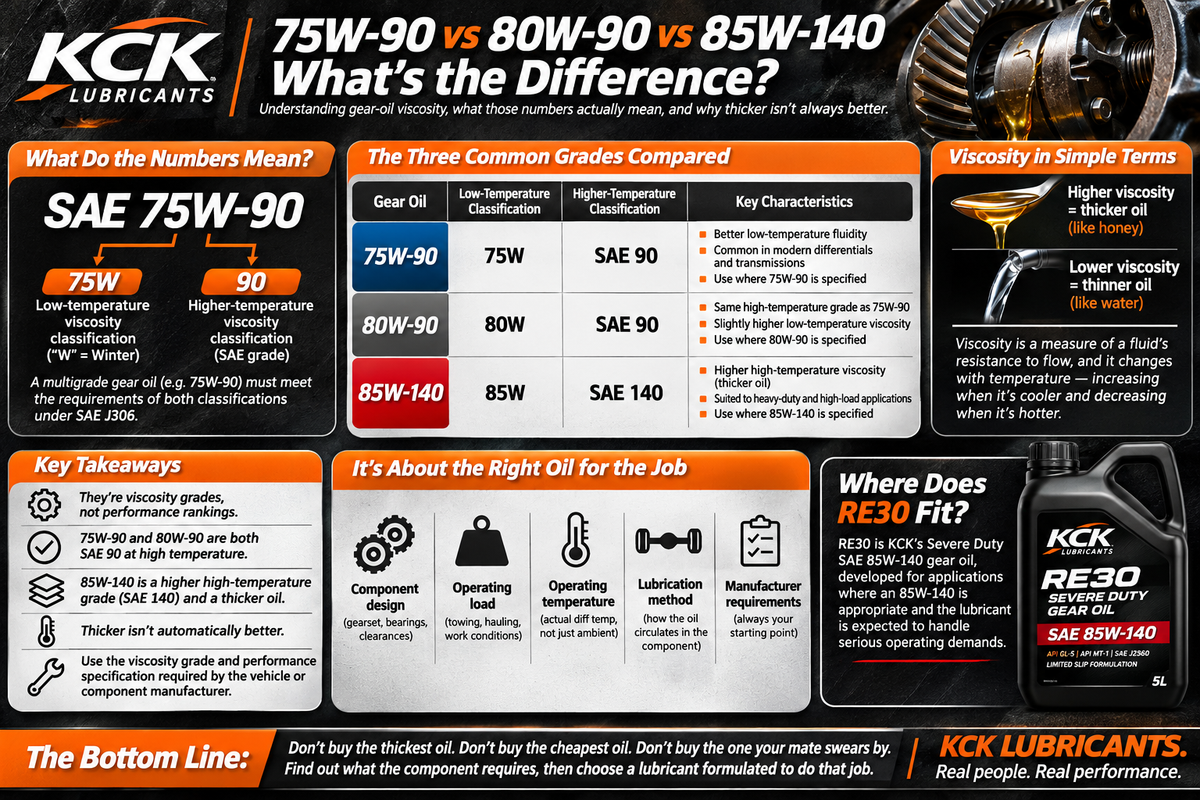
SAE 75W-90
The number is a viscosity classification established under SAE J306, the standard covering automotive driveline lubricant viscosity.
There are two parts to it.
The first part, 75W, describes the lubricant's low-temperature viscosity performance.
The second part, 90, describes its high-temperature viscosity grade, based on the limits and test conditions defined by the standard.
The W stands for winter.
It doesn't mean weight, and it doesn't mean the oil is designed exclusively for cold climates.
It identifies the low-temperature viscosity requirements the lubricant must satisfy.
The second number is the high-temperature viscosity grade.
Put simply, a multigrade gear oil has to meet the requirements of both classifications.
That's why an 80W-90 must satisfy the low-temperature requirements of an 80W grade and the higher-temperature requirements of an SAE 90 grade.
An 85W-140 has to satisfy the requirements of an 85W grade at low temperature and SAE 140 at higher temperature.
Two different parts of the same viscosity classification.
And they're both important.
What does viscosity actually mean?
Viscosity is a measure of a fluid's resistance to flow.
Think about pouring honey compared with pouring water.
Honey flows more slowly because it has a much higher viscosity.
Gear oil behaves in the same basic way.
A higher-viscosity lubricant generally offers greater resistance to flow under comparable conditions.
But here's where things get interesting.
Oil doesn't maintain exactly the same viscosity at every temperature.
As temperature increases, viscosity generally decreases.
As temperature falls, viscosity generally increases.
That's normal lubricant behaviour.
And it's one of the reasons gear-oil formulation is about much more than simply deciding how thick the oil should be.
The lubricant needs to provide suitable flow characteristics when cold while maintaining the viscosity required by the component under operating conditions.
Get that balance wrong and you can create problems at either end of the operating range.
Let's compare the three common gear-oil grades
This is where the numbers start making sense.
75W-90
75W-90 is a multigrade gear oil that meets the low-temperature requirements of the 75W classification and the high-temperature requirements of SAE 90.
It is commonly used in applications where manufacturers specify that viscosity grade.
Its lower-temperature classification can be particularly useful where cold-start fluidity is important.
It's also widely used in modern differentials, manual transmissions and other driveline applications, depending on the required performance specification.
But don't assume that because it's a 75W-90, it's suitable for every gearbox or differential.
The application still determines the requirement.
80W-90
80W-90 meets the low-temperature requirements of 80W and the higher-temperature requirements of SAE 90.
Notice something?
Both 75W-90 and 80W-90 are SAE 90 grades at the higher-temperature classification.
The difference is their low-temperature performance classification.
That doesn't make one universally better than the other.
It means they meet different requirements.
If a component specifies 75W-90, don't automatically substitute 80W-90 because the two oils share the same SAE 90 high-temperature grade.
The manufacturer has specified a complete viscosity grade, not just the second number.
85W-140
Now we're moving into a different high-temperature viscosity classification.
85W-140 meets the low-temperature requirements of 85W and the higher-temperature requirements of SAE 140.
Compared with an SAE 90 grade, SAE 140 has a higher viscosity range under the defined test conditions.
That can be appropriate for components designed to operate with that grade.
Some heavy-duty differentials, commercial axles, 4WD applications and demanding gear-driven equipment specify 85W-140.
But there's a point we want to make very clear:
85W-140 isn't automatically better than 75W-90.
It's a different viscosity grade.
The component needs to be designed or approved for it.
Here's the comparison that matters
| Gear oil | Low-temperature classification | High-temperature classification |
|---|---|---|
| 75W-90 | 75W | SAE 90 |
| 80W-90 | 80W | SAE 90 |
| 85W-140 | 85W | SAE 140 |
The important distinction is that 75W-90 and 80W-90 share the same SAE 90 high-temperature grade, while 85W-140 belongs to a higher high-temperature viscosity grade.
These classifications are defined by SAE J306. They aren't direct measurements of how hot the differential will run, nor are they guarantees of performance in a particular vehicle.
And that brings us to another common misconception.
Does thicker gear oil provide better protection?
This is probably the biggest argument we hear.
Someone has a vehicle doing serious work, so they decide to move to a thicker oil.
The thinking is understandable.
Thicker oil means a stronger oil film, right?
Sometimes viscosity can help maintain film thickness under particular operating conditions.
But that doesn't mean increasing viscosity automatically improves protection.
The lubricant has to be appropriate for the gear design, bearing clearances, operating temperatures, lubrication method and manufacturer's requirements.
Too low a viscosity can compromise the required lubricating film under certain conditions.
Too high a viscosity can increase drag and churning losses, and may not flow or circulate as intended in a component designed around a different grade.
You can actually create problems by using an oil that's unnecessarily thick.
And that's the bit people often overlook.
The goal isn't to use the thickest oil you can find. It's to use the correct viscosity for the job.
A manufacturer doesn't specify 75W-90 simply because they couldn't think of a good reason to use 85W-140.
The component has been designed and validated around particular operating requirements.
Respect that.
Why do differentials use different viscosities?
Because not every differential is doing the same job.
A small passenger vehicle operating under relatively light loads has different requirements from a heavy commercial axle transmitting substantial torque.
A modern 4WD might have a manufacturer-specified 75W-90.
Another vehicle may require 80W-90.
A heavy-duty axle might call for 85W-140.
There are good engineering reasons for those differences.
The design of the gearset matters.
The bearing arrangement matters.
The lubrication method matters.
The operating temperature matters.
The expected load matters.
The manufacturer has to consider all of these factors when specifying the lubricant.
That's why you should never assume that two vehicles using similar differentials will necessarily require the same oil.
And it's why the vehicle or axle specification should always be your starting point.
What about Australian temperatures?
This is where things get particularly relevant to us.
Australia can throw some pretty demanding operating conditions at machinery.
High ambient temperatures.
Long highway distances.
Heavy towing.
Off-road driving.
Mining.
Agriculture.
Commercial transport.
And plenty of vehicles working hard in places where the nearest workshop is a long way away.
It's tempting to assume that because Australia is hot, everybody should be running a thicker gear oil.
But that's not how viscosity selection works.
The ambient temperature is only one part of the equation.
The actual operating temperature of the differential, the component design, the load, the lubrication system and the manufacturer's requirements all matter.
A vehicle operating in hot weather doesn't automatically need a move from 75W-90 to 85W-140.
Likewise, a vehicle towing heavy loads doesn't automatically justify a viscosity change.
Severe-duty operation deserves consideration, but it doesn't cancel out the manufacturer's requirements.
That's an important distinction.
Does 75W-90 always flow better when cold than 80W-90?
Within the SAE J306 classification, 75W has more demanding low-temperature viscosity requirements than 80W.
That's why the 75W classification is associated with better low-temperature fluidity under the standard's test conditions.
But don't confuse the W number with a guaranteed minimum ambient operating temperature.
It isn't a promise that a particular oil will work perfectly at that temperature in every gearbox or axle.
The standard uses defined laboratory test methods.
The actual component, its design and its operating conditions still matter.
And here's another point worth remembering:
An 85W-140 doesn't suddenly become unsuitable just because the weather gets cooler.
It simply has to meet the low-temperature requirements associated with its 85W classification.
Whether that's suitable for a particular vehicle is a separate question.
What happens to viscosity as oil gets older?
Here's where the conversation gets a little more interesting.
Fresh oil has a defined viscosity range.
But lubricants don't live in laboratories.
They live inside machines.
They experience heat, mechanical stress, oxidation, contamination and repeated operating cycles.
Over time, those conditions can change the lubricant's properties.
Depending on the formulation and operating environment, viscosity can increase through oxidation and the formation of degradation products.
It can also decrease through mechanical shear or other forms of degradation.
The important point is that you shouldn't assume the oil in your differential is still behaving exactly as it did when it was new.
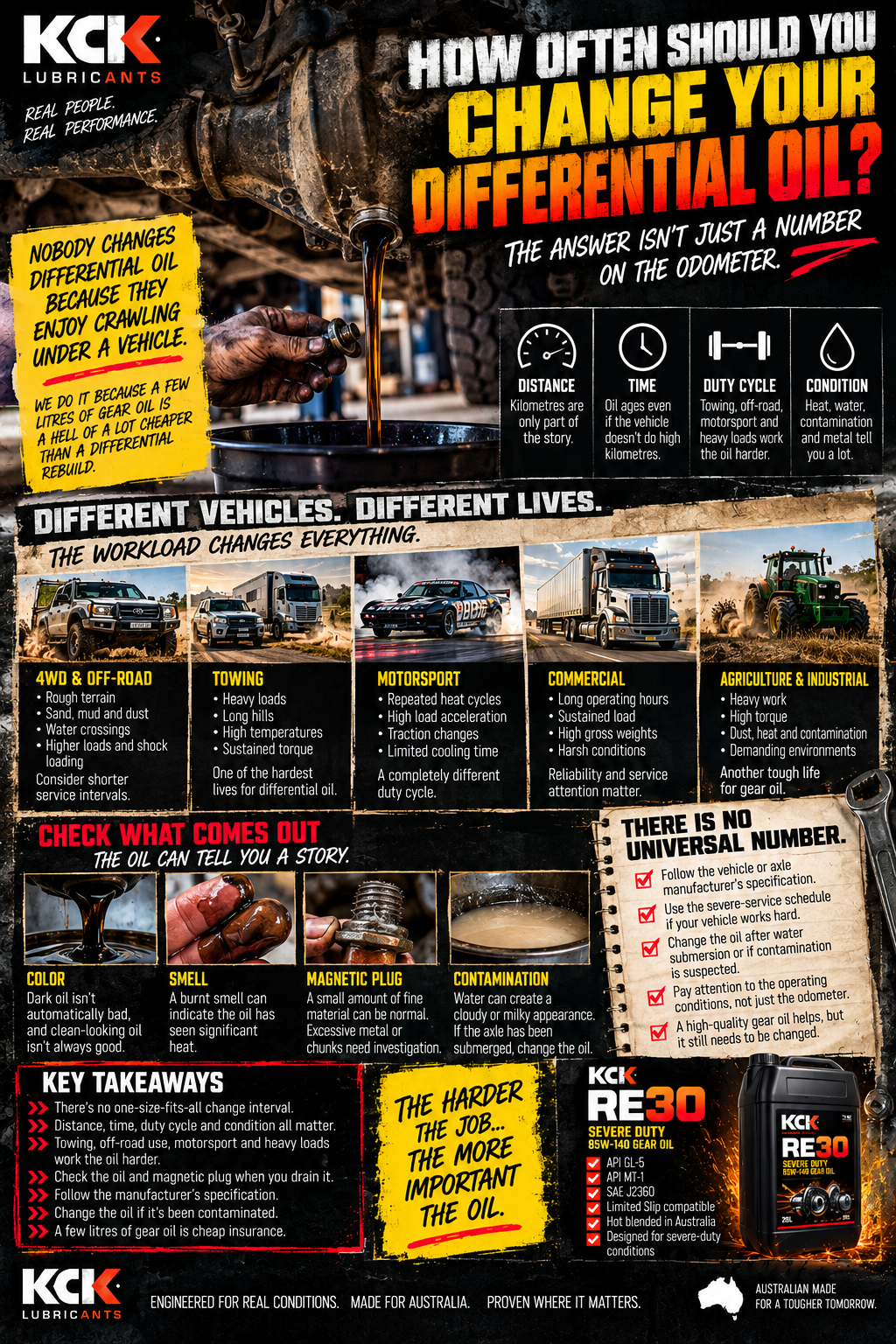
This is one reason service intervals matter.
And it's why simply looking at the colour of the drained oil isn't enough to determine its condition.
Viscosity isn't the same thing as oil quality
This deserves its own section.
Two gear oils can both be labelled 85W-140 and still be very different lubricants.
Why?
Because SAE J306 tells you about viscosity classification.
It doesn't tell you the entire formulation.
It doesn't tell you the complete extreme-pressure capability.
It doesn't tell you how the lubricant handles oxidation.
It doesn't tell you its Limited Slip friction characteristics.
It doesn't tell you everything about corrosion protection, materials compatibility or the additive technology used.
Those characteristics depend on the formulation and the performance requirements the finished lubricant is designed to meet.
You've got base stocks.
EP chemistry.
Anti-wear components.
Oxidation inhibitors.
Corrosion inhibitors.
Foam control.
Friction modifiers where required.
And a whole lot of formulation work bringing those pieces together.
That's why two oils with identical viscosity grades can have very different performance characteristics.
The viscosity tells you how the oil behaves within a defined classification. It doesn't tell you everything the oil can do.
Does synthetic gear oil make a difference?
It can.
But let's not turn this into another marketing argument.
Synthetic base stocks can offer useful characteristics, including strong low-temperature performance and oxidation stability, depending on the base-oil chemistry and finished formulation.
But synthetic doesn't automatically mean better in every application.
Nor does it mean the lubricant is suitable for every component.
You can have a synthetic 75W-90.
You can have a synthetic 85W-140.
And you can have different formulations within either grade.
The finished lubricant still needs to meet the correct performance specification and component requirements.
The base oil is one part of the puzzle.
The additive system and overall formulation are the rest.
Why you shouldn't choose viscosity based on what your mate uses
We see this one all the time.
A bloke has been running 85W-140 in his 4WD for years.
His mate has the same model vehicle and decides he'll use it too.
Sounds reasonable.
Except one vehicle might have a different axle specification, different differential assembly, different operating requirements or a different manufacturer's recommendation.
One might have an aftermarket differential.
One might tow regularly.
One might be used almost exclusively on the highway.
And suddenly the comparison isn't quite as straightforward.
Your mate's experience might be useful.
It isn't a substitute for the component specification.
Same vehicle badge doesn't always mean same lubricant requirement.
So which one should you use?
Let's make this simple.
75W-90
Use it where the vehicle or component manufacturer specifies 75W-90, and where the lubricant meets the required performance specification.
80W-90
Use it where 80W-90 is specified or approved for the application.
85W-140
Use it where the component calls for 85W-140 and the lubricant meets the required performance and manufacturer specifications.
That's the whole point.
You don't select viscosity based on which number looks most impressive.
You select it based on the component's requirements.
And if the vehicle is being used in conditions outside normal service, consult the manufacturer's severe-duty guidance rather than simply choosing a thicker oil.
Where does RE30 fit?
This is where we can bring our own product into the conversation.
RE30 is KCK's Severe Duty SAE 85W-140 gear oil.
It wasn't developed because we thought the world needed another thick gear oil.
There are plenty of those already.
We developed it for applications where an 85W-140 is appropriate and where the lubricant is expected to handle serious operating demands.
Heavy towing.
4WD work.
Commercial transport.
Agricultural and industrial equipment.
Motorsport.
Road-and-race applications.
Around 12 months went into its development, using carefully selected virgin base stocks and advanced additive technology.
It's hot blended and manufactured here in Australia, formulated for Limited Slip applications and developed around demanding performance requirements including API GL-5, API MT-1 and SAE J2360, along with specified axle and manufacturer requirements for applicable applications.
But here's the important part.
RE30 isn't intended to replace every other gear-oil viscosity.
If your differential requires a 75W-90, use the correct 75W-90.
If your application specifies 85W-140, that's where RE30 belongs in the conversation.
We'd rather help someone choose the right lubricant than sell them the wrong one.
That's how we believe this business should work.
The number on the bottle is only the beginning
Let's bring it back to where we started.
75W-90.
80W-90.
85W-140.
They aren't performance rankings.
They aren't temperature settings.
They aren't an indication of which oil is automatically better.
They're viscosity classifications describing how a lubricant behaves under defined test conditions.
And understanding that is the first step towards making a sensible gear-oil selection.
The next step is understanding the performance specification.
Then the application.
Then the formulation.
Because the oil has to do more than simply have the right viscosity when it comes out of the bottle.
It has to protect the component once the gears start turning, the temperature climbs and the workload gets serious.
That's where the real engineering happens.
After 25 years in this game, we've learned that there's a big difference between making oil that fits a specification and understanding what that oil is actually being asked to do.
Don't buy the thickest oil.
Don't buy the cheapest oil.
Don't buy the one your mate swears by.
Find out what the component requires.
Then choose a lubricant formulated to do that job.
Because the differential doesn't care whether the bottle says 75W-90, 80W-90 or 85W-140.
It cares whether you've given it the right oil.
KCK Lubricants.
Real people. Real performance.
Performance isn't created by marketing.
It's created by chemistry.
KCK for Everyone.