
Can You Put Any Gear Oil in Your Differential?
It says “gear oil” on the bottle. How wrong could you go?
More wrong than you think.
Walk into almost any parts store and you'll find a wall of gear oils.
75W-90.
80W-90.
85W-140.
GL-4.
GL-5.
Limited Slip.
Synthetic.
Mineral.
Severe Duty.
Heavy Duty.
Then there are all the manufacturer specifications, axle requirements and numbers that look like somebody threw a chemistry textbook at the label.
And somewhere in the middle of all that, someone inevitably says:
“Mate, it's all gear oil. Just put some in it.”
That's where things can go sideways.
Because gear oil is not one universal fluid.
The viscosity matters.
The performance level matters.
The gear design matters.
The application matters.
The materials inside the component matter.
The differential design matters.
And sometimes the lubricant needs additional friction characteristics that have absolutely nothing to do with how thick the oil feels when you pour it out of the bottle.
So before you grab whatever bottle happens to be sitting on the shelf, let's strip away the confusion.
Because this isn't about finding the best gear oil.
It's about finding the right gear oil.
First things first: “gear oil” isn't a specification
This is probably the biggest misconception we need to kill.
Gear oil is a category.
It isn't a complete specification.
Saying:
“I used gear oil.”
doesn't tell us enough.
It's like saying:
“I put oil in the engine.”
Okay.
What oil?
What viscosity?
What performance level?
What manufacturer requirement?
Same problem.
API's lubricant guidance specifically describes gear-lubricant service designations as a way of selecting lubricants based on gear design and operating conditions. SAE J306, meanwhile, deals with the viscosity classification of automotive driveline lubricants — and SAE is very clear that viscosity classification alone does not describe all the other characteristics of the lubricant.
That distinction is bloody important.
Viscosity tells you one part of the story.
It doesn't tell you the whole story.
Think of gear oil as having a job description
Before choosing a lubricant, you need to know what the component is asking it to do.
Is it a hypoid differential?
A conventional bevel gear axle?
A limited-slip differential?
A manual gearbox?
A transfer case?
A heavy-duty truck axle?
A racing transmission?
An application with specific yellow-metal compatibility requirements?
Different components can place very different demands on the lubricant.
And that's why the manufacturer's lubricant requirement exists.
The oil isn't selected because somebody thinks 85W-140 sounds tough.
It's selected because the mechanical system has a particular lubrication requirement.
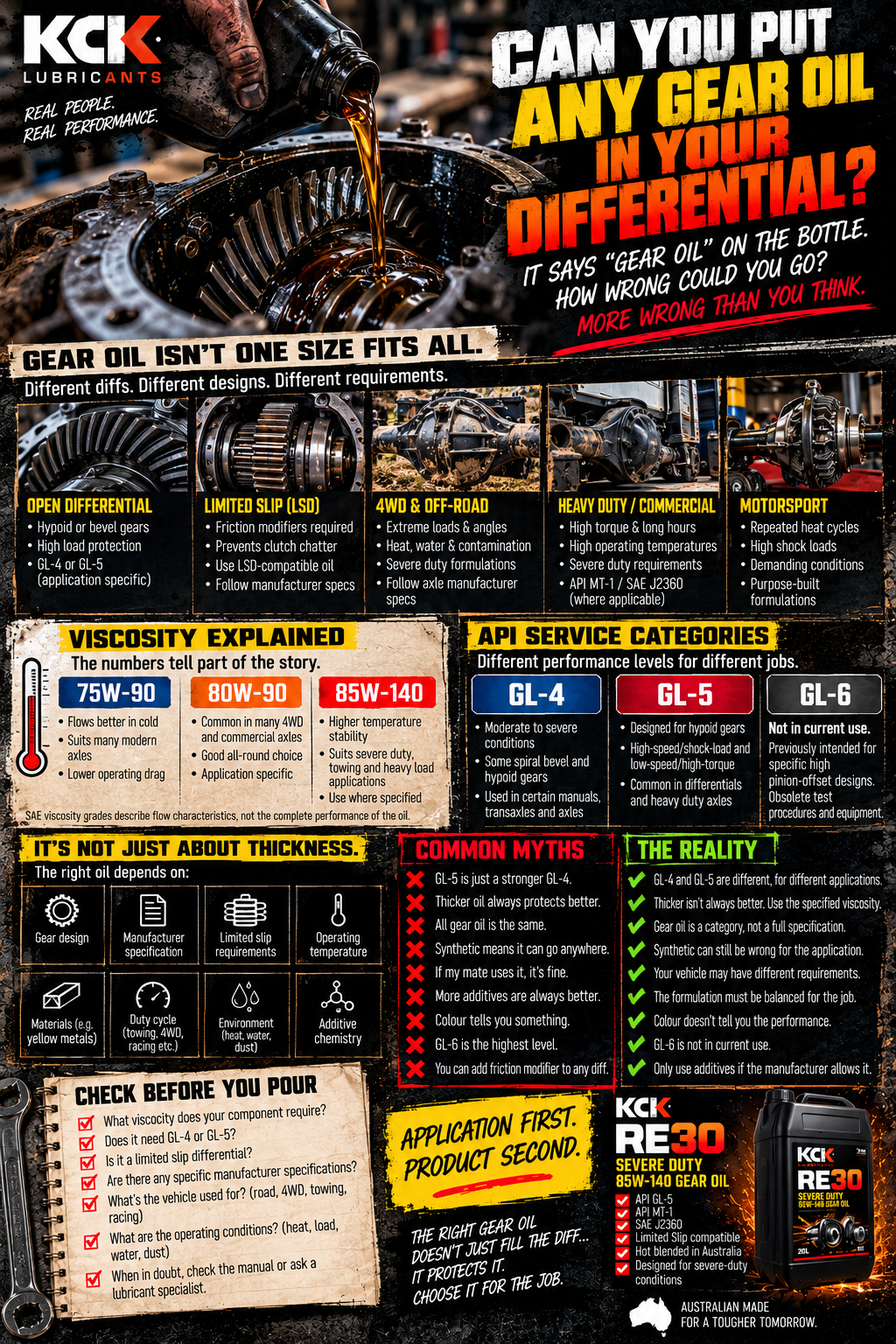
The first trap: viscosity
Let's start with the numbers people recognise.
75W-90.
80W-90.
85W-140.
These are SAE viscosity grades.
They're useful.
Very useful.
But they don't tell you everything about the oil.
SAE J306 is a viscosity classification standard. It classifies automotive gear lubricants according to their rheological characteristics; it does not define all the other performance characteristics a gear lubricant may need.
So when someone says:
“85W-140 is better because it's thicker.”
that's already missing the point.
Thicker isn't automatically better.
Thinner isn't automatically better.
The correct viscosity is the viscosity the application is designed to use.
Thick oil isn't a trophy
This one gets repeated constantly.
Someone wants a heavy-duty lubricant and immediately reaches for the thickest bottle on the shelf.
But viscosity is a design parameter.
Too little viscosity can reduce film thickness under certain operating conditions.
Too much viscosity can increase drag and churning losses and may not be appropriate for the component's design or operating temperature range.
That's why you don't simply substitute an 85W-140 for a manufacturer's specified 75W-90 because:
“Well, 140 must protect better.”
Not necessarily.
The lubricant has to work properly across the operating conditions.
That's engineering.
So what does the “W” actually mean?
The W isn't short for “weight.”
It's part of the SAE viscosity classification and relates to low-temperature behaviour.
The second number describes the lubricant's viscosity classification at the higher-temperature test condition defined by the SAE standard.
So:
75W-90
and
85W-140
aren't simply two different levels of “thickness.”
They represent different viscosity grades intended to cover different operating requirements.
And importantly, SAE J306 is about viscosity classification — not a declaration that one grade is universally superior to another.
That's a distinction worth remembering.
Now we get to GL-4 and GL-5
This is where the internet starts getting messy.
You'll often hear:
“GL-5 is better than GL-4.”
That statement is too simplistic.
GL-4 and GL-5 are different API service designations for different performance requirements and applications.
API describes GL-4 as covering certain spiral-bevel and hypoid applications under specified moderate-to-severe or moderate conditions, while GL-5 is intended particularly for hypoid gears in axles operating under combinations of high-speed/shock-load and low-speed/high-torque conditions.
So the question isn't:
“Which number is bigger?”
The question is:
“Which performance level does my component require?”
That's a much better question.
GL-5 isn't simply “stronger GL-4”
This matters.
A gear lubricant isn't a video game character where GL-5 has simply levelled up from GL-4.
The chemistry and performance requirements are designed around different applications.
GL-5 is particularly associated with demanding hypoid axle service.
GL-4 has applications where its performance level and friction characteristics are appropriate.
And there are applications where the equipment manufacturer specifically calls for one or the other.
So don't treat API categories as a simple ladder where you automatically choose the highest number.
Follow the application requirement.
And what about GL-6?
This one causes even more confusion.
You still see GL-6 mentioned on websites, forums and old technical discussions.
But here's the important bit:
API identifies GL-6 as a service designation that is not in current use.
API's publication explains that GL-6 was intended for certain very high pinion-offset gear designs requiring scoring protection beyond the GL-5 level, but changes in gear design and the obsolescence of the original GL-6 test equipment and procedures greatly reduced its commercial use.
So if someone tells you:
“Just use GL-6 because it's the highest one.”
that's not how this works.
There isn't a modern universal “GL-6 beats everything” rule.
Again:
The application decides.
The second trap: limited-slip differentials
Now we're getting into territory that catches plenty of people.
A Limited Slip Differential isn't necessarily happy with whatever oil you pour into it.
Why?
Because the differential can contain clutch packs or other friction-sensitive mechanisms that require specific friction characteristics.
And this is where friction modifiers can become important.
API specifically notes that axles equipped with limited-slip differentials have additional frictional requirements normally defined by the axle manufacturer.
That's the key.
It's not simply:
“GL-5? Good. Chuck it in.”
You need to know what the LSD requires.
Some lubricants are formulated as Limited Slip compatible.
Some applications require a particular friction-modifier treatment.
Some manufacturers specify a particular lubricant.
Some may specify an additional additive.
And some manufacturers specifically prohibit adding separate additives to their axles.
So don't assume.
Read the requirement.
More additives aren't automatically better either
This is another one worth clearing up.
People sometimes think:
“If the oil needs friction modifier, I'll just pour a bottle of the stuff in.”
Maybe.
Maybe not.
There are applications where the lubricant is already formulated for the required friction behaviour.
There are applications where a manufacturer specifies a particular additive.
And there are applications where adding an aftermarket additive is not recommended.
Dana's published axle service information, for example, has specified applications where separate oil additives and/or friction modifiers are not approved.
So again:
Don't build your own chemistry set under the differential unless the application calls for it.
Then there's the gear design itself
This is where gear oil selection gets really interesting.
A hypoid gearset isn't just a couple of ordinary gears meshing together.
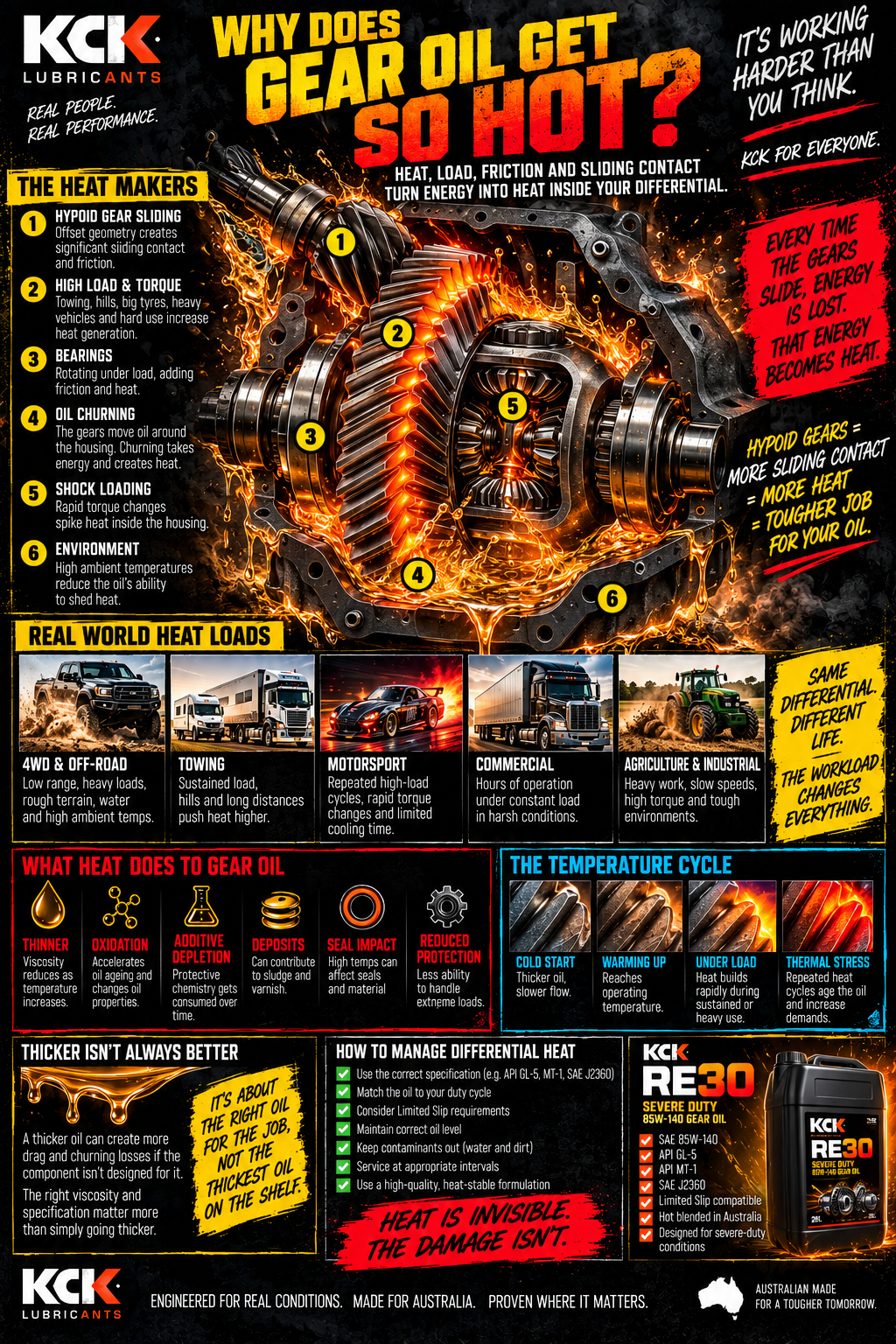
The geometry creates substantial sliding contact between the tooth surfaces.
That creates demanding lubrication conditions.
API's GL-5 description specifically addresses hypoid axle applications involving combinations of high-speed/shock-load and low-speed/high-torque conditions.
That's why EP chemistry becomes so important in these applications.
The lubricant needs to protect the gear surfaces when the contact conditions become severe.
And that's not something you determine by looking at the viscosity number on the front of the bottle.
EP chemistry is where things get serious
Extreme-pressure additives are there to help protect loaded surfaces under conditions where the lubricant film alone may not provide sufficient protection.
They become particularly important in demanding gear applications where the tooth surfaces experience high load and sliding.
But again, EP chemistry isn't simply:
“More is better.”
The chemistry needs to be balanced with the materials, temperatures, seals, friction requirements and overall application.
A formulation is a system.
Changing one component can affect other characteristics.
That's why serious gear lubricant formulation isn't simply throwing every additive you can find into a drum.
Yellow metals change the conversation
Here's where things get really important for some manual transmissions and other components.
Not every gear train is made from the same materials.
Copper alloys, brass, bronze and other yellow-metal components can have different compatibility requirements.
Some additive chemistries that are useful for severe gear protection can be unsuitable for particular materials or applications.
This is one reason you cannot simply look at an EP rating and assume:
“Higher performance = suitable everywhere.”
The component materials matter.
The manufacturer's lubricant requirement matters.
The actual application matters.
This is exactly why lubricant selection is an engineering decision rather than a popularity contest.
“But GL-5 works in everything, right?”
No.
And this is where we really need to kill the internet shortcut.
A GL-5 lubricant may be exactly what a hypoid axle needs.
That does not mean it's automatically the correct lubricant for every manual transmission, transaxle, transfer case or other gear-driven component.
API itself tells users to follow the equipment manufacturer's specific lubricant-quality recommendations.
That's not bureaucratic nonsense.
It's because different components have different lubrication requirements.
The gearbox and differential aren't necessarily asking for the same thing
This catches people with 4WDs all the time.
A vehicle may have:
- Engine oil
- Automatic transmission fluid
- Manual transmission lubricant
- Transfer-case fluid
- Front differential oil
- Rear differential oil
And those fluids may all be different.
Even if two components both contain gears, that doesn't mean they use the same lubricant.
A manual gearbox may contain synchronisers.
A differential may contain hypoid gears.
A transfer case may have its own friction and material requirements.
An automatic transmission is a completely different animal again.
“They all have gears” isn't a lubricant specification.
The third trap: “synthetic means it can go anywhere”
Nope.
Synthetic base oils can provide valuable performance characteristics, including strong thermal and oxidation stability depending on the formulation.
But synthetic doesn't automatically mean universal compatibility.
You can formulate a synthetic 75W-90.
You can formulate a synthetic 85W-140.
You can formulate a synthetic lubricant for one application that is completely wrong for another.
The base oil is one part of the formulation.
The finished lubricant has to meet the requirements of the component.
Base oil isn't the whole story
This is something we've talked about throughout the KCK story.
Two bottles can both say:
75W-90
and still be very different lubricants.
Why?
Because viscosity grade doesn't define the entire formulation.
You've got:
- Base oil selection
- Additive chemistry
- EP system
- Anti-wear chemistry
- Corrosion protection
- Oxidation control
- Foam control
- Friction characteristics
- Seal compatibility
- Thermal stability
- Shear stability
- Application-specific performance
That's a lot more than two numbers and a letter.
SAE J306 specifically focuses on viscosity classification, while API service designations address performance requirements for particular gear-lubricant applications.
That's why reading the whole label matters.
Manufacturer specifications are there for a reason
This is the boring answer.
And it's also the correct one.
Read the manual.
If the manufacturer specifies:
SAE 75W-90, API GL-5
that's what you're looking for.
If it specifies:
SAE 85W-140
then that's the viscosity requirement.
If it specifies a particular OEM approval or manufacturer specification, don't assume that an oil with a similar-looking API classification automatically meets the same requirement.
And if it's an LSD?
Check the friction requirements.
If it's a racing gearbox?
Check the gearbox manufacturer's requirements.
If it's a heavy truck axle?
Check the axle manufacturer's lubricant specification.
This is one area where five minutes with the service documentation can save you a very expensive lesson.
What about severe-duty applications?
Now we're getting into familiar KCK territory.
Because there's a big difference between:
“Will this oil work?”
and:
“What does this oil have to survive?”
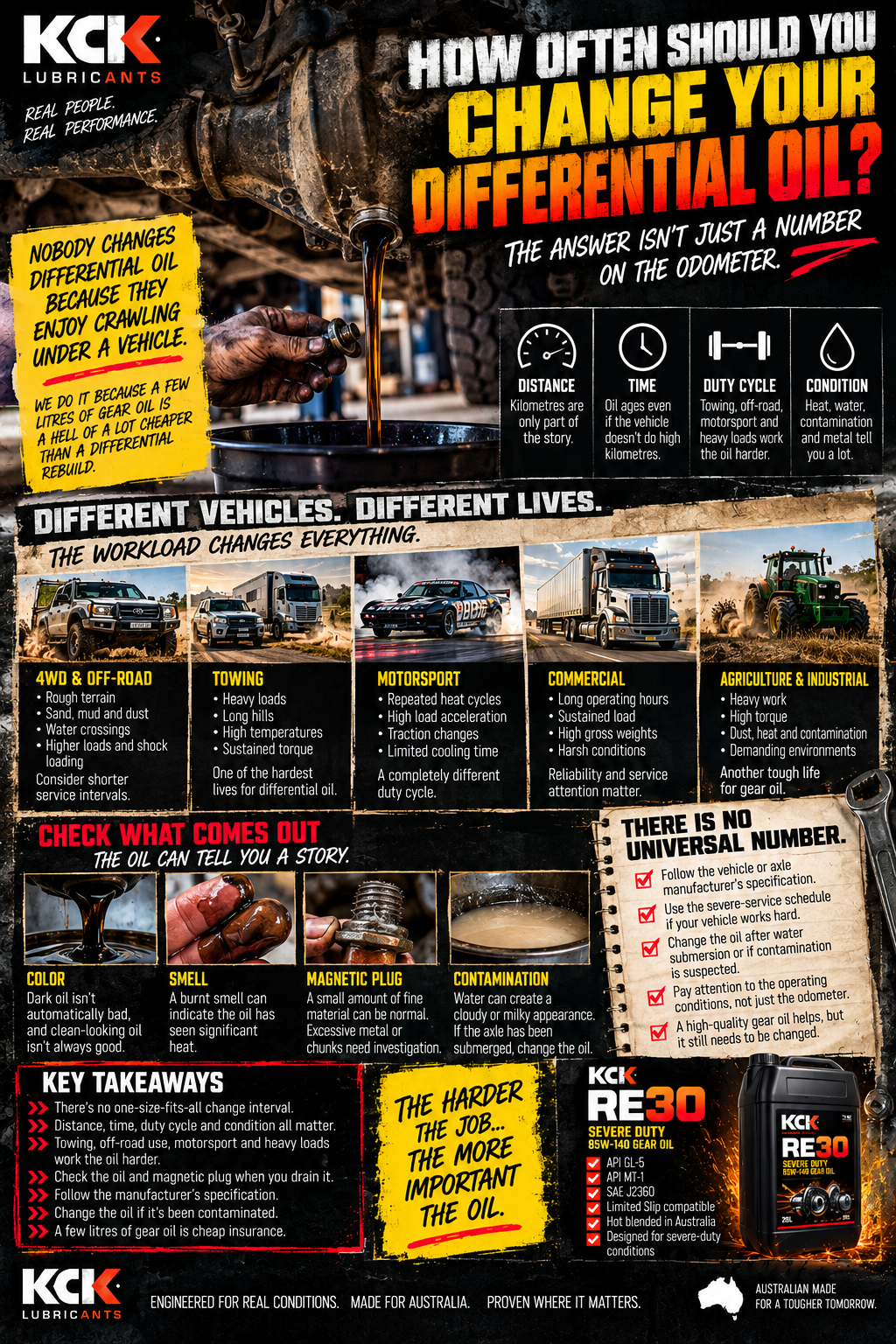
A differential in a lightly loaded commuter vehicle has a different life from:
- A 4WD crawling through sand
- A vehicle towing a heavy trailer
- A commercial truck running at high gross weight
- An agricultural machine working under sustained load
- A race car going through repeated heat cycles
The lubricant requirement still needs to match the component.
But the operating environment becomes an important part of the formulation and maintenance discussion.
SAE J2360, for example, is specifically concerned with demanding gear-lubricant performance and includes applications involving severe hypoid gear service. API notes that J2360-approved lubricants satisfy API GL-5 requirements and adds performance requirements beyond GL-5 in areas such as elastomer compatibility and gear cleanliness after oxidation.
That's what we mean by severe duty.
Not a sticker.
A requirement.
So where does 85W-140 fit?
This is where we can bring our own product into the conversation without turning this article into an advertisement.
85W-140 is a legitimate SAE viscosity grade.
It's used in applications where that viscosity is specified or appropriate.
And there are plenty of serious applications where a robust 85W-140 makes sense.
But we're not going to tell someone:
“Got a diff? Use 85W-140.”
That's exactly the sort of oversimplification this article is trying to eliminate.
Use 85W-140 where the application calls for it.
That's the rule.
This is why we built RE30
RE30 is our severe-duty 85W-140 gear oil.
It was developed around applications where we know the workload can get serious.
4WD.
Heavy towing.
Commercial vehicles.
Heavy-duty equipment.
Motorsport.
Road-and-race applications.
It is formulated to meet requirements including:
API GL-5
API MT-1
SAE J2360
along with specific manufacturer and axle requirements, and it is Limited Slip compatible.
But here's the bit I want to make clear:
We don't think RE30 should go into every differential on the planet.
That's not how proper lubricant selection works.
If your vehicle calls for a 75W-90 GL-5, use the appropriate 75W-90 GL-5.
If it calls for 85W-140, that's where an 85W-140 such as RE30 becomes relevant.
If the component requires a particular OEM specification, make sure the lubricant actually meets it.
That's how you select oil.
Application first. Product second.
Don't choose oil by the colour
Yes, we still have to say this.
Somebody will always say:
“Mate, that oil looks good.”
Brilliant.
What's the specification?
Another will say:
“This one's thicker.”
Okay.
What's the specification?
Someone else:
“This one says racing.”
Fantastic.
What's the specification?
The colour of the oil doesn't tell you what the differential needs.
The marketing words don't tell you what the differential needs.
The size of the bottle doesn't tell you what the differential needs.
The component specification tells you what the differential needs.
Don't choose it because your mate uses it
Your mate's Hilux isn't necessarily your Patrol.
His LSD isn't necessarily your LSD.
His axle isn't necessarily your axle.
His duty cycle isn't necessarily yours.
His manufacturer specification isn't necessarily yours.
He might tow once a year.
You might tow three trailers every week.
He might drive to the pub.
You might race on Saturday and tow home Sunday.
Same bottle?
Maybe.
Maybe not.
The application comes first.
Don't assume “GL-5” tells you everything
This is another subtle but important point.
Even when two lubricants carry the same API performance category, you still need to consider:
Viscosity.
Manufacturer approvals or requirements.
Limited-slip friction requirements.
Material compatibility.
Operating temperature.
Duty cycle.
Other component-specific requirements.
A performance category is important.
It isn't a magic key that unlocks every differential.
What should you actually look for on the bottle?
Here's the simple version.
Before buying gear oil, identify:
1. The required viscosity
75W-90?
80W-90?
85W-140?
Something else?
2. The required performance level
GL-4?
GL-5?
Another specific specification?
3. The manufacturer requirement
Does the axle or gearbox require a particular OEM specification?
4. Limited-slip requirements
Does the component need a particular friction characteristic or LS-compatible lubricant?
5. The application
Road car?
4WD?
Towing?
Commercial?
Motorsport?
Severe duty?
6. The operating environment
Heat?
Cold?
Water?
Dust?
Heavy load?
Long hours?
High torque?
Once you've answered those questions, you're no longer guessing.
You're selecting.
And if you're still unsure?
Ask.
Seriously.
This is one of those areas where there's no prize for pretending you know.
Give the lubricant supplier the exact vehicle, axle, gearbox or differential information.
Give them the manufacturer's required specification.
Tell them how the vehicle is actually used.
A good lubricant supplier should be interested in those details.
Because the right answer isn't always the oil you hoped it would be.
Sometimes the right answer is:
“Don't use ours. Your application needs something else.”
That's good lubricant advice.
The KCK way
We've never believed that selling oil means putting the same bottle into every machine we can find.
That's not engineering.
That's merchandising.
We've spent 25 years around engines, gearboxes, differentials, race cars, trucks, 4WDs and machinery.
We've seen what happens when lubrication is treated as an afterthought.
We've also seen what happens when the lubricant is selected properly for the job.
The lesson is pretty simple.
Don't buy the biggest number.
Don't buy the thickest oil.
Don't buy the loudest label.
Don't buy it because your mate uses it.
Find out what the component actually requires.
Then find a lubricant formulated to meet that requirement.
So, can you put any gear oil in your differential?
Technically?
No.
And that's the whole bloody point.
A gear oil needs to be right for the:
viscosity requirement.
performance requirement.
gear design.
materials.
friction characteristics.
manufacturer specification.
and operating conditions.
That's why the words “gear oil” on the front of the bottle are only the beginning of the conversation.
The oil might look similar.
The bottles might sit next to each other on the shelf.
The numbers might even look close.
But inside the differential, the chemistry has a job to do.
And it doesn't get a second chance.
The simple KCK rule
If you remember nothing else from this article, remember this:
Don't choose gear oil by what it is.
Choose it by what the machine needs.
That's the difference between pouring oil into a differential...
and actually selecting a lubricant.
Because when the gears are loaded, the temperature is climbing and the machine is earning its keep, the differential doesn't care what the marketing department printed on the bottle.
It cares whether the lubricant is right for the job.
KCK Lubricants.
Real people. Real performance.
25 years of learning where oil gets tested hardest.
Performance isn't created by marketing.
It's created by chemistry.
KCK for Everyone.