
How Often Should You Change Your Differential Oil?
The answer isn't simply a number on the odometer — your differential's workload matters
Nobody changes differential oil because they enjoy crawling underneath a vehicle.
Nobody wakes up on Saturday morning thinking:
“Bloody hell, I can't wait to spend the afternoon draining diff oil.”
We do it because the alternative can be considerably more painful.
A few litres of gear oil is cheap.
A differential rebuild isn't.
And yet differential oil is probably one of the most neglected lubricants in the average vehicle.
Engine oil gets changed religiously.
Transmission fluid gets talked about.
Coolant gets checked.
Brake fluid gets attention.
The differential?
“Yeah mate, it'll be right.”
Maybe.
But maybe it won't.
Because the right question isn't simply:
“How many kilometres has the vehicle done?”
It's:
“What has that differential been asked to do?”
And that's where this gets interesting.
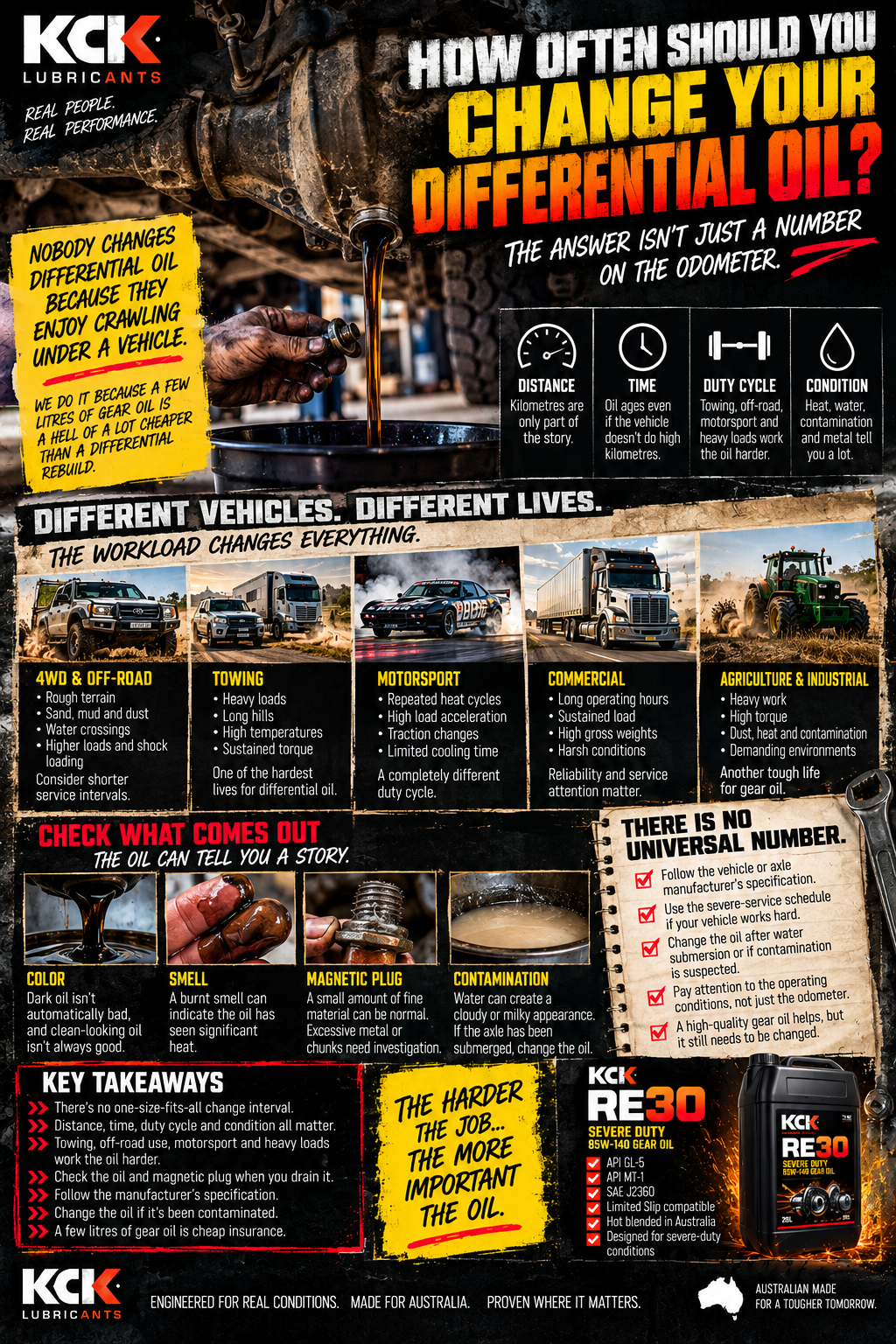
There is no magic number
Let's kill this one straight away.
There is no universal:
“Change your differential oil every 50,000 km.”
It doesn't work like that.
Different vehicles have different axle designs, oil capacities, specifications, operating temperatures, loads and manufacturer service schedules.
Some manufacturers specify very long intervals under normal use.
Others specify more frequent servicing under severe conditions.
Some applications may not call for a routine change under certain normal operating conditions, but require attention if the axle has been submerged or a leak is suspected.
Ford's published service information provides a good example of how much this can vary: one schedule specifies much shorter rear-axle intervals for prolonged towing in warm conditions when using non-synthetic fluid, while allowing a substantially longer interval with the specified 75W-140 synthetic fluid. Other Ford manuals specify checking or changing axle fluid after water submersion rather than on a simple kilometre schedule.
That's why we're not going to make up a number and tell you it's gospel.
Your vehicle manufacturer's specification comes first.
But that doesn't mean severe use can be ignored.
Far from it.
So what actually determines the service interval?
Think about four things:
Time.
Distance.
Duty cycle.
Condition.
Distance is only one piece of the puzzle.
A vehicle that has travelled 50,000 km towing a heavy trailer through hills and heat may have worked its differential considerably harder than a vehicle that's travelled 100,000 km doing mostly easy highway kilometres.
Same odometer.
Completely different life.
That's the bit people often miss.
Normal use and severe use are not the same thing
This distinction is critical.
A vehicle cruising around town, doing occasional highway trips and carrying light loads is living a relatively easy life.
Now compare that with:
- Heavy towing
- Regular trailer work
- Long mountain climbs
- Off-road driving
- Sand
- Mud
- Water crossings
- High ambient temperatures
- Commercial operation
- Heavy payloads
- Motorsport
- Repeated acceleration and shock loading
- Long periods under high torque
That's a completely different workload.
And manufacturers recognise this.
Ford, for example, explicitly identifies heavy loads and towing, along with extreme temperatures and other demanding conditions, as severe-service conditions in its maintenance information.
So if your vehicle works hard, don't compare its service life to the bloke who drives his to the shops twice a week.
Heat changes the equation
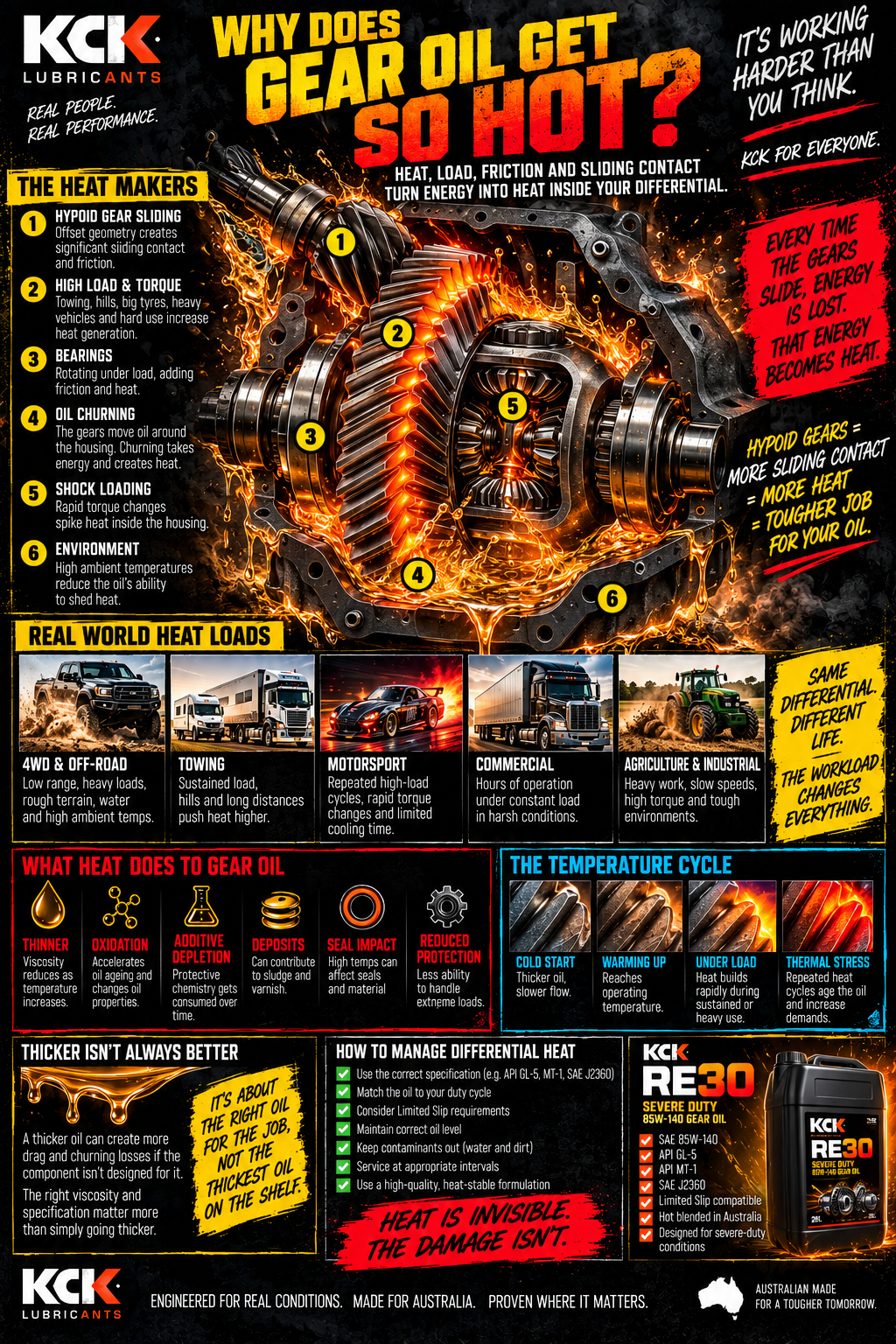
We've already covered this in Part 6.
Your differential generates heat.
That's normal.
But sustained load, towing, high ambient temperatures and repeated heavy operation can increase the thermal stress placed on the lubricant.
And heat isn't just about viscosity.
Over time, elevated temperature contributes to lubricant ageing and oxidation.
The lubricant is being chemically and mechanically worked every time the differential operates.
The harder the duty cycle, the harder the oil has to work.
This is one reason severe-duty applications deserve more attention than simply following the easiest possible interpretation of a service interval.
Towing is one of the big ones
This is where a lot of 4WD and work-truck owners need to pay attention.
When you tow a serious load, the engine works harder.
The transmission works harder.
The driveline works harder.
And the differential is transmitting the torque required to move that extra mass.
Do that up a long hill in high ambient temperatures and the differential is living a very different life from the same vehicle running empty on flat roads.
Ford's service information illustrates this nicely: one published schedule calls for rear-axle fluid changes at 48,000 km under prolonged trailer towing in temperatures above 21°C when using non-synthetic fluid, while allowing a much longer interval when the specified synthetic 75W-140 is used.
That's not us saying:
“Everyone needs to change their diff oil every 48,000 km.”
It's the exact opposite.
It's an example of why duty cycle and lubricant specification matter.
Water changes the game completely
If there's one thing we really want 4WD owners to remember, it's this:
Water in your differential oil is not part of the formulation.
A water crossing can turn a perfectly healthy differential into a contamination problem.
Depending on the vehicle design and circumstances, water can enter through breathers, seals or other paths.
And once it's in there, you don't want to leave it sitting around hoping it'll magically disappear.
Some manufacturers explicitly call for axle-fluid attention following water submersion. Ford's current service information includes axle-fluid checks after submersion, while other manufacturer documentation warns that water contamination can reduce the life of driveline components.
This is why a vehicle that has been through a serious water crossing deserves different treatment from one that's never left the bitumen.
The kilometre count doesn't tell you that story.
The vehicle owner does.
Off-road work is hard on differentials
Off-road driving brings several variables together.
Traction changes.
Wheel speeds change.
Loads change.
The vehicle may be climbing, descending, bouncing and twisting.
The differential can see sudden changes in torque as grip comes and goes.
Then throw mud, dust, sand and water into the environment.
It's not necessarily the hardest thing a differential can experience, but it's certainly not the easy life.
And if the vehicle regularly sees that sort of work, servicing the differential should be part of the routine rather than something you remember after hearing a strange noise.
Motorsport is a different animal again
Here's where my own motorsport brain wants to take over.
A race car can put a differential through repeated heat cycles and high-load events that a road vehicle may never experience.
Hard acceleration.
Corner exit.
Traction changes.
Shock loads.
Repeated laps.
Heat.
Then do it again.
And again.
There may be very little recovery time between those events.
That's why race teams don't generally treat lubricant condition as an afterthought.
The duty cycle is completely different.
And while you can't simply take a race-car service interval and apply it to a road car, the principle is useful:
The harder you work the component, the more seriously you should think about lubricant condition.
Heavy trucks have their own version of punishment
A heavy truck may not see the same violent heat cycles as a race car.
Instead, it can see something arguably more relentless:
sustained load.
Hour after hour.
Day after day.
Towing.
Hauling.
Long grades.
High gross weights.
High ambient temperatures.
The differential doesn't get to have a coffee break.
It's transmitting torque continuously.
That's why severe-duty gear lubrication is relevant well beyond 4WDs and motorsport.
It's equally relevant to the commercial and industrial world.
The oil coming out can tell you a story
Here's where changing the oil gets interesting.
Don't just pull the plug, walk away and throw the old oil in the waste drum.
Look at it.
Smell it.
Pay attention to what comes out.
Now, before we go too far:
Oil colour by itself isn't a laboratory diagnosis.
Dark oil doesn't automatically mean it's dead.
Clean-looking oil doesn't automatically mean it's perfect.
But changes in appearance, unusual odour, contamination, water, excessive debris or visible metallic particles can all be reasons to investigate further.
And if there's a magnetic drain plug?
Have a look at it.
A small amount of fine ferrous material may not automatically mean catastrophe.
A significant amount of metal, chunks, unusual debris or obvious signs of distress are another story.
If something looks wrong, don't just pour new oil in and pretend you didn't see it.
Find out why.
Water has a tell
Water contamination can sometimes produce a noticeably cloudy or milky appearance, depending on how much water is present and how the lubricant has been agitated.
But again, don't rely on appearance alone.
If you know the differential has been submerged, treat that as useful information in itself.
You don't need to wait for the oil to look like a cappuccino before taking contamination seriously.
What about a burnt smell?
A strong abnormal odour can be another clue that the lubricant has seen significant thermal stress.
But again, we're not going to pretend you can diagnose a differential by taking a sniff and announcing:
“Yep, that's exactly 143°C worth of abuse.”
You can't.
Oil condition assessment is more complicated than that.
The point is to pay attention to changes and investigate anything that looks or smells abnormal.
The drain plug is worth looking at
If your differential has a magnetic drain plug, it can provide another useful visual check during servicing.
The magnet exists for a reason.
It captures ferrous particles circulating in the lubricant.
Some fine material can accumulate through normal wear.
But a large amount of metallic debris or unusual fragments should get your attention.
A differential is full of expensive precision-machined components.
If it's suddenly shedding a lot of metal, that's not the time to shrug and say:
“Beauty, free glitter.”
That's the time to investigate.
What if the oil still looks good?
This is where people sometimes get caught.
They drain the oil.
It looks reasonably clean.
They think:
“See? Didn't need changing.”
Not necessarily.
Lubricant condition isn't determined by colour alone.
The oil can have experienced heat, oxidation, additive depletion, contamination and mechanical stress without looking dramatically different to the naked eye.
That's why service intervals exist.
They're not based entirely on whether the oil looks dirty.
They're based on the expected operating conditions and the manufacturer's understanding of the component and lubricant.
Don't confuse lubricant life with component life
This is another important distinction.
A good gear oil can provide strong protection and remain stable under demanding conditions.
That doesn't mean the component itself is immortal.
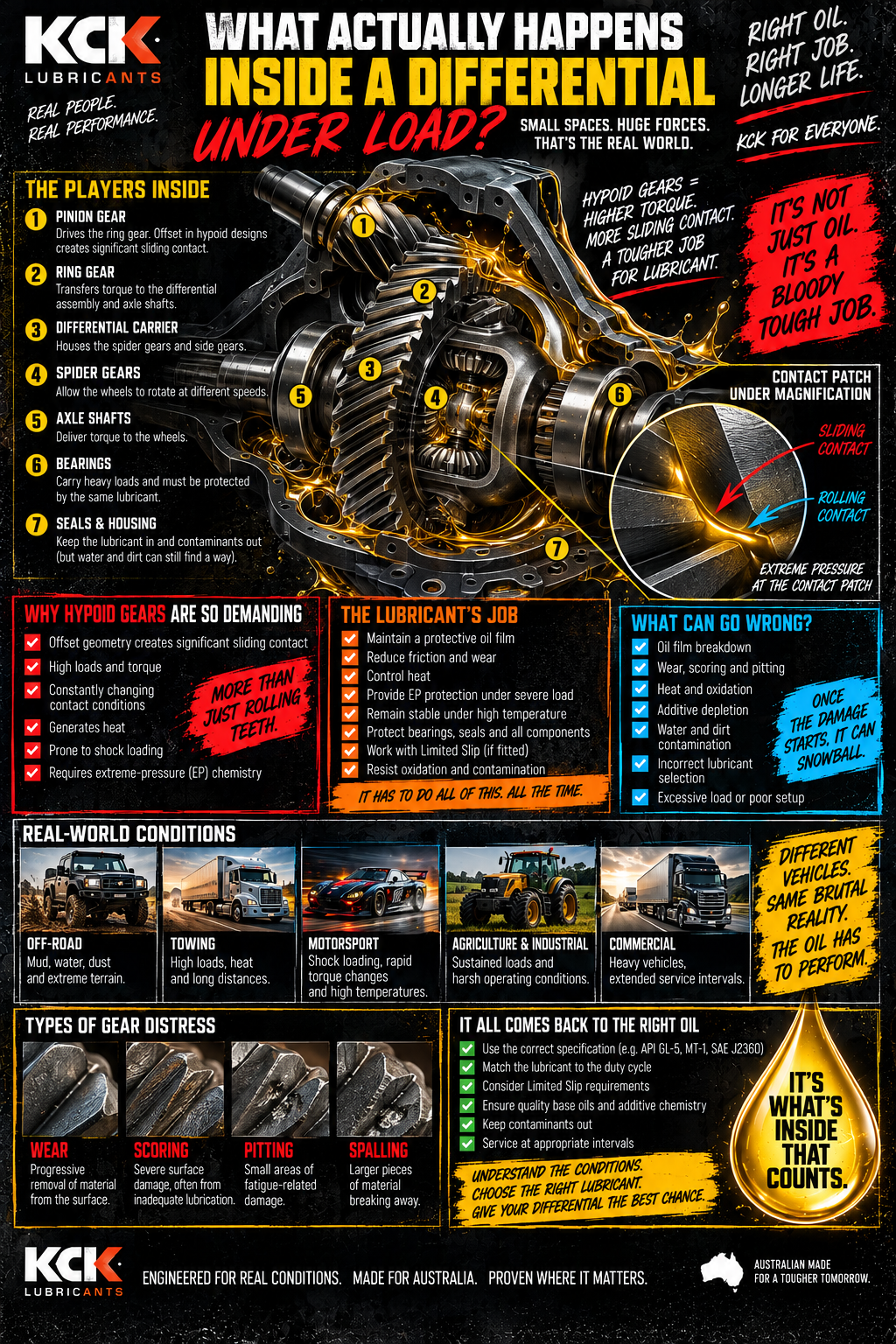
Bearings wear.
Seals age.
Gear alignment matters.
Tooth surfaces can suffer damage.
Overloading can cause problems.
Poor setup can destroy hardware.
Changing the oil doesn't repair mechanical problems.
It gives the mechanical system the lubricant it was designed to operate with.
That's it.
And that's bloody important.
So should you change it more often than the manufacturer says?
This is where we need to be sensible.
Not automatically.
If the manufacturer specifies a particular lubricant, specification and service interval for your vehicle, that's the starting point.
Don't throw that out because somebody on Facebook reckons every diff needs fresh oil every 10,000 km.
But if your vehicle operates in conditions that the manufacturer classifies as severe service, follow the severe-service schedule.
And if you've introduced an event that can contaminate the lubricant — particularly water intrusion — don't simply wait for the next scheduled service.
That's the difference between maintenance based on the machine's actual life and maintenance based purely on the odometer.
What about a better-quality gear oil?
Here's where things get interesting.
A high-quality lubricant can be formulated for demanding operating conditions and may offer stronger resistance to heat, oxidation, wear and other forms of lubricant stress.
But don't confuse that with:
“Better oil means I never have to change it.”
That's rubbish.
A premium lubricant isn't a force field.
If the manufacturer says service it, service it.
If the axle has been submerged, deal with the contamination.
If the oil is contaminated, replace it.
If the component is failing, fix the component.
Good oil is part of a maintenance strategy.
It isn't a replacement for one.
This is where RE30 fits
This is exactly the environment we had in mind when we developed RE30.
We wanted a severe-duty 85W-140 gear oil that could bridge the gap between the traditional heavy-duty world and the road-and-race customer looking for more from their lubricant.
RE30 is built around carefully selected virgin base stocks and advanced additive technology, then hot blended and manufactured here in Australia.
It's designed for demanding applications including:
4WD and off-road use.
Heavy towing.
Commercial trucks.
Industrial and agricultural equipment.
Motorsport.
Road-and-race applications.
And it is formulated for Limited Slip applications.
It meets or exceeds a broad range of requirements, including API GL-5, API MT-1 and SAE J2360, along with a range of manufacturer and axle specifications.
But none of that changes the basic rule:
Use the correct specification for the component and service it appropriately.
That's the responsible way to do it.
There is no prize for leaving old oil in the diff
This might be the simplest message in the whole article.
If your differential has done its job for years, don't assume the lubricant inside it is still at day-one condition.
The oil has been heated.
Worked.
Churned.
Loaded.
Possibly contaminated.
And chemically aged.
If the vehicle works hard, that process can happen faster.
Changing the oil isn't glamorous.
It doesn't make the vehicle sound faster.
It doesn't add horsepower.
Nobody is going to see your fresh diff oil at the car meet and give you a trophy.
But it can be one of the cheapest forms of insurance you can buy for an expensive mechanical assembly.
Think about the job, not just the kilometres
Here's how I'd look at it.
Sunday cruiser
Mostly easy road use?
Follow the manufacturer's normal schedule.
Daily 4WD
Regular road use with occasional off-road work?
Follow the manufacturer's schedule and pay attention to the actual conditions.
Serious off-roader
Regular mud, sand, water crossings and heavy terrain?
The manufacturer's severe-use guidance becomes much more important, and water contamination needs immediate attention.
Heavy towing vehicle
Frequent towing, long hills, high temperatures and heavy loads?
Treat it as the serious workload it is.
Commercial truck
Long operating hours and sustained load?
Service according to the manufacturer's commercial/severe-duty requirements.
Race car
Repeated heat cycles, high loads and competition use?
Don't treat it like a commuter car.
The duty cycle is fundamentally different.
The real answer to "when should I change it?"
Here it is.
When the manufacturer says to.
Sooner when the operating conditions demand it.
Immediately when contamination or a problem is suspected.
That's a much better answer than throwing a universal kilometre figure at everyone.
Because a differential doesn't live its life in kilometres.
It lives its life in:
load.
heat.
time.
torque.
contamination.
shock.
and duty cycle.
That's what determines how hard the lubricant has been worked.
Don't wait for the differential to complain
The problem with differential oil is that it usually doesn't give you much warning.
There isn't necessarily a dashboard light saying:
“Hey mate, I'm getting a bit tired in here.”
It just keeps working.
Until it doesn't.
And once a differential starts making noises, you've potentially moved from a maintenance conversation into a repair conversation.
That's why preventative maintenance makes so much sense.
Fresh, correctly specified lubricant is cheap compared with gears, bearings, seals, labour and downtime.
Especially when that differential is attached to a vehicle that earns its living.
The KCK way
We've spent 25 years around engines, gearboxes, differentials, race cars, workhorses and people who aren't particularly interested in babying their machinery.
We've learned that machinery doesn't care about marketing.
It cares about conditions.
And oil has to be ready for those conditions.
That's why we don't believe in making sweeping promises like:
“This oil lasts X kilometres in everything.”
That's marketing.
The right question is:
What is the machine doing?
Then:
What does the manufacturer specify?
Then:
What conditions has the lubricant actually experienced?
That's how you make a sensible decision.
A differential rebuild is a hell of a lot more expensive
Let's finish where we started.
Nobody changes differential oil because it's fun.
You change it because you've got something expensive underneath the vehicle that you'd rather keep working.
A few litres of the correct gear oil.
A little time.
A service.
A look at what comes out.
Maybe a magnetic drain plug covered in a bit of fine material.
Maybe perfectly clean oil.
Maybe you find something that needs attention before it becomes a much bigger problem.
That's preventative maintenance.
It's not exciting.
It's not sexy.
But neither is replacing a ring and pinion on a Sunday afternoon when the vehicle was supposed to be towing the boat on Monday.
Look after the oil.
Look after the differential.
And the differential has a much better chance of looking after you.
That's the whole bloody point.
KCK Lubricants.
Real people. Real performance.
Performance isn't created by marketing.
It's created by chemistry.
KCK for Everyone.