
Why Does Gear Oil Get So Hot?
The heat problem inside your differential — and why a hard-working gear oil can be cooking long before you know there's a problem
Here's something worth thinking about.
Your differential doesn't need to be broken to be getting bloody hot.
In fact, when it's doing exactly what it was designed to do, it's generating heat.
Every time the gears mesh, there is friction.
Every time those hypoid teeth slide across each other, energy is lost as heat.
The bearings contribute.
The oil itself gets churned around inside the housing.
Then add vehicle weight, towing, hills, big tyres, high ambient temperatures, off-road work, motorsport or commercial loads.
Suddenly that little housing under the vehicle is doing a hell of a lot of work.
And sitting in the middle of it all is the gear oil.
Its job isn't simply to be "slippery."
It has to lubricate, protect, manage heat, survive pressure, handle sliding contact, support the additive system and keep doing it over and over again.
That's a serious assignment for a bottle of oil.
And it's one of the reasons we don't like the old attitude of:
"It's only diff oil. Chuck some 85W-140 in it and forget about it."
That's not how it works.
Let's get into the heat.
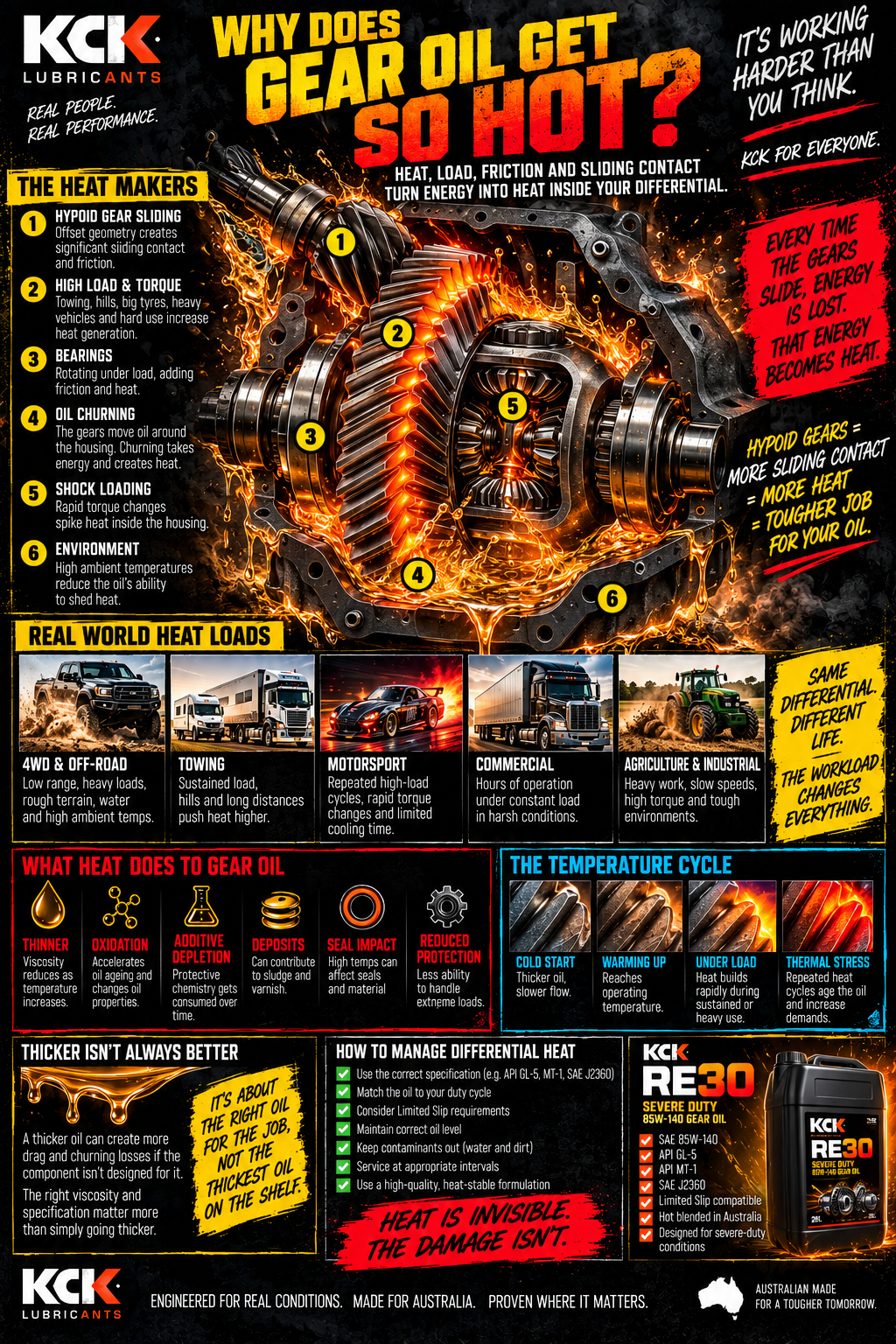
Where does all that heat come from?
The short answer is:
friction.
But there's a little more to it than that.
Inside a differential, several things are happening at once.
The ring and pinion are transmitting torque.
The gear teeth are rolling and sliding against each other.
Bearings are rotating under load.
The lubricant is being moved and churned around the housing.
The differential mechanism itself is moving.
Every one of those processes consumes some energy.
Some of that energy ultimately ends up as heat.
And hypoid gears make the problem particularly interesting because of the amount of sliding contact involved.
SAE J2360 describes severe-duty automotive hypoid gear applications involving high-speed/shock-load and low-speed/high-torque conditions, noting that the significant sliding contact in these applications typically requires EP additives to protect loaded gear flanks.
So the differential isn't simply spinning gears through oil.
It's a little mechanical heat factory sitting underneath the vehicle.
Hypoid gears are bloody good at making heat
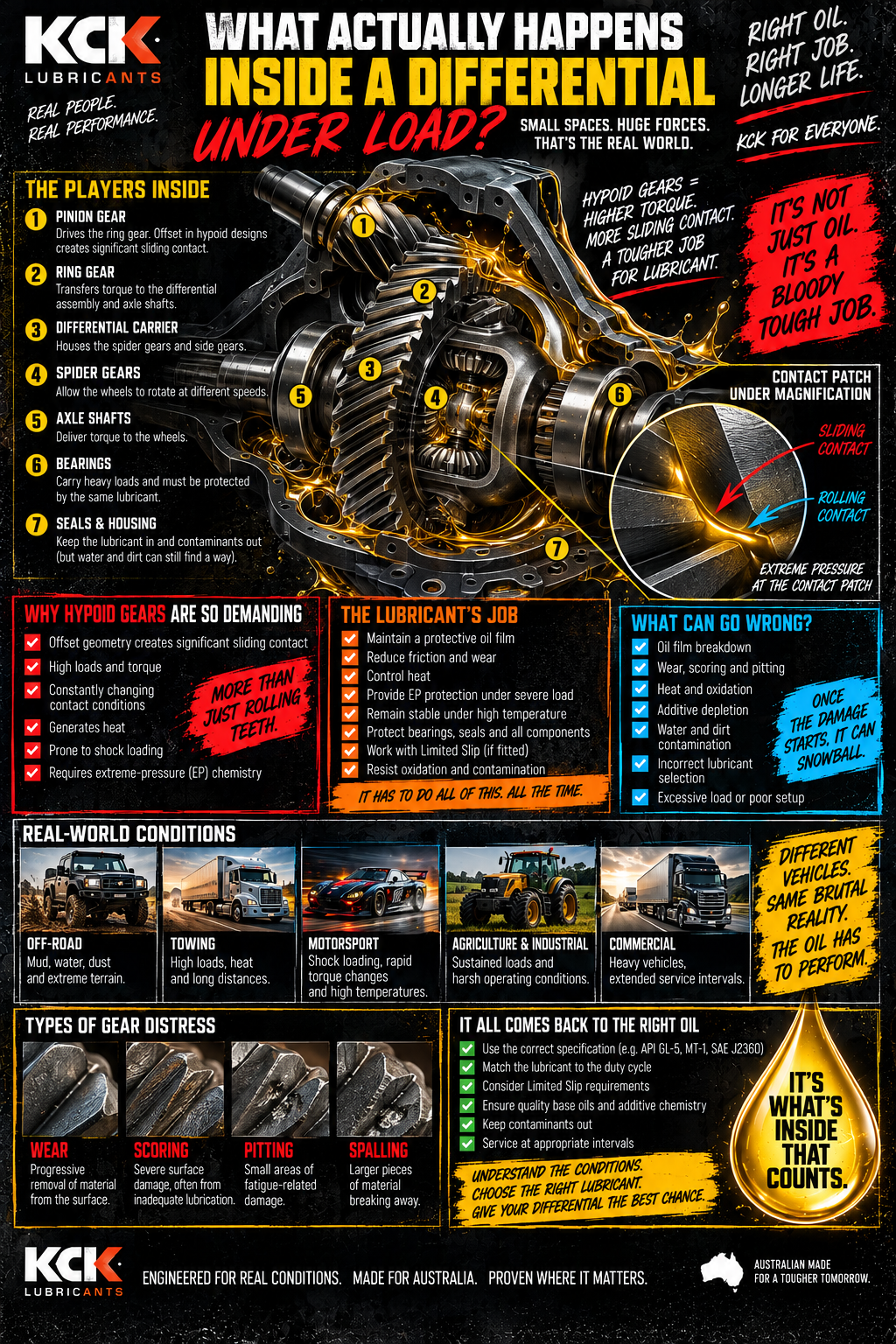
This is one of the reasons we keep coming back to hypoid gears throughout this series.
Their geometry is extremely effective at transferring torque.
But the price of that geometry is significant sliding contact between the tooth surfaces.
And sliding means friction.
Think about rubbing your hands together.
Do it slowly and gently.
Not much happens.
Now press harder and rub faster.
You start generating heat.
The same basic principle exists inside a differential — except we're not talking about human hands.
We're talking about hardened gear teeth transmitting serious torque.
The forces are considerably less forgiving.
That's why the lubricant isn't just there to make everything "slippery."
It's there to help control what happens at those loaded surfaces.
The oil is working too
Here's something people don't always consider.
The gears aren't the only things moving.
The oil is moving as well.
As the ring gear rotates through the lubricant, it picks up and moves oil around the housing.
That's important because the lubricant needs to reach the areas requiring protection.
But moving oil takes energy.
Churning the lubricant creates additional resistance and heat.
So you've got an interesting balancing act.
You need enough lubricant in the right places to properly lubricate the component.
But the lubricant itself is part of the mechanical system and isn't completely passive.
It's being dragged, thrown, squeezed and moved around while the gears are working.
This is one reason lubricant quantity and application design matter.
More oil isn't automatically better.
Less oil isn't automatically better.
The right amount, in the right application, is what matters.
Then you add load
This is where the average road car and a serious working vehicle can start living very different lives.
Imagine two identical differentials.
One belongs to a commuter car.
It spends most of its life cruising around town and sitting on the highway.
The other belongs to a 4WD towing a heavy trailer through hilly country in 35°C heat.
Same basic mechanical component.
Very different workload.
The second differential is dealing with substantially more torque and sustained load.
And when the load goes up, the mechanical stresses and heat generation can increase as well.
Now keep doing that for hours.
That's where severe-duty lubrication starts to make sense.
Towing is a perfect example
If you've ever towed something heavy up a long hill, you've probably noticed what happens to the engine temperature.
The engine works harder.
The transmission works harder.
The cooling system works harder.
And guess what?
The differential works harder too.
The final drive is still responsible for transmitting that torque to the wheels.
It doesn't get to sit back and have a cup of tea because the trailer is heavy.
It's right there in the driveline doing the work.
And unlike an engine, the differential usually doesn't have a big radiator sitting out front specifically dedicated to keeping its lubricant cool.
Its thermal environment is very different.
The housing is relying on its design, lubricant, airflow, surrounding components and operating conditions to manage that heat.
That's why sustained towing is a completely different duty cycle from an occasional trip to the shops.
Australia doesn't exactly make the job easier
This is where we have a bit of an unfair advantage.
Or disadvantage.
Depending on how you look at it.
We've got huge distances.
Heavy towing.
Long stretches of highway.
4WD tracks.
Mining.
Agriculture.
Commercial transport.
Motorsport.
And some bloody hot operating environments.
A vehicle working hard in the Australian summer doesn't have the same thermal conditions as one operating gently in a cool climate.
The differential doesn't care about the weather forecast.
It just keeps doing the job.
And the hotter the environment starts, the less thermal headroom the lubricant has before things become increasingly demanding.
That's why Australian duty cycles are something we take seriously when thinking about lubricant formulation.
Heat doesn't just make the oil thinner
This is another common oversimplification.
People sometimes think:
"Oil gets hot → oil gets thinner → that's the problem."
Viscosity change with temperature is certainly important.
But that's only part of the story.
Temperature also influences:
- Oxidation
- Additive chemistry
- Deposit formation
- Lubricant ageing
- Volatility
- Seal behaviour
- Surface protection
- The overall life of the lubricant
The lubricant isn't simply changing viscosity and then returning to normal when it cools down.
Repeated thermal stress is part of the ageing process.
And that's where things get interesting.
Heat and oxidation are not good friends
Oxidation is one of the major mechanisms behind lubricant degradation.
As lubricant temperature and exposure increase, oxidation reactions can become more significant.
Over time, that can contribute to changes in lubricant properties and the formation of degradation products.
The oil that went into the differential on day one isn't necessarily chemically identical after thousands of kilometres of heat, load and contamination.
That's just reality.
Oil ages.
How quickly it ages depends on the formulation and the conditions it experiences.
This is one reason base-oil quality and additive technology matter.
You aren't simply buying viscosity.
You're buying a formulated system designed to survive a particular environment.
The additive package is doing some serious work
We've talked about EP chemistry throughout this series.
This is where it earns its keep.
Under severe gear conditions, the lubricant needs more than a basic fluid film.
EP additives are designed to provide additional surface protection under conditions where the gear teeth are heavily loaded and sliding against each other.
But the additive package is much broader than EP chemistry alone.
A properly formulated gear lubricant can involve chemistry addressing multiple performance requirements.
Extreme-pressure protection.
Anti-wear behaviour.
Oxidation control.
Corrosion protection.
Foam control.
Friction behaviour.
Materials compatibility.
The challenge is getting all of those pieces to work together.
Because changing one part of the formulation can influence another.
That's formulation.
And that's why serious lubricant development isn't simply a shopping list of additives.
Here's where cheap formulation starts to show itself
This is one of the things we've learned over 25 years.
You can make a bottle of gear oil look pretty impressive on a label.
Big numbers.
Lots of specifications.
Plenty of technical language.
But what matters is what happens when the oil is actually working.
Under load.
At temperature.
For hours.
With the gears hammering away inside the housing.
A lubricant that performs beautifully under easy conditions doesn't necessarily tell you what happens when the temperature climbs and the component is being pushed hard.
That's where formulation quality becomes important.
The easy conditions don't tell you much.
The hard conditions do.
"Just use a thicker oil"
We hear versions of this one all the time.
And it sounds logical.
If heat can reduce viscosity, why not start with something thicker?
Because lubricant selection isn't that simple.
Viscosity has to match the component's requirements.
A lubricant that's too viscous can create its own problems, including increased drag and churning losses, particularly where the component wasn't designed around that viscosity.
And the required viscosity doesn't replace the need for the correct performance specification.
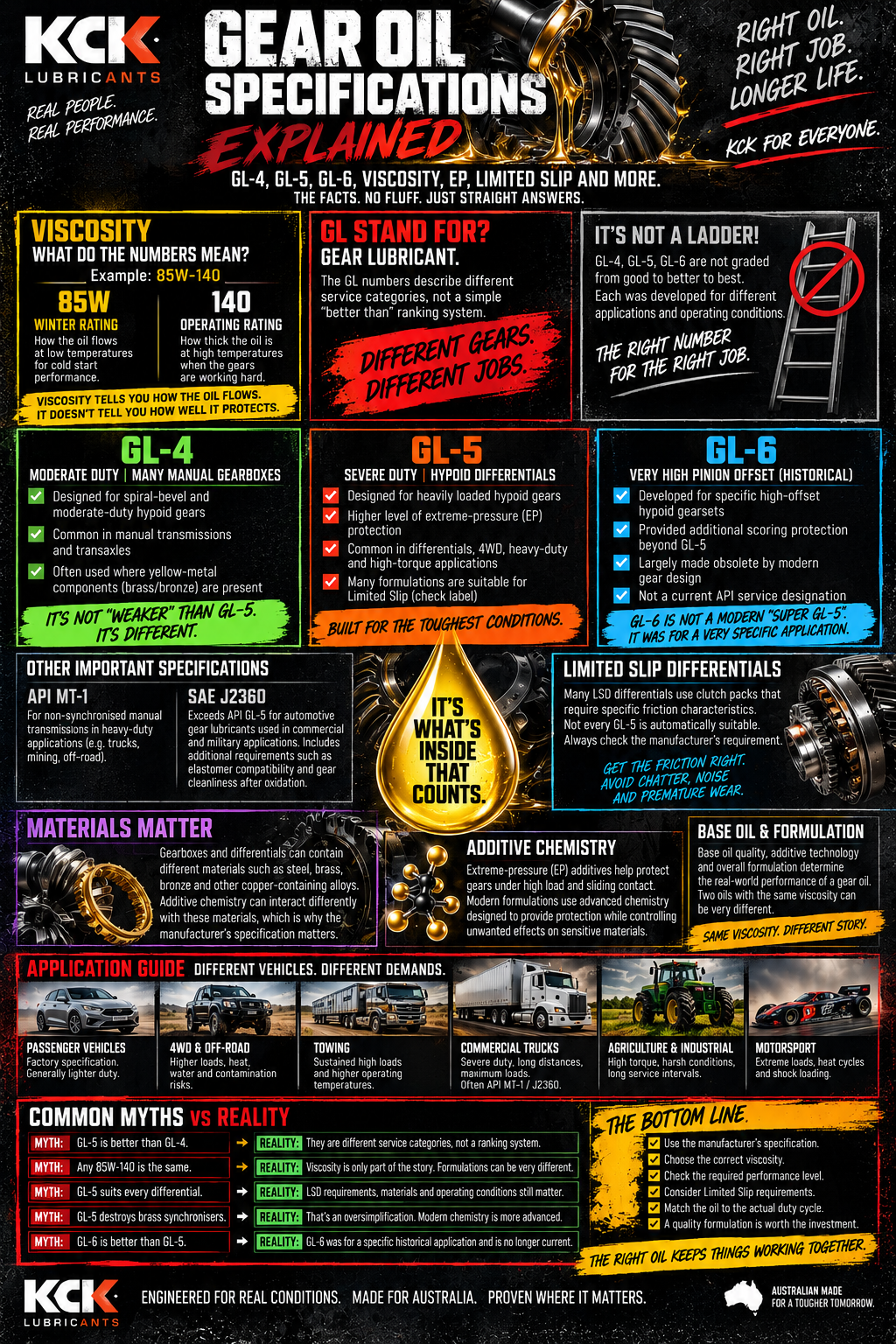
This is why 85W-140 isn't automatically better than 75W-90 simply because it's thicker.
The correct lubricant depends on the component, the manufacturer's specification and the operating conditions.
We covered that in Part 4.
The number on the bottle isn't a trophy.
It's part of the engineering requirement.
Big tyres can change the conversation too
Here's one for the 4WD crowd.
Changing tyre size can alter the mechanical conditions experienced by the driveline.
Larger or heavier tyres can affect effective gearing, rotational inertia and the loads experienced by drivetrain components depending on the vehicle and setup.
Add towing.
Add low-range work.
Add heavy terrain.
Add aggressive driving.
Now you're asking the driveline to deal with a very different workload from the vehicle that left the factory.
This doesn't mean every vehicle with bigger tyres automatically needs a different gear oil.
It means the duty cycle has changed, and that's worth considering.
The differential doesn't care what size tyres you've bolted on.
It simply experiences the consequences.
Motorsport turns the heat up another notch
This is where my motorsport brain gets involved.
And honestly, this is why lubricant development has always fascinated me.
A race car doesn't give its drivetrain much time to recover.
You get acceleration.
Hard cornering.
Traction changes.
Braking.
More acceleration.
Repeated high-load cycles.
Heat.
Then you do it again.
And again.
And again.
That's a completely different environment from a Sunday drive.
Motorsport is brutal because it exposes weaknesses.
If something isn't happy under repeated heat and load, racing has a habit of finding it.
That's one of the reasons we've spent so much of our history learning from competition.
The racetrack doesn't care about your marketing story.
If the oil can't do the job, the hardware eventually tells you.
Heavy trucks are another kind of punishment
Then there's the other end of the spectrum.
A big truck towing serious weight through Australia isn't necessarily generating the same instantaneous shock loads as a race car.
But it can create something equally demanding:
sustained load.
Hour after hour.
Kilometre after kilometre.
Heat building.
Torque being transmitted continuously.
That's a completely different form of punishment.
The lubricant needs to remain stable while the differential keeps doing the same job over and over.
This is why severe-duty gear oils have applications well beyond motorsport.
The environments are different.
The requirement is the same:
Protect the hardware when the workload gets serious.
Heat can be the silent problem
Here's the part that worries me most.
A differential can be getting hammered without making a dramatic noise.
There may be no warning light.
No smoke.
No obvious sign from the driver's seat.
The vehicle simply keeps moving.
Meanwhile, inside the housing, the lubricant is doing its job under increasing thermal and mechanical stress.
That's why maintenance matters.
That's why lubricant selection matters.
And that's why assuming:
"It's still in the diff, so it must still be good."
isn't necessarily a safe assumption.
Oil doesn't get a free pass just because it's hidden underneath the vehicle.
What happens when heat wins?
If the lubricant is pushed beyond what the formulation and component can reasonably handle, the consequences can include accelerated oxidation, loss of lubricant performance and increased surface distress.
And once the protective margin starts disappearing, the gears can begin paying the price.
Remember Part 5?
Wear.
Scoring.
Pitting.
Spalling.
Those failures don't magically appear from nowhere.
They're the result of a mechanical system operating outside the conditions it can comfortably survive.
Sometimes the cause is mechanical.
Sometimes it's lubrication.
Often it's a combination.
The important thing is understanding the environment before something breaks.
This is where severe-duty gear oil earns its name
"Severe duty" shouldn't simply mean:
"We put the words Severe Duty on the label."
It should mean the formulation has been designed around demanding operating conditions.
High load.
High torque.
High temperature.
Shock loading.
Sliding contact.
Long operating periods.
And the chemical demands that come with them.
That's exactly the territory SAE J2360 is aimed at, with its requirements for automotive gear lubricants exceeding API GL-5 performance and intended for severe hypoid applications.
That's a much more meaningful way of looking at a severe-duty lubricant.
Start with the conditions.
Then formulate for the conditions.
This is why we spent 12 months on RE30
RE30 wasn't developed because we thought the world needed another bottle of 85W-140.
There are plenty of those already.
We wanted to build something that made sense across the environments we understand.
The 4WD that gets worked.
The bloke towing serious weight.
The truck earning its money every day.
The machinery working in harsh conditions.
The road-and-race customer wanting more from their lubricant.
And the motorsport customer who already understands that heat and load don't negotiate.
So we spent roughly 12 months developing RE30 around that requirement.
Carefully selected virgin base stocks.
Advanced additive technology.
Hot-blended manufacturing.
Australian-made.
SAE 85W-140.
API GL-5.
API MT-1.
SAE J2360.
Limited Slip compatible.
And a range of additional manufacturer and axle requirements.
But the reason we're proud of RE30 isn't the list on the label.
It's what sits behind the list.
The formulation.
The oil has to survive the job, not the brochure
This is probably the biggest lesson from the entire series.
A lubricant doesn't get judged by how impressive it looks sitting on a shelf.
It gets judged inside the machine.
When the temperature climbs.
When the load increases.
When the gears start sliding.
When the trailer is behind you.
When the track gets rough.
When the truck is pulling.
When the race is on.
That's when the oil has to earn its keep.
And that's where we think lubricant engineering matters most.
So, how hot is too hot?
That's where things get a little more complicated than giving you one magic number.
There isn't a universal "danger temperature" that applies to every differential, every oil and every vehicle.
Component design matters.
Oil formulation matters.
Oil level matters.
Ambient temperature matters.
Load matters.
Speed matters.
Cooling matters.
The manufacturer's requirements matter.
And how long the lubricant spends at elevated temperature matters.
So we're not going to make up some neat little number and tell you:
"Above X°C your differential is doomed."
That's not engineering.
What we can say is this:
As thermal stress increases, the demands placed on the lubricant increase with it.
And if your vehicle lives under severe conditions, lubricant selection and maintenance become increasingly important.
That's the bit worth remembering.
Your differential might be small. Its workload isn't.
Think about that next time you're looking underneath your vehicle.
That little housing is taking the torque produced by the engine and delivering it to the wheels.
It's dealing with gear contact.
Sliding.
Load.
Heat.
Bearings.
Shock.
And whatever the driver decides to throw at it.
All day.
Every day.
Sometimes for years.
And all the while, the oil inside is being asked to protect the machine without anybody thinking about it.
That's a pretty important job for something most people only remember exists when it's time for a service.
The KCK view
We've never been particularly interested in making oil for the easy jobs.
Anyone can make something that works when everything is comfortable.
The interesting stuff starts when the conditions get ugly.
Heat.
Load.
Pressure.
Torque.
Shock.
That's where formulation matters.
That's where base stocks matter.
That's where additive chemistry matters.
And that's where experience starts counting for something.
Because after 25 years around performance, motorsport, heavy-duty applications and the aftermarket, we've learned one thing pretty clearly:
Oil doesn't get to choose the conditions.
The machine does.
Our job is to make sure the lubricant is ready when those conditions arrive.
Heat is invisible. The damage isn't.
You probably won't see the oil getting hotter while you're driving.
You won't see the protective chemistry working between the gear teeth.
You won't see the lubricant being churned around the housing.
You won't see the heat cycles slowly ageing the oil.
But you will see the consequences if the system eventually can't cope.
Noise.
Wear.
Damage.
Failure.
And a repair bill that makes the price of good gear oil look pretty bloody insignificant.
So next time you're choosing the oil for your differential, don't just ask:
"What viscosity is it?"
Ask:
"What conditions is this lubricant going to live through?"
Because that's the question that matters.
The differential doesn't care what the bottle looks like.
It doesn't care how clever the marketing sounds.
It doesn't care how cheap the oil was.
It cares whether the lubricant can do the job when things get hot.
That's the real test.
And that's where good gear oil earns its keep.
KCK Lubricants.
Real people. Real performance.
Performance isn't created by marketing.
It's created by chemistry.
KCK for Everyone.