
GL-4, GL-5, GL-6 & Gear Oil Specifications Explained
What those numbers actually mean — and why choosing the wrong gear oil can be an expensive mistake
There are few subjects in the lubricant world that generate more confusion than gear oil specifications.
GL-4.
GL-5.
GL-6.
85W-140.
75W-90.
Limited Slip.
EP.
J2360.
MT-1.
Throw a few manufacturer specifications into the mix and, before long, what should be a fairly simple question becomes a bloody minefield.
“What gear oil should I use?”
We've been dealing with this question for a long time.
And one thing we've learned after more than 25 years around lubricants, drivetrains, motorsport and the aftermarket is that a lot of the information floating around about gear oil is either incomplete, outdated or just plain wrong.
One of the biggest problems is that people often treat gear-oil specifications like a ladder.
GL-4.
GL-5.
GL-6.
Higher number must mean better oil.
Right?
No.
That's not how it works.
The GL number isn't a score out of ten.
It doesn't tell you which oil is universally “better”.
It tells you something about the service performance the lubricant was designed around.
And once you understand that, choosing gear oil becomes a whole lot easier.
Let's start with the number on the bottle
When you see something like:
SAE 85W-140
that is a viscosity classification.
It's important, but it isn't the whole story.
The viscosity grade tells you how the lubricant fits within the SAE viscosity classification system. It doesn't, by itself, tell you how much extreme-pressure protection the formulation provides, how it behaves under oxidation, whether it is suitable for Limited Slip applications, or how compatible its chemistry is with the materials inside a particular component.
That's why two different oils can both be labelled 85W-140 and still be very different lubricants.
The same applies to 75W-90, 80W-90 and other gear-oil viscosity grades.
Think of viscosity as one piece of the puzzle.
Then you've got the performance specification.
Then you've got the actual formulation behind it.
That's where the interesting stuff starts.
The label tells you the grade. The formulation tells you the story.
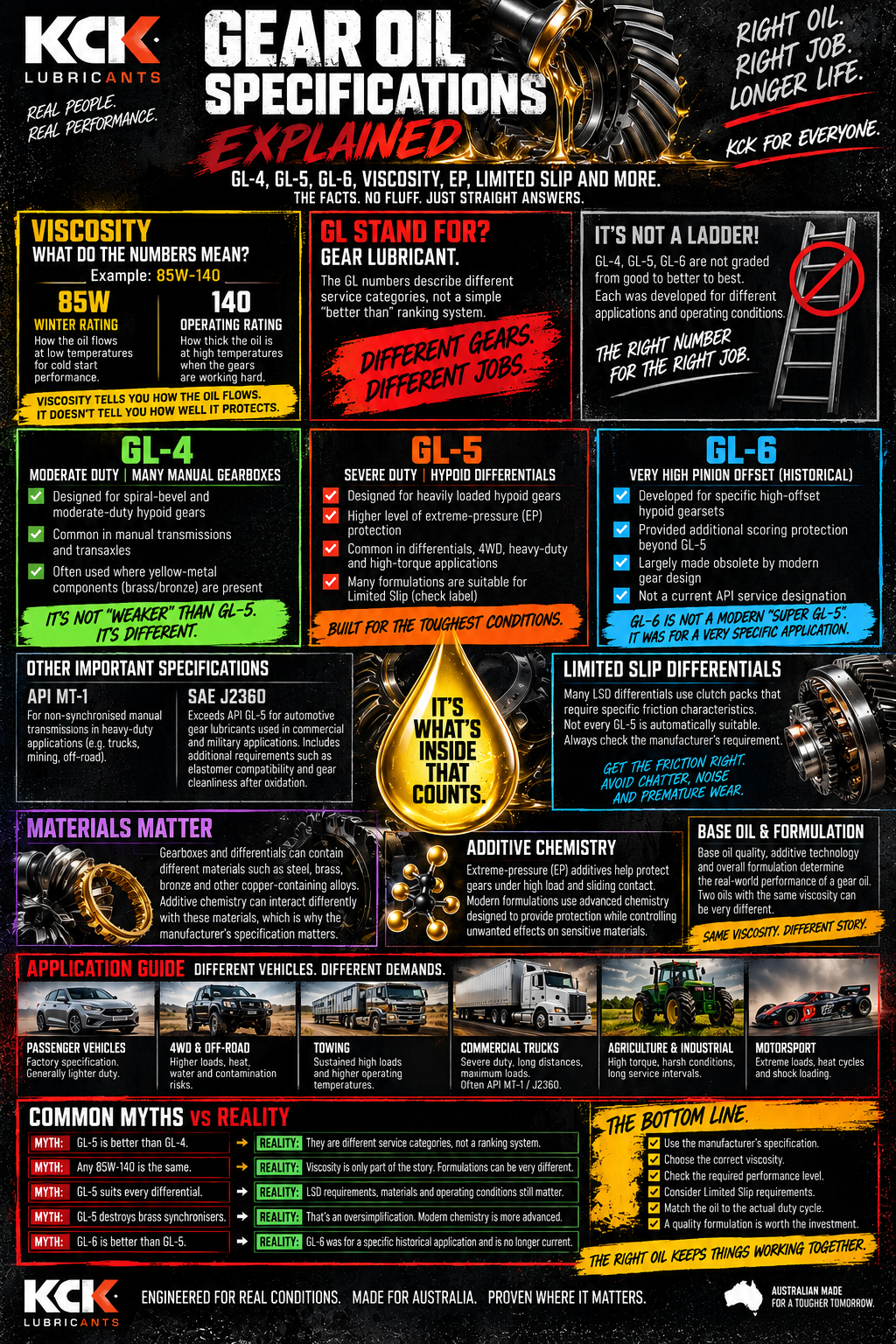
So what does GL actually mean?
GL stands for Gear Lubricant.
The numbers that follow it refer to different service categories developed around different gear designs and operating conditions.
And this is where one of the biggest myths starts.
People see:
GL-4 → GL-5 → GL-6
and assume they're looking at a simple progression from good to better to best.
They aren't.
API's current automotive gear-lubricant documentation identifies GL-5 as the current automotive service designation, while GL-1, GL-2, GL-3, GL-4 and GL-6 are identified as no longer current API service categories. That doesn't mean you'll never see GL-4 on a bottle — it remains widely used commercially, particularly in discussions around manual transmissions and older equipment — but it does mean the history behind these designations matters.
So let's look at what these numbers actually mean.
GL-4 isn't “bad GL-5”
This one needs to be put to bed.
GL-4 was developed around particular gear-service conditions, including applications involving spiral-bevel and moderate-duty hypoid gears, and it has historically been widely associated with manual transmissions and transaxles.
GL-5 was developed for more severe gear service, particularly hypoid axles operating under combinations of high-speed/shock-load and low-speed/high-torque conditions.
That doesn't make GL-5 universally better.
It makes it different.
And that's an important distinction.
If a gearbox manufacturer specifies a GL-4 lubricant, putting GL-5 into it simply because:
“GL-5 is stronger.”
is not sound lubricant selection.
You're assuming that more extreme-pressure capability automatically means better compatibility with the entire component.
It doesn't.
The lubricant has to work with the hardware.
And that means we need to talk about what's actually inside the hardware.
The chemistry matters
A gearset isn't just a pile of steel gears sitting in oil.
Different drivetrain components can contain different materials, and those materials can interact differently with lubricant chemistry.
Heavy-duty differentials commonly contain highly loaded steel gears and bearings.
Manual transmissions can contain synchroniser components and other parts made from copper-containing alloys such as brass or bronze.
That matters because extreme-pressure additives are chemically active by design.
Under severe load, the oil film alone may not be enough to prevent damaging surface interaction between gear teeth.
EP additives help by creating protective chemical films at the loaded surfaces.
That's exactly what you want when a hypoid gearset is under serious pressure and sliding contact.
But the chemistry has to be controlled.
Some forms of chemically active sulphur-containing additive chemistry can attack copper-containing alloys under certain conditions.
And that's where the old saying came from:
“GL-5 destroys brass.”
But here's the problem.
That statement is just as misleading as saying:
“GL-5 is better than GL-4.”
Modern lubricant chemistry has moved a long way.
Additive systems can be formulated using chemistry designed to deliver the required EP performance while controlling unwanted chemical activity toward sensitive materials.
So the correct lesson isn't that GL-5 automatically destroys synchronisers.
Nor is it that every GL-5 is automatically suitable for every manual transmission.
The correct lesson is much simpler:
Use the lubricant specification the component manufacturer requires.
That's the rule that matters.
Why the GL numbers aren't a performance ladder
This is probably the easiest way to remember it.
A 14mm spanner isn't better than a 12mm spanner because 14 is a bigger number.
It's better when the nut requires 14mm.
Same principle.
GL-4 was developed around one set of service requirements.
GL-5 around another.
GL-6 was developed for an even more specific historical application.
The number describes the category.
The application determines which category you need.
That's why asking:
“What's the strongest gear oil?”
isn't necessarily the right question.
The better question is:
“What does this component require?”
And then there's GL-6
This is where the “bigger number equals better oil” theory really falls apart.
GL-6 wasn't developed as some kind of modern supercharged GL-5.
It was intended for specific gearsets with very high pinion offset, where additional scoring protection beyond the GL-5 level was required.
It was a very specific service requirement.
As gear design evolved, the need for that category largely disappeared, and the original GL-6 test equipment and procedures became obsolete.
API now identifies GL-6 as no longer in current use.
So if someone tells you:
“GL-6 is better than GL-5 because six is higher than five.”
you can probably stop listening at that point.
The number isn't the story.
The application is.
There's another specification worth understanding: SAE J2360
This is where things get particularly interesting for heavy-duty automotive applications.
SAE J2360 is a recognised performance specification for automotive gear lubricants used in commercial and military applications.
The current revision was updated in December 2025 and covers lubricants intended for automotive units with primary hypoid gears operating under high-speed/shock-load and low-speed/high-torque conditions. It also establishes performance requirements beyond the basic API GL-5 category.
That's important because it demonstrates something we've been saying throughout this series:
“GL-5” doesn't tell you everything about an oil.
A more detailed specification can impose additional performance requirements.
API's own documentation notes that SAE J2360 lubricants satisfy API GL-5 and that J2360 includes additional requirements, including areas such as elastomer compatibility and gear cleanliness following oxidation testing.
In other words, don't look at a gear-oil bottle and stop reading when you see the words GL-5.
There can be considerably more information sitting behind that label.
Limited Slip is another piece of the puzzle
Here's another common mistake.
Someone sees:
85W-140 GL-5
and thinks:
“That's diff oil. Done.”
Not necessarily.
If you've got a Limited Slip differential, the lubricant may need specific friction characteristics to allow the Limited Slip mechanism to operate correctly.
Many Limited Slip differentials use clutch-pack systems.
Those clutches need controlled friction.
Too much friction.
Too little friction.
The wrong friction behaviour.
All can create problems.
Noise and chatter are common complaints when the lubricant isn't suited to the application.
That's why Limited Slip compatibility needs to be considered separately from simply asking whether the oil is GL-5.
And again, the manufacturer's requirement comes first.
GL-5 doesn't automatically mean “suitable for every Limited Slip differential.”
What about yellow metals?
This is one of the areas where we hear the most misinformation.
Brass.
Bronze.
Copper.
Synchronisers.
Sulphur.
GL-5.
It all gets thrown into one bucket.
The reality is more complicated.
Different additive chemistries behave differently.
Different concentrations behave differently.
Temperature changes the chemical environment.
Exposure time matters.
The actual alloy matters.
The component design matters.
And modern additive technology is not the same thing as the chemistry used decades ago.
So rather than repeating:
“GL-5 eats brass.”
or the opposite:
“Modern GL-5 is safe in everything.”
we'd rather give you the useful answer.
Check the component manufacturer's specification.
If the manufacturer specifies a lubricant designed for yellow-metal compatibility, use one that meets that requirement.
If the manufacturer specifies GL-5, use a properly formulated GL-5 lubricant suitable for the application.
Don't make lubricant selection based on an internet slogan.
Here's how to choose gear oil properly
This is the bit we really want people to take away from this article.
Because choosing gear oil doesn't have to be complicated.
You just need to ask the right questions.
1. What are you lubricating?
A differential?
A manual transmission?
A transfer case?
A final drive?
Industrial equipment?
Agricultural machinery?
Don't assume that because two components both contain gears, they need the same oil.
They might.
They might not.
Start with the component.
2. What does the manufacturer specify?
This should always be your starting point.
Not what your mate uses.
Not what a bloke on Facebook swears by.
Not what was cheapest on the shelf.
The manufacturer designed the component and specified a lubricant requirement around it.
Start there.
3. What viscosity does it require?
Now look at the SAE viscosity grade.
75W-90?
80W-90?
85W-140?
Whatever the component manufacturer calls for.
Get that part right.
4. What performance specification is required?
GL-4?
GL-5?
SAE J2360?
API MT-1?
A manufacturer-specific specification?
This is where you need to look beyond the viscosity number.
5. Is it Limited Slip?
If it is, check the required friction characteristics and lubricant recommendation.
Don't assume every GL-5 is automatically suitable.
6. What sort of life is the component going to live?
This one gets forgotten all the time.
A differential in a daily commuter isn't necessarily living the same life as one in a vehicle towing a heavy trailer across Australia in summer.
A weekend 4WD isn't doing the same job as a mine-site vehicle.
A road train isn't experiencing the same duty cycle as a passenger car.
And a competition differential?
That's another conversation entirely.
Same component. Completely different punishment.
The Australian factor matters
We live in a country that can be bloody hard on machinery.
Heat.
Dust.
Long distances.
Heavy towing.
Water crossings.
Corrugations.
Mining.
Agriculture.
Commercial transport.
Off-road work.
Motorsport.
Sometimes all of them in the same week.
That's why duty cycle matters so much.
A lubricant doesn't know whether the vehicle has a shiny paint job.
It only knows what is happening inside the differential.
Load.
Temperature.
Speed.
Pressure.
Sliding contact.
Shock loading.
Contamination.
Time.
That's the real environment the lubricant has to survive.
And that's why selecting gear oil purely because it is the cheapest bottle with the right viscosity printed on the front isn't necessarily saving money.
The oil may cost a little more.
The differential doesn't.
Don't confuse viscosity with protection
This deserves repeating because it's such a common misconception.
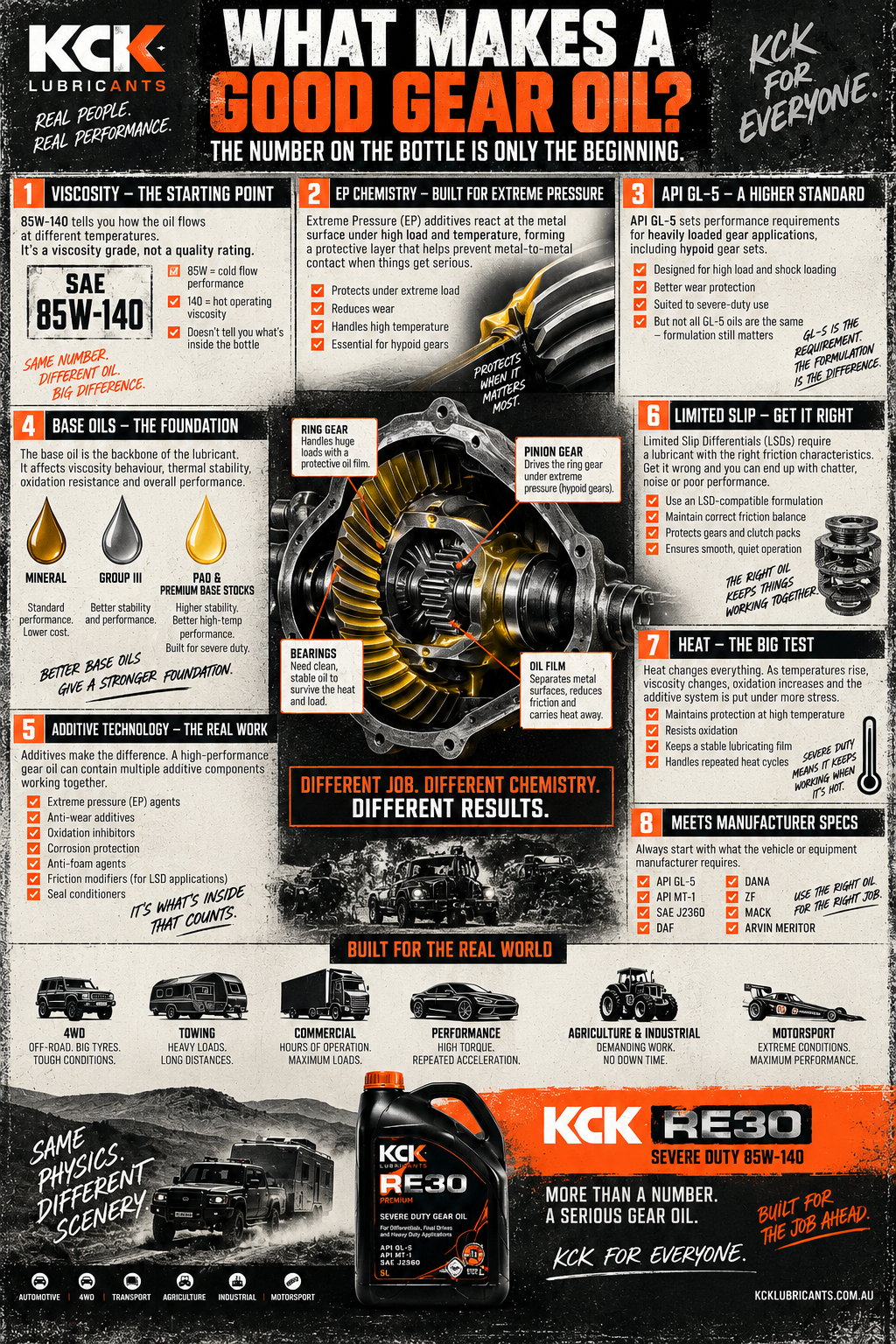
85W-140 is a viscosity grade.
It isn't a complete description of the lubricant.
The base oil matters.
The additive system matters.
EP chemistry matters.
Oxidation resistance matters.
Friction characteristics matter.
Materials compatibility matters.
The performance specifications matter.
And how all of those things work together matters.
That's formulation.
You can have the right viscosity and still have the wrong lubricant for the job.
Correct viscosity doesn't automatically mean correct lubricant.
Five gear-oil myths worth leaving behind
MYTH 1: GL-5 is better than GL-4 because five is bigger than four.
No.
They're different service categories associated with different applications and performance requirements.
The right specification is the one the component requires.
MYTH 2: Any 85W-140 is basically the same.
No.
85W-140 tells you the viscosity classification.
It doesn't tell you everything about the formulation behind it.
MYTH 3: If it says GL-5, it's suitable for every differential.
No.
Limited Slip requirements, manufacturer specifications, friction characteristics, materials and operating conditions still matter.
MYTH 4: GL-5 automatically destroys brass synchronisers.
That's an oversimplification.
The additive chemistry, formulation, component materials and manufacturer requirements all matter.
MYTH 5: GL-6 is better than GL-5.
No.
GL-6 was developed for a specific historical high-offset hypoid application and is no longer a current API service designation.
The biggest number isn't automatically the smartest choice.
So where does RE30 fit into all of this?
This is where we can finally talk about our own product.
And notice we left it until now.
Because if we'd started this article with:
“RE30 is the answer!”
we wouldn't have taught you much.
The whole point of this series is to help you understand why lubricant selection matters.
RE30 came from that same thinking.
We didn't start with a bottle and decide what words to put on the label.
We started with the job.
Severe duty.
Heavy loads.
Hypoid gears.
Heat.
Shock loading.
Towing.
4WD.
Commercial transport.
Motorsport.
Agricultural and industrial equipment.
Then we worked backwards into the formulation.
Around 12 months went into developing RE30.
It's an SAE 85W-140 severe-duty gear oil formulated using carefully selected virgin base stocks and advanced additive technology, then hot blended and manufactured here in Australia.
It is formulated for Limited Slip applications and is built around demanding performance requirements including API GL-5, API MT-1 and SAE J2360, along with a range of manufacturer and axle requirements.
But even with RE30, the same rule applies.
Always check what the component manufacturer requires.
That's more important than anything written on our bottle.
Because good lubricant selection isn't about finding the biggest number.
It's about understanding the job.
The right gear oil starts with the right question
The biggest mistake isn't necessarily choosing GL-4 instead of GL-5.
Or 75W-90 instead of 85W-140.
The biggest mistake is choosing a lubricant without understanding what you're choosing.
Gear oil isn't simply:
“Thick stuff that goes in the diff.”
There's a lot happening inside that bottle.
Viscosity is one part.
EP chemistry is another.
Base oil is another.
Friction behaviour is another.
Materials compatibility is another.
Oxidation resistance is another.
And the component itself matters.
So does the duty cycle.
So does the temperature.
So does the manufacturer's specification.
Once you understand that, the numbers on the bottle start making a lot more sense.
GL-4 isn't automatically worse.
GL-5 isn't automatically better.
GL-6 isn't the next rung on the ladder.
85W-140 doesn't tell you everything about the oil.
And the cheapest bottle isn't necessarily the cheapest option when the component you're protecting costs thousands to repair.
The question worth asking isn't:
“What's the strongest gear oil I can buy?”
It's:
“What does this component require, and what is this lubricant actually formulated to do?”
That's the question that matters.
Because the differential doesn't care what the marketing department printed on the front of the bottle.
The gearbox doesn't care what your mate swears by.
And the gears certainly don't care that the number on the label looked impressive.
They care about chemistry, load, temperature, friction, materials and protection.
After 25 years in this game, that's the bit we've learned to respect.
Performance isn't created by marketing.
It's created by chemistry.
KCK Lubricants.
Real people. Real performance.
KCK for Everyone.