
What Makes a Good Gear Oil?
The number on the bottle is only the beginning.
So you've finally thought about your differential oil.
Good.
Maybe you've checked the service interval. Maybe you've crawled underneath the vehicle and discovered the oil hasn't been changed for longer than you'd like to admit.
Now comes the next question.
What do you actually put back in there?
Walk into an automotive store and you'll find plenty of bottles claiming to protect gears, handle extreme pressure, survive heavy loads and keep differentials happy.
Most of them look the part.
Most of them sound the part.
And if you're not familiar with lubricant chemistry, it can be pretty bloody hard to work out what actually matters.
There's a viscosity number.
There's API GL-5.
Maybe there's an LS rating.
There might be a pile of manufacturer specifications you've never heard of.
And somewhere underneath all that is the actual oil.
That's where things get interesting.
Because gear oil isn't defined by the number printed on the front of the bottle.
The number tells you something.
It just doesn't tell you everything.
Let's start with the number
Take 85W-140.
You've probably seen it before.
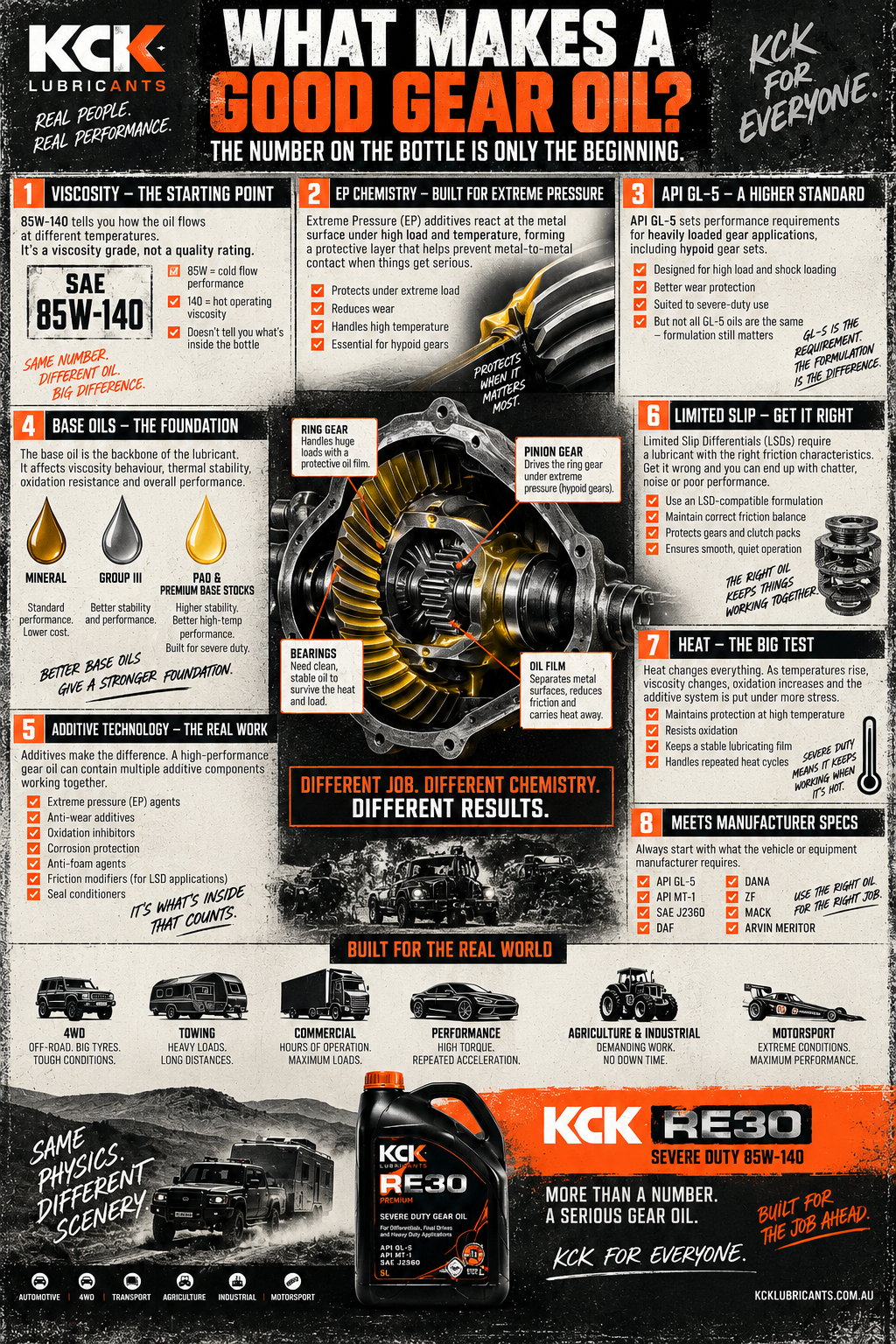
The first thing to understand is that 85W-140 is a viscosity grade, not a quality rating.
That's an important distinction.
Viscosity describes how the lubricant behaves in relation to temperature.
It doesn't tell you whether the oil has a good extreme-pressure additive system.
It doesn't tell you what base stocks are being used.
It doesn't tell you how stable the formulation is at high temperature.
It doesn't tell you whether it's suitable for a Limited Slip differential.
And it certainly doesn't tell you how well one particular 85W-140 formulation compares with another.
Two oils can carry the same viscosity grade and have very different chemistry behind that label.
That's why simply asking:
“Is it 85W-140?”
isn't enough.
The better question is:
“What sort of 85W-140 is it?”
Thick doesn't mean bulletproof
There's another misconception worth clearing up.
A lot of people assume thicker automatically means stronger.
It doesn't.
A heavier viscosity can provide useful film thickness under the conditions the lubricant was designed for, but viscosity alone doesn't determine a gear oil's ability to handle extreme pressure and load.
That's where formulation comes in.
Imagine two people carrying the same weight.
One might be strong enough to handle it comfortably.
The other might struggle.
Same load.
Different capability.
Gear oils work in much the same way.
The viscosity is part of the package.
The chemistry determines much of what happens when the going gets ugly.
Now let's talk about the gears
Inside a differential, the ring and pinion are doing some serious work.
Especially with hypoid gearing.
The teeth aren't simply rolling together like two perfectly meshed wheels.
There's a combination of rolling and sliding contact.
That sliding creates friction.
The load creates pressure.
The friction generates heat.
And all of it happens while the lubricant is expected to keep the metal surfaces separated by a protective film.
That's a pretty unreasonable job when you stop and think about it.
Two hardened metal surfaces are transmitting enormous forces through a tiny contact area.
And you're asking a relatively small quantity of oil to stand between them and say:
“Not today, fellas.”
That's where extreme-pressure chemistry earns its keep.
What does EP actually mean?
You'll often see EP — Extreme Pressure — associated with gear oils.
It's not just a fancy acronym.
EP additives are designed to help protect gear surfaces under conditions where the lubricant film alone may not be sufficient.
Under severe pressure and temperature at the contact zone, certain additive components can react at the metal surface and help form a protective boundary layer.
The result is a sacrificial chemical protection mechanism that helps reduce damaging surface interaction under extreme conditions.
That's one of the reasons gear oil chemistry is so different from simply taking an engine oil and making it thicker.
Different job. Different chemistry.
The differential doesn't need an oil that merely flows around the gears.
It needs a lubricant formulated for what those gears are actually doing.
This is where GL-5 comes into the conversation
API GL-5 is one of the specifications you'll commonly encounter with automotive gear oils.
It relates to the performance requirements of lubricants used in demanding gear applications, particularly where high loads and hypoid gear sets are involved.
But here's something worth remembering.
Seeing GL-5 on the bottle tells you the lubricant is formulated around a defined performance category.
It doesn't mean every GL-5 oil is identical.
The formulation behind that performance still matters.
Base oils matter.
Additive chemistry matters.
Treat rates matter.
Thermal stability matters.
Manufacturing consistency matters.
Application suitability matters.
Think of GL-5 as part of the conversation — not the entire conversation.
And then there are manufacturer requirements
This is where things get even more interesting.
Modern drivetrains aren't all built the same.
Different gear sets.
Different materials.
Different loads.
Different operating temperatures.
Different friction requirements.
Different differential designs.
That's why manufacturers establish their own specifications and requirements.
You'll see names such as ZF, Dana, DAF, Mack, Arvin Meritor and others appearing on serious gear-oil data sheets.
Those requirements exist because the people designing the hardware understand what their components need from the lubricant.
That's why the first rule of choosing gear oil is still the least exciting one:
Check what the vehicle or component manufacturer requires.
KCK has never had a problem with that rule.
If your vehicle specifies a particular viscosity or performance requirement, that's where you start.
Not with the biggest number on the shelf.
Not with the loudest label.
And not with whatever your mate reckons worked in his Hilux ten years ago.
Limited Slip is where things get really interesting
A conventional differential and a Limited Slip differential don't necessarily want exactly the same friction characteristics from their lubricant.
An LSD may use clutch packs or other mechanisms that rely on controlled friction to operate correctly.
That means the lubricant has to do two jobs at once.
Protect the gears.
And provide the friction behaviour the differential needs.
Get the balance wrong and you can experience chatter, noise or undesirable operation.
This is why “just chuck some 85W-140 in it” isn't always good advice.
The viscosity might be correct.
The application might not be.
That's an important distinction.
Correct viscosity doesn't automatically mean correct lubricant.
Heat changes everything
This is the part that gets underestimated.
A differential might look like a fairly simple lump of metal sitting underneath the vehicle.
Inside it, things can get considerably more interesting.
As the gears work, energy becomes heat.
The harder they work, the more heat can be generated.
Heavy towing.
Long highway runs.
Large tyres.
High torque.
Low-range 4WD work.
Motorsport.
Commercial hauling.
Repeated acceleration.
They all change the thermal demands placed on the lubricant.
And temperature matters because lubricants don't behave identically at every temperature.
As temperatures rise, viscosity changes.
Oxidation becomes more important.
The additive system is placed under greater stress.
And the lubricant has to continue doing the job it was formulated to do.
This is why severe-duty lubrication isn't about one spectacular moment.
It's about maintaining performance while the punishment continues.
Here's the bit most people never see
When you look at a bottle of gear oil, you see a liquid.
That's it.
You can't see the additive chemistry working.
You can't see the lubricating film between the gear teeth.
You can't see the pressure at the contact point.
You can't see the temperature inside the housing.
You can't see the chemical reactions taking place at the metal surface.
You can't see oxidation beginning.
You can't see microscopic wear taking place.
And that's part of the problem.
Lubricants are invisible when they're doing their job properly.
You only tend to notice them when something goes wrong.
That's why the formulation matters so much.
The important work is happening where you can't see it.
Base oil isn't just base oil either
Here's another rabbit hole worth understanding.
The base oil provides the foundation of the lubricant.
It influences properties such as viscosity behaviour, volatility, thermal stability and oxidation resistance.
But the base oil doesn't work alone.
The additive package has to be compatible with it.
The finished formulation has to remain stable.
The components need to work together.
And the manufacturing process matters too.
This is why KCK puts so much emphasis on the formulation rather than simply looking at the label.
We aren't trying to win a competition for the biggest claim printed on a bottle.
We're interested in what happens when the oil actually goes to work.
What about cheap gear oil?
Here's where I'll probably annoy someone.
Cheap gear oil isn't automatically rubbish.
And expensive gear oil isn't automatically brilliant.
That's not how lubrication works.
But price does reflect something.
Formulation costs money.
Quality base stocks cost money.
Additive chemistry costs money.
Development costs money.
Testing costs money.
Manufacturing properly costs money.
If you're comparing two oils purely on the price of the bottle, you're missing most of the story.
The real question is whether the lubricant is appropriate for the job you're asking it to do.
Because the differential doesn't care that you saved ten bucks.
It has no concept of budgets.
It just keeps turning.
And if something goes wrong, the gears, bearings, seals, labour and downtime don't suddenly become cheaper because the oil was.
So what does severe duty really demand?
This is where the whole conversation comes together.
Severe duty isn't a marketing phrase.
It's a description of what you're asking the lubricant to endure.
Consider a vehicle towing a heavy caravan through an Australian summer.
Then consider a 4WD crawling through low range on large tyres.
Then a performance car putting serious torque through the rear axle.
Then a truck working long hours under heavy load.
Then a race car repeatedly accelerating hard and generating heat cycle after heat cycle.
They're completely different applications.
But from the lubricant's point of view, they share something important.
They're asking a lot.
That's when formulation becomes increasingly important.
You need the right viscosity.
You need the right performance level.
You need the right additive chemistry.
You need compatibility with the application.
And you need the finished lubricant to keep doing its job when conditions aren't particularly friendly.
That's why RE30 isn't just another 85W-140
This is where KCK's thinking becomes pretty simple.
When we started developing RE30, we weren't looking for another number to put in the catalogue.
We were looking at the gap between ordinary expectations and the conditions people were actually putting their vehicles through.
Twelve months went into the development.
The formulation uses carefully selected virgin base stocks and the latest additive technology available to us, combined with KCK's hot-blend manufacturing process.
The goal was to create a serious severe-duty gear oil suitable across a broad range of demanding applications.
4WDs.
Heavy towing.
Performance street cars.
Motorsport.
Commercial transport.
Road trains.
Mining.
Agriculture.
Industrial equipment.
Final drives and differentials.
And Limited Slip applications.
That's a lot of different machinery.
But the underlying requirement is remarkably consistent.
The lubricant has to keep protecting the hardware when the hardware is working hard.
The label tells you the grade.
The formulation tells you the story.
That's probably the easiest way to remember all of this.
85W-140 tells you the viscosity grade.
GL-5 tells you about a defined performance category.
Manufacturer specifications tell you about application requirements.
LS compatibility tells you the lubricant has been formulated with the friction characteristics of those applications in mind.
But underneath all of that is the chemistry.
That's where the real work happens.
And that's why two bottles that look similar on a shelf can be very different once they are sitting between a ring gear and pinion carrying serious load.
Don't choose gear oil by the biggest words on the bottle
Choose it because it belongs there.
Check the manufacturer's requirements.
Check the viscosity.
Check the performance specifications.
Check whether the differential requires Limited Slip compatibility.
Then look at the lubricant itself.
Who makes it?
How is it formulated?
What sort of base stocks are being used?
What additive technology sits behind it?
Is it intended for the conditions you're actually putting the vehicle through?
Those questions are far more useful than asking which bottle has the toughest-looking picture on the front.
Because there's a funny thing about gear oil.
The less you understand about what's inside it, the more likely you are to choose it based on what's printed outside it.
And that's the KCK way of looking at it
After 25 years around lubricants, racing, machinery and the aftermarket, we've learned not to get too excited about labels.
The real test starts when the vehicle leaves the workshop.
When the trailer is hooked up.
When the track heats up.
When the climb gets steep.
When the truck is loaded.
When the tyres are big.
When the torque goes through the driveline.
That's when the bottle stops being a bottle.
It becomes a lubricant.
And that's when the chemistry has to earn its keep.
Performance isn't created by marketing.
It's created by chemistry.
That's why RE30 exists.
Not because 85W-140 needed another product.
Because some differentials are being asked to do a bloody hard job.
And if you're going to ask the hardware to work harder, it's worth giving some thought to what's working between those gears.
The oil might be out of sight.
But it should never be out of mind.
KCK Lubricants.
KCK for Everyone.