
The Most Neglected Oil in Your Vehicle Could Also Be the Most Important
Why differential oil deserves a lot more attention than it gets
Ask someone when they last changed their engine oil and there's a pretty good chance they'll know.
Ask them when they last changed the oil in their differential.
You'll often get a blank stare.
And that's understandable.
The engine gets all the attention. It has an oil light, an oil filter, a dipstick or electronic oil monitor, and usually a service sticker somewhere reminding you when it's due.
The differential is tucked underneath the vehicle doing its job without making much fuss.
Until it doesn't.
And by the time a differential starts making enough noise to get your attention, the oil has usually been telling the story for quite a while.
That's the bit worth thinking about.
Because differential oil might be one of the most overlooked lubricants in the entire vehicle.
And depending on what you drive, how you drive it and what you ask it to do, it can also be one of the hardest working.
Poor old differential oil
There's a funny thing about vehicle maintenance.
People will spend serious money on engine oils, filters, coolants, fuel systems and performance parts, then crawl underneath the vehicle and discover the differential oil hasn't been touched since who knows when.
Maybe it was changed at the last major service.
Maybe it wasn't.
Maybe someone topped it up once.
Maybe nobody knows.
And if the vehicle isn't making any strange noises, the temptation is to assume everything must be fine.
That's where complacency gets expensive.
A differential doesn't need your attention every morning.
It doesn't need you checking the oil before you drive to work.
It just needs the lubricant inside it to keep doing its job every time those gears are asked to transmit torque.
Quietly.
Repeatedly.
Under load.
And sometimes in absolutely miserable conditions.
So what does the differential actually have to do?
At its simplest, a differential allows the driven wheels to rotate at different speeds while still transmitting torque.
That becomes important whenever a vehicle turns, because the outside wheel travels further than the inside wheel.
But there's considerably more going on inside that housing.
The differential has gears, bearings and other moving components working together to transfer torque through the driveline.
In many conventional differentials, the ring and pinion gears are hypoid gears.
That matters.
Hypoid gears don't simply roll across one another like two perfectly meshed spur gears.
There's a significant amount of sliding contact as well as rolling contact.
That sliding action, combined with the loads being transmitted through the teeth, puts some very serious demands on the lubricant.
The oil has to form and maintain a protective film between surfaces that are carrying enormous forces.
It also has to deal with friction, heat, contamination and repeated load cycles without simply giving up.
That's a very different job from sitting in a bottle on a shelf looking impressive.
Here's where things get interesting
Think about what happens when you put a heavy load behind a vehicle.
A caravan.
A car trailer.
A boat.
A loaded work trailer.
Now add a long climb.
Then add an Australian summer.
The engine is working harder.
The transmission is working harder.
The driveline is working harder.
And the differential is right there in the middle of it, transmitting that torque to the wheels.
The same thing happens in a 4WD climbing a steep track in low range.
Or a performance car putting serious torque through the rear axle.
Or a truck hauling a heavy load for hours.
Or a race car repeatedly accelerating hard and generating substantial heat through the driveline.
The scenery changes.
The physics don't.
That's something worth remembering.
A differential doesn't know whether it's underneath a LandCruiser, a race car, a prime mover, a tractor or a work ute.
It only knows load, speed, temperature, friction and pressure.
Heat is where things get serious
Heat is one of the great enemies of lubricants.
And differential oil doesn't get a free pass.
As gears mesh and slide against one another, energy is converted into heat.
The harder the differential works, the more heat it can generate.
Heavy towing increases the load.
Large tyres can increase the demands placed on the driveline.
Off-road work can mean sustained low-speed, high-load operation.
Motorsport can mean repeated acceleration and heat cycles.
Commercial equipment can simply keep doing it for hours.
And once temperatures rise, the lubricant has a harder job maintaining the properties you need from it.
This is why looking at a gear oil purely by its viscosity number can be misleading.
There's much more happening inside that bottle.
So what's the deal with 85W-140?
This is where people sometimes get the wrong idea.
They see 85W-140 and think:
“That's thick stuff. It must be better.”
Not necessarily.
A thicker oil isn't automatically a better oil.
The correct viscosity is determined by the application, operating conditions, temperature range and manufacturer requirements.
But in applications designed for a heavier gear oil, an 85W-140 formulation can provide the viscosity characteristics required to maintain an appropriate lubricating film under demanding operating conditions, particularly when temperatures and loads are high.
The important word there is formulation.
Because viscosity is only one part of the story.
Two bottles can both say 85W-140 on the label and still be very different lubricants.
That's something the average vehicle owner rarely gets told.
Gear oil isn't just gear oil
This is probably the biggest point in the whole conversation.
A gear oil isn't defined solely by the number printed on the front of the bottle.
The base oil matters.
The additive system matters.
Extreme-pressure protection matters.
Anti-wear performance matters.
Oxidation resistance matters.
Friction characteristics matter.
Thermal stability matters.
Compatibility with the particular differential matters.
And the finished formulation has to work as a complete system.
Think of it like building an engine.
You wouldn't choose an engine solely because it has a particular displacement.
You'd want to know what components are inside it, how they're put together and what the finished engine is actually capable of doing.
Lubricants are no different.
The viscosity grade tells you something important.
It just doesn't tell you everything.
Limited Slip changes the conversation
Then there are Limited Slip differentials.
These introduce another consideration because the lubricant has to provide the required gear protection while also working with the friction characteristics of the differential's clutch system.
Get that balance wrong and you can end up with chatter, noise or undesirable differential behaviour.
That's why you can't simply grab the thickest gear oil you can find and pour it into everything with a diff.
Correct application first.
Then the right lubricant for that application.
RE30 is formulated for Limited Slip applications, but as always, the vehicle or differential manufacturer's requirements should be checked before choosing any lubricant.
That's not marketing.
That's just good mechanical practice.
What does “severe duty” actually mean?
The phrase gets thrown around a lot.
But severe duty isn't simply something you print on a label because it sounds tough.
Severe duty means the lubricant is being asked to operate with less margin for error.
Heat.
Heavy loads.
Shock loading.
Long operating periods.
High torque.
Repeated acceleration.
Low-speed high-load work.
Towing.
Off-road use.
Commercial transport.
Competition.
Sometimes several of those at once.
Take a road train pulling multiple trailers through Australia.
The differential doesn't get a coffee break because the road is long.
It keeps working.
Now compare that with a performance car that spends its weekend launching hard at the track.
Different vehicle.
Different environment.
Same basic problem.
The lubricant has to protect loaded gear teeth while dealing with heat, pressure and repeated cycles.
That's severe duty.
Towing changes the equation
A vehicle that spends its life unloaded cruising around town may have a relatively easy existence.
Put a large caravan behind it and head across the country in summer and you've changed the equation.
The engine works harder.
The transmission works harder.
The differential works harder.
And the longer the journey, the longer those components remain under load.
This is why towing shouldn't be treated simply as “normal driving with something behind you.”
It isn't.
You're asking the entire driveline to work harder for longer.
For anyone regularly towing heavy loads, differential oil deserves to be part of the conversation — not an afterthought.
4WD changes it again
Four-wheel drives can be particularly demanding because of how they're used.
Low-range work.
Steep climbs.
Large tyres.
Heavy vehicles.
High traction.
Mud.
Rocks.
Sand.
Water crossings.
Heat.
And then there's one of the nastiest situations a differential can encounter.
A hot differential entering cold water.
The housing and lubricant can be extremely hot, then suddenly exposed to a much cooler environment.
Depending on the vehicle's design, seals, breathers and conditions, water contamination can become a genuine concern.
That's why serious 4WD owners shouldn't think of differential oil as something that only needs attention when the service book tells them to have a look.
The way the vehicle is actually being used matters.
Motorsport is a different kind of punishment
Anyone who's spent enough time around racing knows that “normal driving” doesn't really mean much once the flag drops.
Hard acceleration.
High torque.
Rapid load changes.
Shock loading.
Heat cycles.
Repeated passes.
Short periods of extreme demand.
The differential might only be working hard for a few minutes at a time, but those minutes can be brutal.
Motorsport has always been a good teacher of lubricant quality because there's nowhere to hide when the conditions get nasty.
You don't get to average out the bad moments.
A lubricant either protects the components when they're being pushed hard, or it doesn't.
And that's one reason motorsport has always influenced the way KCK thinks about lubrication.
The track doesn't care what the marketing department wrote on the bottle.
The gears certainly don't.
Then there are the specifications
This is where things get a little more technical, but it's important.
Specifications exist for a reason.
They give manufacturers and users a way of identifying performance requirements for different applications.
RE30 Severe Duty 85W-140 is formulated to meet or exceed the requirements associated with a demanding range of applications and specifications, including:
API GL-5
API MT-1
SAE J2360
Along with requirements associated with applications from manufacturers and driveline systems including DAF, Dana, BTR Limited Slip, Arvin Meritor, Mack, ZF and GM Limited Slip applications.
That's a pretty serious spread of requirements.
But here's the point that often gets lost:
Meeting a specification is the starting point — not the entire formulation story.
You still have to formulate the lubricant properly.
You still have to select the right base stocks.
You still have to build the additive system.
And you still have to manufacture the finished product consistently.
A specification can tell you a lot.
It doesn't tell you everything about the journey taken to get there.
What's actually inside the bottle?
This is where things get interesting from a formulator's point of view.
A finished gear oil isn't simply “oil with some additives mixed into it.”
The base stock provides the foundation.
The additive system provides the chemistry required to deliver particular performance characteristics.
And the finished lubricant has to remain stable and effective across the operating conditions it was designed for.
Get the balance wrong and you can have a lubricant that looks good on paper but doesn't perform the way you expected in the real world.
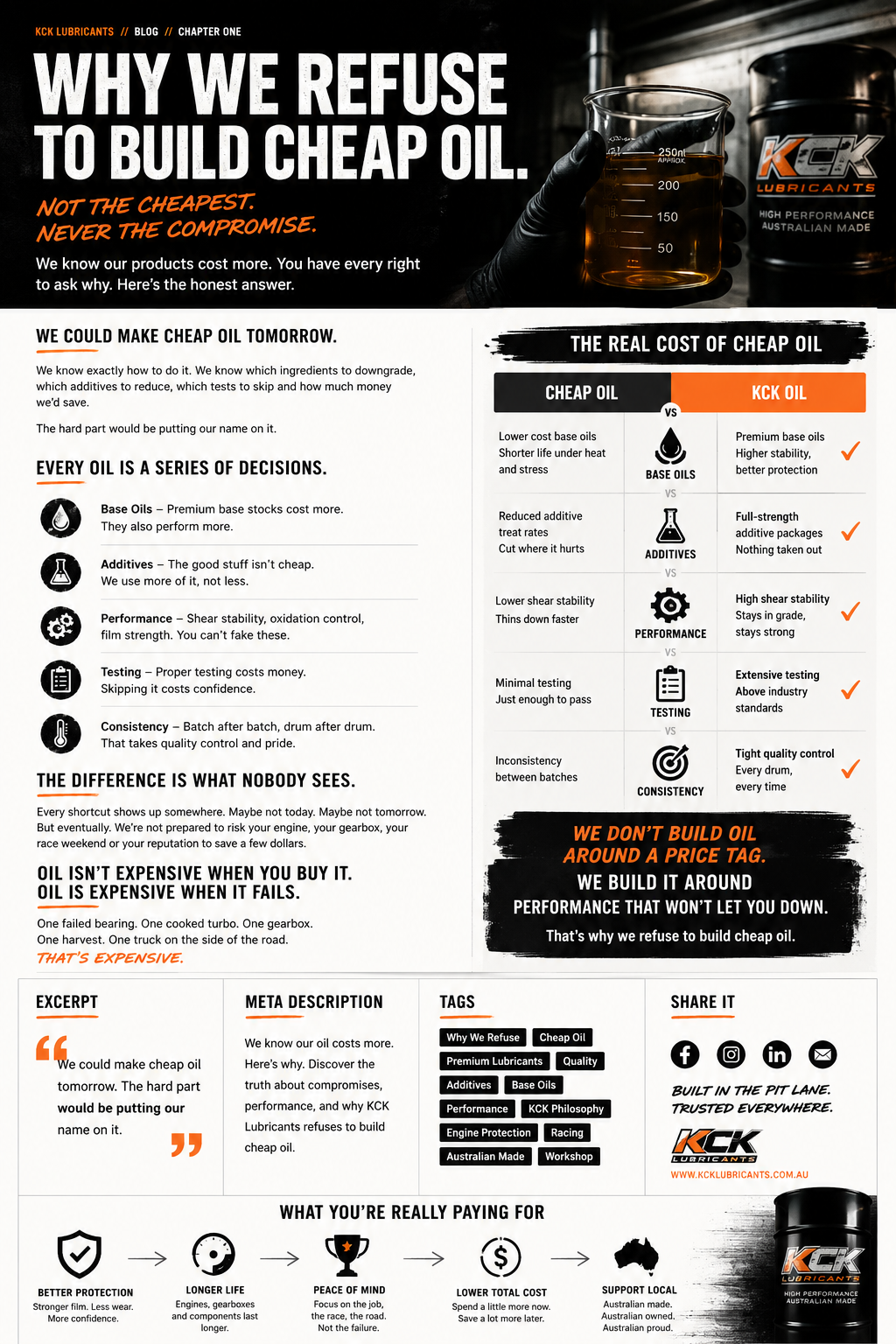
At KCK, we don't see the bottle as the product.
The formulation is the product.
The bottle is just how you get it to the differential.
That's why RE30 took 12 months
RE30 wasn't created because KCK needed another number on the product range.
It came from a much simpler question:
What happens when you build a gear oil specifically around the kind of conditions people are actually putting their vehicles and machinery through?
The answer took time.
Around 12 months of development went into RE30.
The formulation uses carefully selected virgin base stocks, the latest generation of additive technology available to us and KCK's hot-blend manufacturing process.
The aim wasn't to make an oil that sounded severe duty.
It was to build one capable of operating across a broad range of genuinely demanding applications.
4WD.
Heavy towing.
Performance street cars.
Motorsport.
Commercial transport.
Road trains.
Mining.
Agriculture.
Industrial equipment.
Final drives and differentials.
That's a fairly broad audience.
But the common denominator is simple.
The vehicle is being asked to work.
And this is where price becomes an interesting conversation
There's always someone who will ask why one gear oil costs more than another.
Fair question.
You should ask.
But the answer isn't found by comparing the colour of two bottles or counting the letters on the label.
You have to look underneath the label.
What base stocks are being used?
What additive chemistry is being used?
What performance requirements is the formulation designed around?
How is it blended?
How is it manufactured?
And what is the lubricant expected to do once it is sitting between those gears?
Cheap oil isn't necessarily bad.
Expensive oil isn't automatically good either.
The smart decision is understanding what you're buying and whether it's appropriate for the job.
Because saving a few dollars on lubricant looks pretty clever right up until the lubricant is no longer the cheapest part of the problem.
The oil nobody thinks about
That's really the strange part of differential oil.
You don't notice it when it's doing its job.
You don't hear it.
You don't see it.
You don't think about it when you're towing the caravan up a hill.
You don't think about it when the 4WD is crawling up a rocky climb.
You don't think about it when the race car launches.
You don't think about it when the truck is hauling another load down the highway.
And that's exactly how a good lubricant should behave.
It quietly does its job.
The problem is that quiet reliability can make people forget how important the lubricant actually is.
Until something changes.
A whine.
A growl.
Heat.
Wear.
Damage.
A repair bill.
Suddenly everyone wants to know what happened.
Quite often, the answer started long before the noise did.
Your differential doesn't care about the logo
This is probably the simplest way to look at the whole subject.
The differential doesn't care how impressive the bottle looks.
It doesn't care how many awards the brand has won.
It doesn't care how clever the advertisement is.
It doesn't care whether the bottle is sitting on the shelf of a massive multinational or an independent Australian blender.
It cares about chemistry.
It cares about the lubricating film.
It cares about heat.
It cares about pressure.
It cares about friction.
It cares about whether the lubricant can keep doing its job when the conditions get ugly.
That's the test.
And it's a test every lubricant eventually has to face.
So maybe it's time to think about the oil underneath you
The next time you check your engine oil, think about what's happening underneath the vehicle.
There's another lubricant working away down there.
No dipstick demanding attention.
No warning light.
No dashboard telling you it's getting tired.
Just gears turning, bearings carrying loads and oil doing everything it can to keep metal surfaces protected.
Maybe you've got a weekend 4WD.
Maybe you tow a caravan.
Maybe you've got a performance car.
Maybe you drive a truck for a living.
Maybe you spend your days around tractors, machinery or equipment that simply can't afford to stop.
The applications are different.
The demand is different.
But the principle is the same.
The harder you work the vehicle, the less margin for error your lubricant has.
And that's why differential oil deserves more attention than it gets.
Not because it's glamorous.
It isn't.
Not because it's another thing to sell you.
It shouldn't be.
Because when the vehicle is working hard, the lubricant inside that differential is working hard too.
That's where RE30 comes in
After 25 years around lubricants, motorsport, machinery and the aftermarket, KCK has learned something pretty simple.
You don't build a serious lubricant by starting with the marketing.
You start with the job.
You understand what the lubricant has to survive.
You choose the chemistry accordingly.
Then you test, refine and manufacture it properly.
That's the thinking behind RE30 Severe Duty 85W-140.
It wasn't designed because 85W-140 needed another bottle on a shelf.
It was developed because there are plenty of vehicles, machines and differentials out there that ask a hell of a lot from their lubricant.
And those applications deserve something built with that reality in mind.
Designed for severe duty.
Built around the chemistry.
Made in Queensland.
That's KCK.
No magic tricks.
No nonsense.
Just 25 years of learning what happens when the theory meets the workshop floor.
Because the best lubricant is rarely the one you think about.
It's the one that keeps doing its job while you're busy doing yours.
And maybe that's why differential oil has been neglected for so long.
It's been doing its job too well.
Until now.