
How Engine Oil Is Actually Made (And Where Most Brands Cut Corners)
Walk into any parts store and you’ll see shelves packed with engine oils.
Different brands.
Different labels.
Different promises.
But here’s the uncomfortable truth:
Most of them are built to hit a price point — not a performance target.
And once you understand how engine oil is actually made…
you’ll never look at those bottles the same way again.
The Reality Most Brands Won’t Tell You
There are two very different ways to make engine oil:
1. Manufacture for performance
or
2. Manufacture for cost
Guess which one dominates the market?
Mass production rewards efficiency, speed, and margin.
Not perfection.
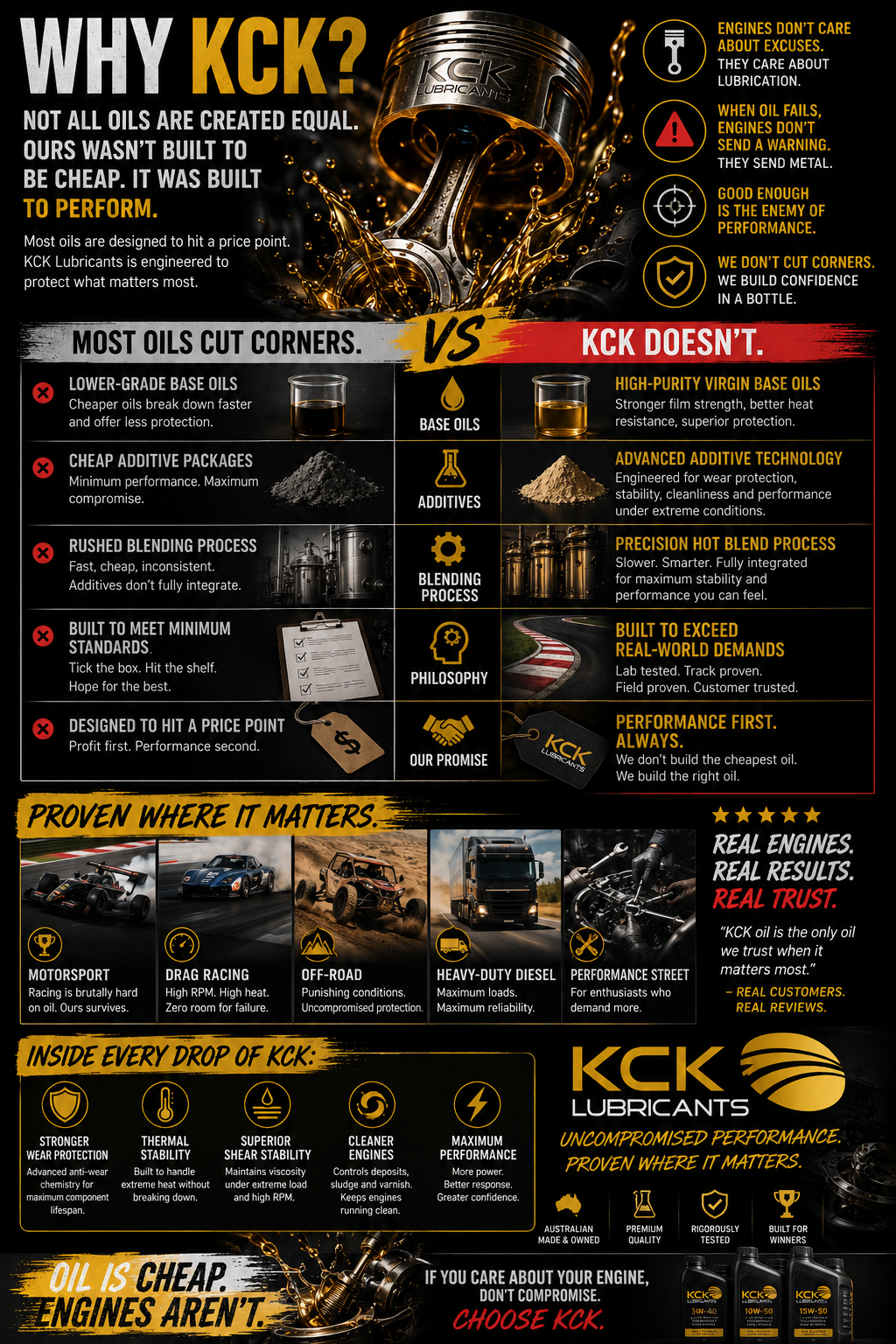
Step 1: The Base Oil — Where Quality Is Decided
Every engine oil starts with base oil.
This is the foundation — and it’s also the first place corners get cut.
The Mass Production Approach:
- Use lower-cost base stocks, often reclaimed or recycled
- Blend to meet minimum specification
- Accept broader quality variation
Result: It passes… but only just
The KCK Approach:
- High-purity Virgin base stocks oils only
- Selected for thermal stability and consistency
- Zero tolerance for “good enough”
Result:
A foundation that holds up when engines are pushed hard
Step 2: Additives — The Real Performance Engine
Additives are where oil earns its keep.
They control:
- Wear
- Cleanliness
- Stability
- Longevity
But here’s where things get interesting…
The Mass Production Approach:
- Standardised additive packages
- Cost-driven treat rates
- Designed to meet specs — not exceed them
Additives are often:
- Under-dosed
- Compromised for compatibility
- Designed for average use
The KCK Approach:
- Premium additive systems
- Balanced for real-world stress, not lab conditions
- Built to stay active under heat, load, and time
Because an additive that breaks down early…
isn’t protection — it’s a false sense of security.
Step 3: The Blending Process (This Is Where It All Comes Together… or Falls Apart)
This is the step almost nobody talks about.
And it’s one of the biggest differences between average oil… and exceptional oil.
The Mass Production Method:
- Fast blending at lower temperatures
- Minimal dwell time
- High throughput focus
It’s efficient
It’s scalable
It’s profitable
But…
Additives may not fully integrate
Stability can suffer
Consistency varies batch to batch
The KCK Method: Hot Blend Technology
We do things differently.
We use a controlled hot blending process that:
- Fully activates additive chemistry
- Ensures complete integration with the base oil
- Delivers a uniform, stable formulation
This isn’t the fastest way to make oil.
It’s not the cheapest.
But it produces something mass production simply can’t:
Consistency you can trust under extreme conditions
Step 4: Quality Control — Minimum Standard vs Maximum Confidence
Every oil gets tested.
But how far that testing goes?
That’s where the gap opens up again.
The Industry Standard:
- Test to meet specification
- Tick the box
- Move product
The KCK Standard:
- Test beyond specification
- Validate under real-world conditions
- Refine based on actual performance data
* Motorsport.
* Heavy-duty applications.
* Extreme environments.
This isn’t theoretical.
It’s proven.
Where Corners Are Actually Cut
Let’s call it what it is.
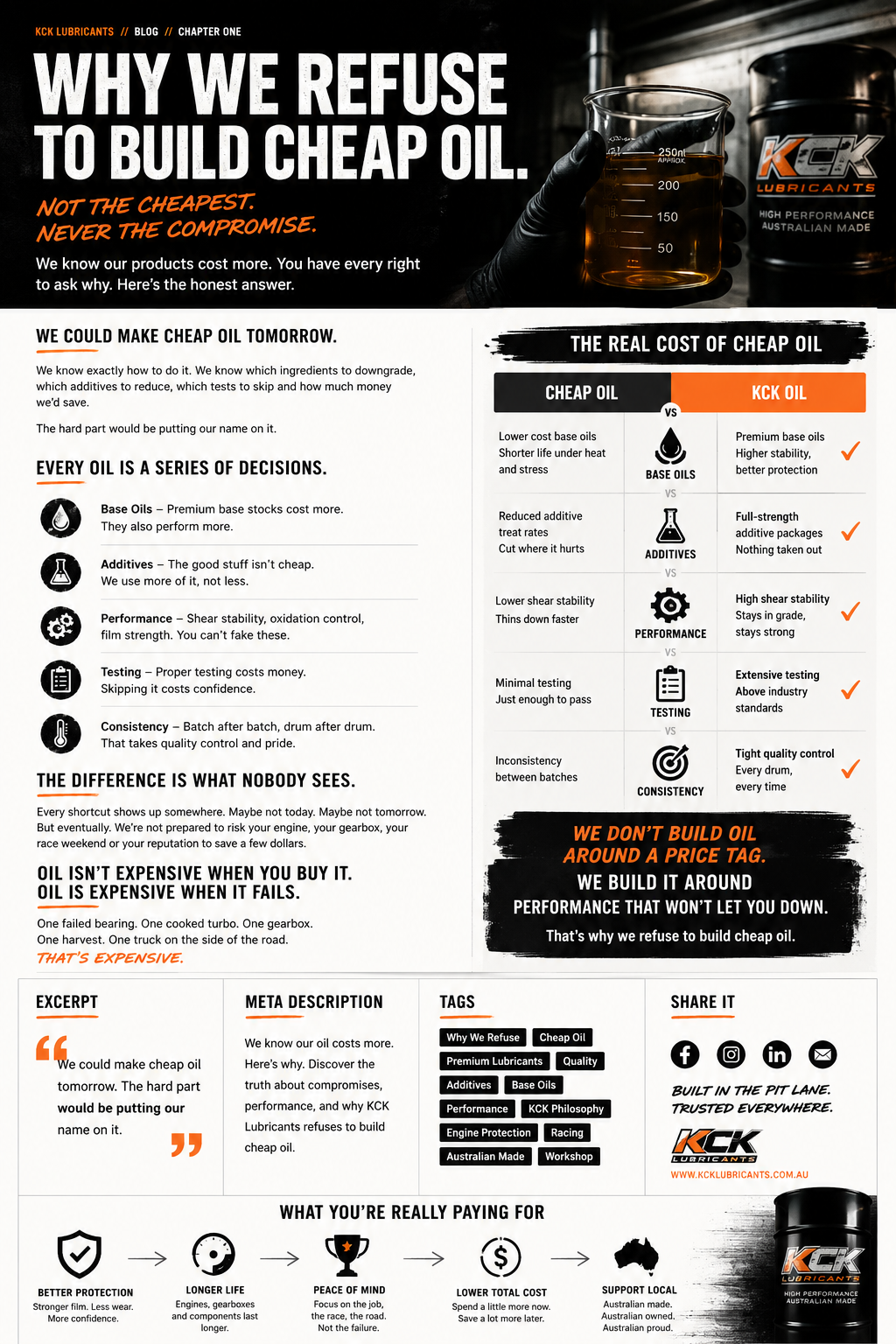
Most oils cut corners in one (or more) of these areas:
- Lower-quality base oils
- Reduced additive concentrations
- Faster, less precise blending
- Minimal real-world validation
Why?
Because it saves money.
And Here’s the Problem…
Those savings don’t disappear.
They get passed on to your engine.
- Faster oil breakdown
- Reduced protection under load
- Increased wear over time
- Shorter engine life
Not immediately.
Not dramatically.
But gradually… consistently… expensively.
The KCK Difference (And Why It Exists)
At KCK Lubricants, we made a decision a long time ago:
We don’t formulate to a price. We formulate to a standard.
That means:
- No shortcuts on base oils
- No compromises on additives
- No rushed blending processes
- No “that’ll do” mentality
We build oils for:
- Motorsport
- High-load engines
- Demanding real-world conditions
And those environments don’t tolerate compromise.
Technical Summary
Engine oil quality is determined by:
- Base oil purity and stability
- Additive system quality and concentration
- Blending method and consistency
- Real-world validation
Change any one of these… and the final product changes dramatically.
Myth vs Fact
Myth:
All engine oils are made the same — the label is the only difference.
Fact:
Engine oils can vary significantly in base oil quality, additive chemistry, and blending process. Two oils that look identical on paper can perform completely differently in real-world conditions.
Final Thought
You’ll never see:
- Base oil quality
- Additive concentration
- Blending precision
…on the front of a bottle.
But your engine feels it every time you turn the key.
The Bottom Line
You can buy oil that:
- Meets the minimum
- Hits a price point
- Looks good on the shelf
Or…
You can run oil that’s engineered to perform when it actually matters.
About the Author
Matt is part of the team behind KCK Lubricants, an Australian manufacturer specialising in high-performance engine oils for motorsport, heavy-duty diesel, and extreme mechanical environments.
With more than 25 years of formulation and real-world testing experience, KCK oils are built for those who demand performance — not promises.