
Why Two Oils With the Same Viscosity Can Perform Completely Differently
Walk into any parts store, jump online, or scroll a forum and you’ll see it:
“It’s fine — they’re both 10W-40.”
That assumption has probably caused more engine wear, noise complaints, and disappointing performance than almost anything else in lubrication.
Because viscosity is only one small piece of the story.
Two oils can share the exact same viscosity grade on the label and behave nothing alike inside an engine.
Here’s why.
Viscosity Is a Measurement — Not a Quality Standard
The SAE viscosity rating (10W-40, 15W-50, etc.) only tells us:
-
How thick the oil is when cold
-
How thick it is at 100°C under a controlled test
That’s it.
It does not tell you:
-
How strong the oil film is under load
-
How quickly it shears down
-
How it handles heat spikes
-
How long the additives survive
-
How much base oil actually does the work
-
Whether it was built for durability or built for price
Viscosity is a number.
Performance is chemistry.
The Hidden Difference: Base Oil Quality
Two oils can both be labelled 10W-40 but be built from completely different base stocks.
One may rely heavily on highly refined mineral Group III stocks designed to meet a cost target.
The other may use PAO and ester components chosen for:
-
Thermal stability
-
Natural film strength
-
Low volatility
-
Resistance to oxidation
-
Mechanical shear resistance
Both hit the viscosity target when new.
Only one keeps it.
Shear Stability — Where Cheap Oils Disappear
Engines don’t operate in laboratory conditions.
They run under:
-
Gear train loading
-
Bearing squeeze
-
Fuel contamination
-
Extreme localised heat
-
High RPM mechanical stress
To achieve a multi-grade viscosity, oils rely on viscosity modifiers — long polymer chains that “stretch” as temperature rises.
In lower quality oils, these polymers:
Break.
Once they shear:
10W-40 → behaves like a thin 10W-30 (or worse)
You won’t see it on the dipstick.
But the engine will feel it.
Loss of oil pressure.
More valvetrain noise.
Reduced protection.
The label didn’t change.
The oil did.
Film Strength vs. Thickness — The Most Misunderstood Concept
People assume thicker oil equals better protection.
In reality:
Film strength matters more than film thickness.
A well-engineered oil maintains a stable lubricating barrier even when squeezed to microscopic levels between moving parts.
That comes from:
-
Base oil molecular structure
-
Additive chemistry
-
Polarity and surface affinity
-
Load-carrying capability
Two oils may measure the same viscosity — but one collapses under load while the other holds the boundary layer.
That difference is what quietens gear drives.
It’s what protects flat tappets.
It’s what keeps race engines alive.
Additive Systems: Where Real Engineering Lives
Additives are not just a checklist.
They must be balanced to work together under stress.
Detergents, dispersants, anti-wear agents, friction modifiers, antioxidants — all interact.
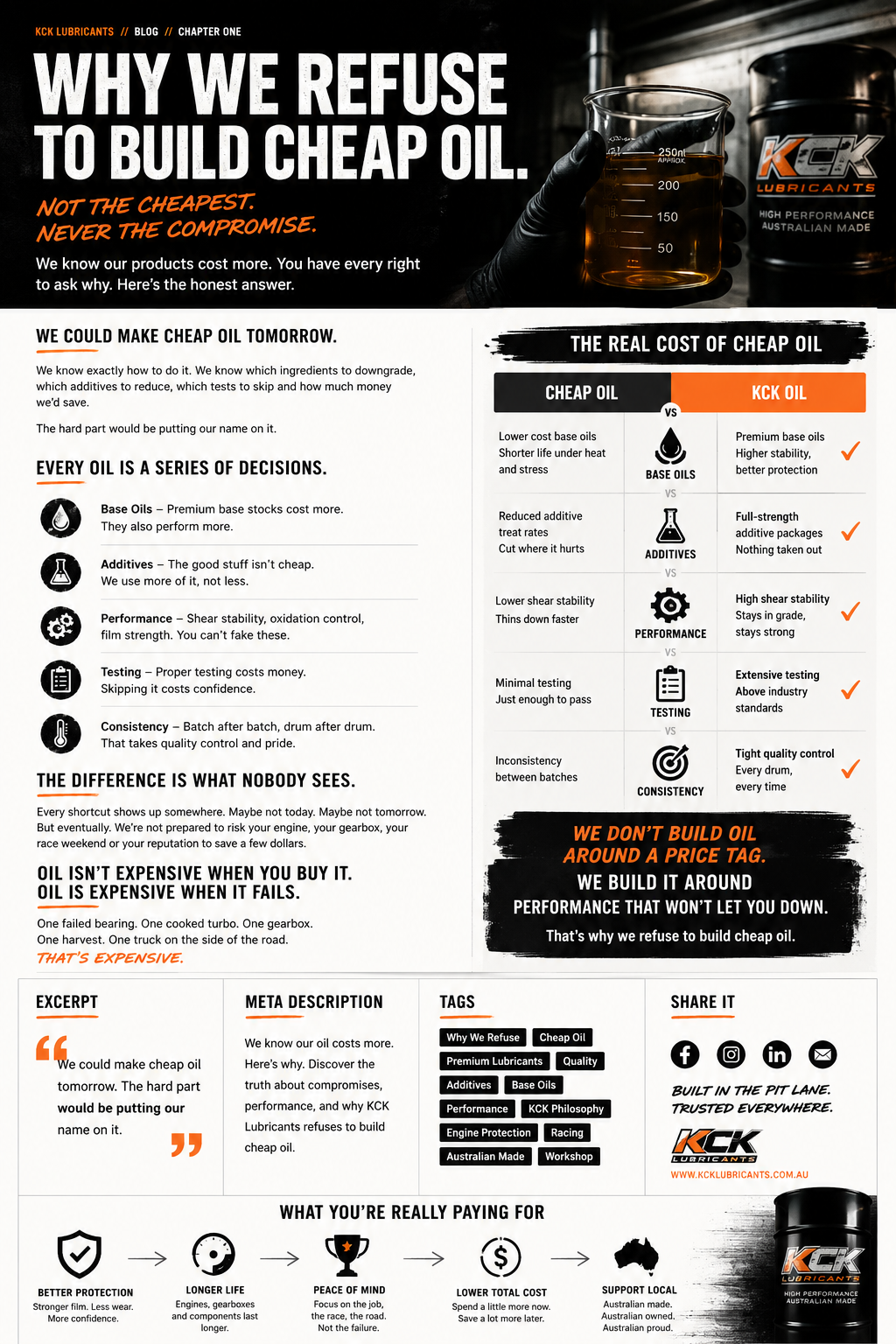
In price-driven formulations, additives are selected to:
Meet specification ✔
Pass certification ✔
Hit cost target ✔
In performance-driven formulations, they are selected to:
Stay active longer
Survive higher temperature
Maintain surface protection
Resist depletion
Work under sustained load
That difference doesn’t show up in a catalogue.
It shows up after thousands of kilometres.
Built Backwards vs Built For Purpose
Many commercial oils are formulated backwards:
Start with the price → Build an oil that fits it.
Performance oils are built forwards:
Start with the problem → Engineer the oil to solve it.
That’s why comparing oils by viscosity grade alone is like comparing two engines by capacity without looking at power, materials, or design.
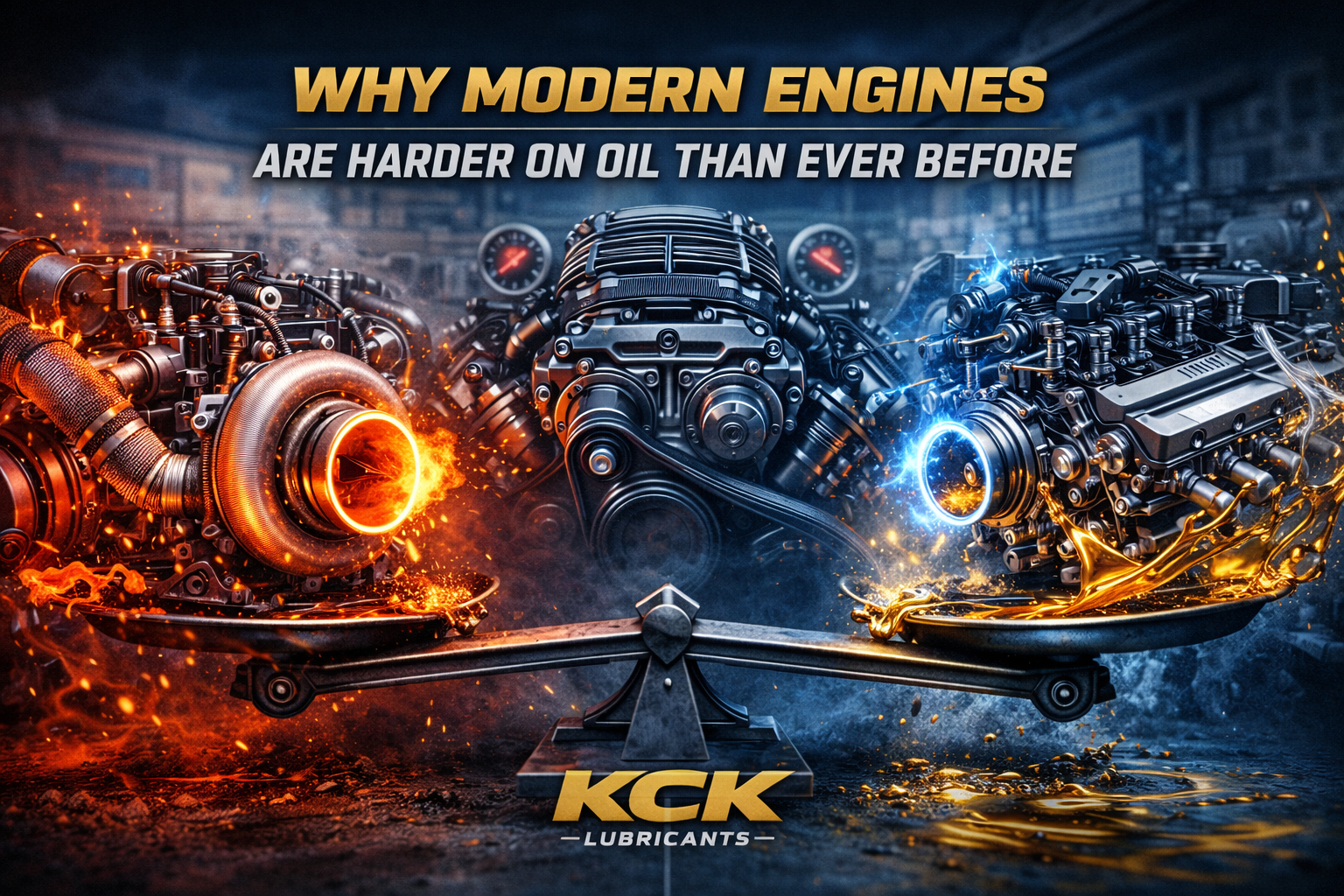
Why This Matters More in Modern Engines
Today’s engines run:
-
Hotter
-
Tighter clearances
-
Higher specific output
-
Turbocharged loads
-
Longer service intervals
-
Greater contamination stress
They demand oils that stay stable — not just oils that start at the right thickness.
The margin for lubricant failure is smaller than ever.
The Takeaway
Viscosity tells you how thick the oil is.
It does not tell you how well it protects.
Two oils can share the same number on the bottle yet deliver completely different outcomes in wear control, stability, and durability.
When you choose an oil, you’re not buying a grade.
You’re buying the formulation behind it.
And that’s where the real difference lives.