
What Makes High-Performance Engine Oil Different? (And Why Most Oils Aren’t Good Enough)
Modern engines are pushing harder than ever before.
More power.
More heat.
Tighter tolerances.
Less margin for error.
But here’s the uncomfortable truth most people don’t want to hear:
Engine technology has evolved faster than the oil most people are still using.
And that gap?
That’s where wear, damage, and lost performance quietly live.
Not All Engine Oil Is Created Equal
On paper, a lot of oils look the same.
Same viscosity.
Same certifications.
Same promises.
But in the real world?
Two oils with the same grade can deliver completely different levels of protection.
One survives the job.
The other slowly breaks down… and takes your engine with it.
The Real Difference Starts at the Base
Every oil starts with a base stock — and this is where the first big divide happens.
Cheap oils rely on heavily processed, lower-grade base oils.
High-performance oils?
They use high-purity, thermally stable base stocks designed to survive extreme conditions.
The result:
- Greater resistance to heat
- Lower volatility (less burn-off)
- More stable lubrication film
- Consistent performance under load
In simple terms:
They don’t fall apart when things get serious.
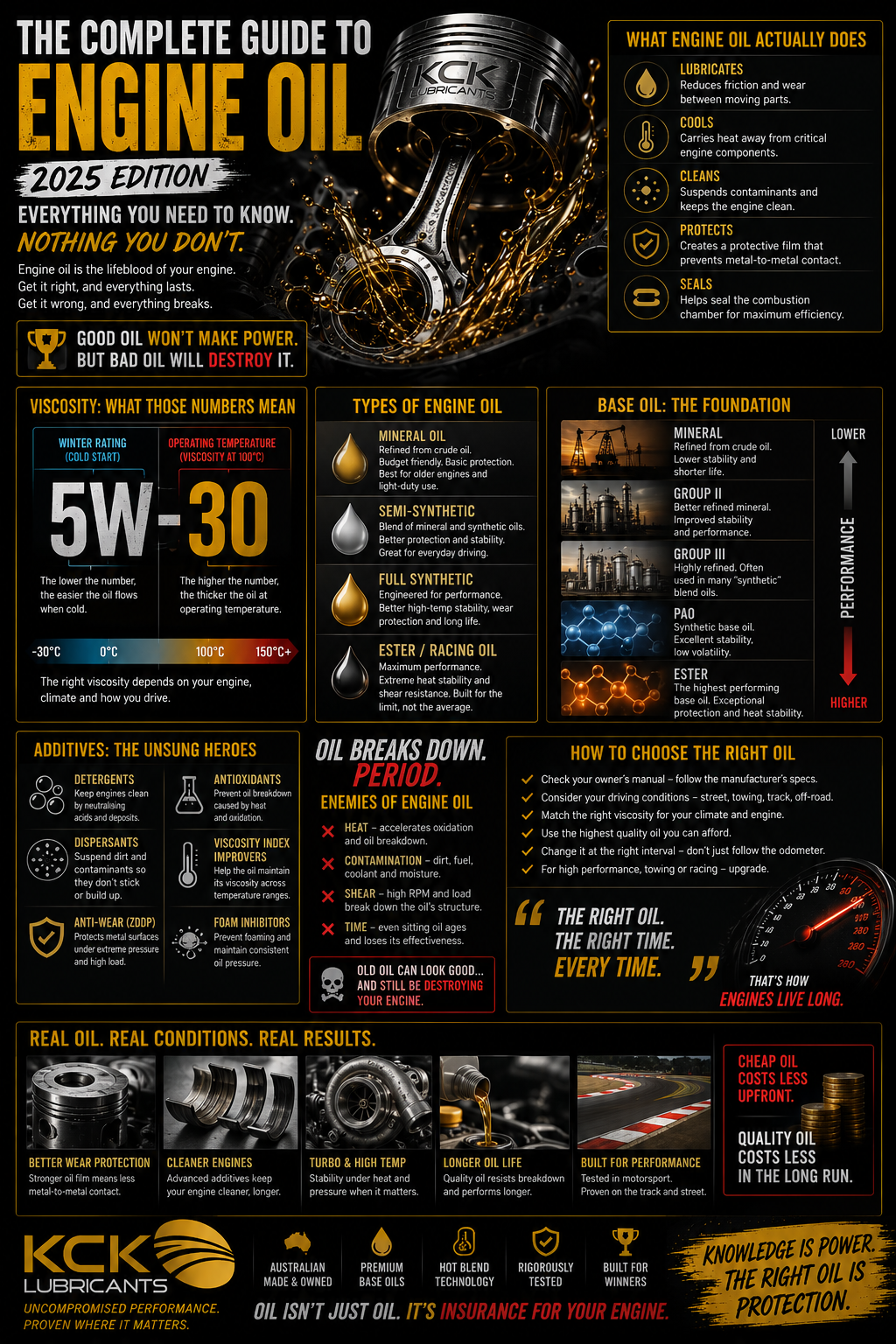
Additives: Where the Magic (or Failure) Happens
Base oil is just the foundation.
The real performance comes from the additive system — and this is where the gap widens even further.
High-performance oils use complex, balanced additive packages that:
- Keep engines clean (detergents)
- Hold contaminants in suspension (dispersants)
- Protect metal surfaces under extreme load (anti-wear agents)
- Resist oxidation and breakdown (antioxidants)
- Prevent corrosion
But here’s the kicker:
Additives only work if they stay stable and active.
Lower-quality oils often:
- Deplete faster
- Fall out of suspension
- Lose effectiveness under heat and stress
Which means protection drops off… long before the oil is changed.
Heat: The Silent Oil Killer
Heat destroys oil. Slowly. Relentlessly.
Through oxidation and thermal degradation, oil thickens, breaks down, and loses its ability to protect.
In high-performance or turbocharged engines?
This process accelerates fast.
High-performance oils are built to resist it.
They maintain:
- Chemical stability
- Film strength
- Protective properties
Even when temperatures climb into the danger zone.
Viscosity Stability: Holding the Line Under Pressure
Oil isn’t just about being slippery — it’s about staying consistent.
Under extreme mechanical stress, inferior oils can suffer from viscosity shear:
👉 They thin out
👉 The protective film weakens
👉 Metal starts getting closer than it should
High-performance oils are engineered to resist this.
They hold their viscosity under load
They maintain separation between moving parts
And that’s the difference between:
- Controlled operation
- And accelerated wear
When Load Goes Up, Weak Oils Fail
Performance engines, towing setups, diesel workhorses — they all have one thing in common:
Massive load on internal components
This is where high-performance oils shine.
They form microscopic protective films that:
- Reduce friction
- Prevent metal-to-metal contact
- Extend component life
Lower-grade oils?
They simply don’t hold up under sustained pressure.
Clean Engine = Consistent Performance
Engines don’t just wear — they get dirty.
Soot. Fuel dilution. Combustion by-products.
All of it ends up in the oil.
High-performance oils:
Keep contaminants suspended
Prevent sludge and deposit build-up
Because once deposits start forming:
- Oil flow suffers
- Heat increases
- Wear accelerates
Real-World Conditions Don’t Care About Marketing
This isn’t about lab results or spec sheets.
It’s about what happens when things get real:
- Motorsport engines living at redline
- Turbo engines running sustained boost
- Diesel engines hauling serious loads
- Vehicles operating in extreme heat or cold
This is where oil gets tested properly
And this is where the gap between average and high-performance becomes impossible to ignore.
The KCK Difference (No Compromises)
At KCK Lubricants, we don’t formulate oils to just meet specifications.
We build them to exceed real-world demands.
That means:
- High-purity base oils (no shortcuts)
- Advanced additive systems designed to stay active
- Formulations engineered for extreme heat and load
- Precision blending techniques that ensure consistency
No fillers.
No fluff.
No compromise.
Because when it comes to protecting engines:
“Good enough” isn’t good enough.
Technical Summary
High-performance engine oils deliver:
- Superior base oil stability
- Advanced additive chemistry
- Resistance to oxidation and heat breakdown
- Strong viscosity stability under stress
- Enhanced wear and deposit protection
These aren’t marketing claims — they’re the difference between engines that last… and engines that don’t.
Myth vs Fact
Myth:
All engine oils perform the same if the viscosity grade is correct.
Fact:
Viscosity is only one piece of the puzzle.
Two oils with the same grade can deliver vastly different protection depending on base oil quality, additive chemistry, and formulation integrity.
Choosing oil based on viscosity alone is like choosing tyres based only on size.
Final Thought
Engine oil isn’t just a fluid.
It’s the only thing standing between your engine components and direct metal-to-metal contact.
And when that protection fails?
The damage doesn’t ask permission.
The Bottom Line
You can:
- Choose oil based on price
- Follow outdated advice
- Assume all oils are the same
Or…
You can run a lubricant that’s engineered to perform when it actually matters.
About the Author
Matt is part of the team behind KCK Lubricants, an Australian manufacturer specialising in high-performance engine oils for motorsport, heavy-duty diesel, and extreme mechanical environments.
With more than 25 years of real-world testing and formulation experience, KCK oils are built for those who demand performance — not promises.
Internal Linking
Previous articles:
Week 1
Ultimate Guide to Engine Oil
Week 2
What Does Oil Viscosity Mean
Week 3
Synthetic vs Mineral Oil
Week 4
Why Engine Oil Turns Black
Week 5
Why Cheap Oil Costs More
Week 6
Diesel Engine Oil Specifications
Week 8
Why Engine Oil Breaks Down Over Time
Week 9
How Often Should You Change Your Engine Oil?
Week 10